|
|
| Line 1: |
Line 1: |
| ;[[Past Imperfect]] -PLBE- [[Paris - 1933]] -PLBE- [[Paris]] | | ;[[Kingdom of Italy]] |
| [[File:Paris a gargoyles perspective.jpg]]
| |
| <br>
| |
| <br>
| |
| == '''Quote''' == | | == '''Quote''' == |
| ''"Paris was a universe whole and entire unto herself, hollowed and fashioned by history; so she seemed in this age of Napoleon III with her towering buildings, her massive cathedrals, her grand boulevards and ancient winding medieval streets--as vast and indestructible as nature itself. All was embraced by her, by her volatile and enchanted populace thronging the galleries, the theaters, the cafes, giving birth over and over to genius and sanctity, philosophy and war, frivolity and the finest art; so it seemed that if all the world outside her were to sink into darkness, what was fine, what was beautiful, what was essential might there still come to its finest flower. Even the majestic trees that graced and sheltered her streets were attuned to her--and the waters of the Seine, contained and beautiful as they wound through her heart; so that the earth on that spot, so shaped by blood and consciousness, had ceased to be the earth and had become Paris."''
| |
|
| |
| ― Anne Rice, '''''Interview with the Vampire'''''
| |
| ---- | | ---- |
| <br> | | <br> |
| <br> | | <br> |
| ---- | | ---- |
|
| |
| == '''''Paris during the Belle Époque''''' ==
| |
| === Mood ===
| |
|
| |
| The Mood of Paris, during La Belle Époque is that of fantastic change coming to an end, with science and civility being the culmination of 200 years of revolution. The Iffle tower is the grounding rod of the New Century, and with it a static reality of great wealth and beauty has overtaken the city.
| |
|
| |
| The majority of Parisians think that things are becoming more staid and predictable. Wonder only comes in the form of the next art piece, the next dress. Consumerism is the plan for the future, and Paris plans to make things for people to consume.
| |
|
| |
| === In Short ===
| |
| Paris in the Belle Époque, between 1871 and 1914, from the beginning of the Third French Republic until the First World War, saw the construction of the Eiffel Tower, the Paris Métro, the completion of the Paris Opera, and the beginning of the Basilica of Sacré-Cœur on Montmartre. Three universal expositions in 1878, 1889 and 1900 brought millions of visitors to Paris to see the latest in commerce, art and technology. Paris was the scene of the first public projection of a motion picture, and the birthplace of the Ballets Russes, Impressionism and Modern Art.
| |
|
| |
| The expression Belle Époque came into use after the First World War, a nostalgic term for what seemed a simpler time of optimism, elegance and progress.
| |
|
| |
| '''Paris 1900:''' ''La Belle Époque, l'Exposition Universelle, l'Art Nouveau'' (https://www.youtube.com/watch?v=8MZGusqwKPo)
| |
| ----
| |
| <br>
| |
| <br>
| |
| ----
| |
|
| |
| == '''Appearance''' == | | == '''Appearance''' == |
| === Rebuilding after the Commune ===
| | [[File:Rome by Night medieval.jpg]] |
| [[File:Paris Commune rue de Rivoli.jpg]] | |
| <br>
| |
| <br>
| |
| After the violent end of the Paris Commune in May 1871, the city was governed by martial law, under the strict surveillance of the national government. The government and parliament did not return to the city from Versailles until 1879, though the Senate returned earlier to its home in the Luxembourg Palace.
| |
| | |
| The end of the Commune also left the city's population deeply divided. Gustave Flaubert described the atmosphere in the city in early June 1871: ''"One half of the population of Paris wants to strangle the other half, and the other half has the same idea; you can read it in the eyes of people passing by."'' But that sentiment soon became secondary to the need to reconstruct the buildings that had been destroyed in the last days of the Commune. The Communards had burned the Hôtel de Ville (including all the city archives), the Tuileries Palace, the Palais de Justice, the Prefecture of Police, the Ministry of Finances, the Cour des Comptes, the State Council building at the Palais-Royal, and many others. Several streets, particularly the rue de Rivoli, had also been badly damaged by the fighting. The column in Place Vendôme had been toppled, on a suggestion from Gustave Courbet, a supporter of the Commune. On top of the reconstruction, the new government was obliged to pay 210 million francs in gold to the victorious German Empire as reparations for the disastrous Franco-Prussian War of 1870. On August 4, 1871, at the first meeting of the city council after the Commune, the new Prefect of the Seine, Léon Say, put forward a plan to borrow 350 million francs for reconstruction and to pay Germany. The city's bankers and businessmen quickly raised the money, and the reconstruction was soon underway.
| |
| | |
| The Conseil d'État and Palais de la Légion d'Honneur (Hôtel de Salm) were rebuilt in their original style. The new Hôtel de Ville was given a more picturesque Renaissance style than the original, borrowed from the Château de Chambord in the Loire Valley, with a facade decorated with statues of outstanding personages who contributed to the history and fame of Paris. The destroyed Ministry of Finance on the rue de Rivoli was replaced by a grand hotel, while the Ministry moved into the Richelieu wing of the Louvre, where it remained until 1989. The ruined Cour des Comptes on the left bank was replaced by the gare d'Orléans, also known under the name gare d'Orsay, now the Museé d'Orsay. The one difficult decision was the Tuileries Palace; built in the 16th century by Marie de' Medici, a royal and imperial residence. The interior had been entirely destroyed by the fire, but the walls were still largely intact, and remained standing for ten years, while the fate of the ruins was debated. Baron Haussmann, in retirement, appealed for a restoration of the building as an historic monument, and it was proposed to turn it into a new museum of modern art. But, in 1881, the new Chamber of Deputies, more sympathetic to the Commune than previous governments, decided that it was too much a symbol of the monarchy, and had the walls pulled down.
| |
| | |
| On 23 July 1873, the National Assembly endorsed the project of building a basilica at the site where the uprising of the Paris Commune had begun; it was intended to atone for the sufferings of Paris during the Franco-Prussian War and the Commune. The Basilica of Sacré-Cœur was built in the neo-Byzantine style, and paid for by public subscription. It was not finished until 1919, and quickly became one of the most recognizable landmarks in Paris.
| |
| | |
| === Architecture ===
| |
| [[File:Paris Effele tower 1900.jpg]]
| |
| <br>
| |
| <br>
| |
| The architectural style of the Belle Époque was eclectic, and sometimes combined elements of several different styles. While the structures of the new buildings were resolutely modern, using iron frames and reinforced concrete, the façades ranged from the Romano-Byzantine style of the Basilica of Sacré-Cœur on Montmartre, to the strange neo-Moorish Palais du Trocadéro, to the nouveau Renaissance style of the new Hôtel de Ville, to the exuberant reinvention of French of the 17th and 18th centuries classicism in the Grand Palais and Petit Palais and the Gare d'Orsay, decorated with domes, colonnades, mosaics and statuary. The most innovative buildings of the period were the Gallery of Machines at the 1889 exposition, and the new railroad stations and department stores: their classical exteriors concealed very modern interiors, with large open spaces and large glass skylights made possible by the new engineering techniques of the period. The Eiffel Tower shocked many traditional Parisians, both because of its appearance and because it was the first building in Paris taller than the cathedral of Notre-Dame.
| |
| | |
| The Art nouveau became the outstanding style of the period, particularly associated with the metro station entrances designed by Hector Guimard, and with a handful of buildings, including Guimard's Castel Béranger (1889) at 14 rue La Fontaine and the Hôtel Mezzara (1910) in the 16th arrondissement. The enthusiasm for Art nouveau metro station entrances did not last long; in 1904 it was replaced at the Opera metro by a less exuberant "modern" style. Beginning in 1912, all the Guimard metro entrances were replaced with functional entrances without decoration.
| |
| | |
| A revolutionary new building material, reinforced concrete, appeared at the beginning of the 20th century and quietly began to change the face of Paris. The first church built in the new material was Saint-Jean-de-Montmartre, at 19 rue des Abbesses at the foot of Montmartre. The architect was Anatole de Baudot, a student of Viollet-le-Duc. The nature of the revolution was not evident, because Baudot faced the concrete with brick and ceramic tiles in a colorful Art nouveau style, with stained glass windows in the same style.
| |
| | |
| The Théâtre des Champs-Élysées (1913) is another architectural landmark of the period, one of the few Paris buildings in the Art deco style. Designed by Auguste Perret, it was also built of reinforced concrete, and decorated by some of the leading artists of the era; bas-reliefs on the façade by Antoine Bourdelle, a dome by Maurice Denis, and paintings in the interior by Édouard Vuillard. It was the setting in 1913 for one of the major musical events of the Belle Époque, the first season of the Ballets Russes and the premiere of Igor Stravinsky's The Rite of Spring.
| |
| | |
| === Bridges ===
| |
| Eight new bridges were put across the Seine during the Belle Époque. The pont Sully, built in 1876, replaced two foot bridges which had connected the Île Saint-Louis to the right and left bank. The pont de Tolbiac was built in 1882], connecting the left bank with Bercy. The Pont Mirabeau, made famous in a poem by Apollinaire, was dedicated in 1895. Three bridges were built for the 1900 Exposition: the pont Alexandre-III, dedicated by the Czar Nicholas II of Russia in 1896, which connected the left bank with the grand exposition halls of the Grand Palaisand Petit Palais; the passerelle Debilly, a foot bridge which linked two sections of the Exposition; and a railroad bridge between Grenelle and Passy. Two more bridges were dedicated in 1905; the pont de Passy (now the pont de Bir-Hakeim), and the viaduc d'Austerlitz, crossed by the metro.
| |
| | |
| === Streets and Boulevards ===
| |
| The construction of the new boulevards and streets begun by Napoleon III and Haussmann had been much criticized by Napoleon's opponents near the end of the Second Empire, but the government of the Third Republic continued his projects. The avenue de l'Opéra, boulevard Saint-Germain, avenue de la République, boulevard Henry-IV and avenue Ledru-Rollin were all completed essentially as Haussmann had planned them by 1889. After 1889, the pace of construction slowed down; boulevard Raspail was finished, rue Réaumur was extended, and several new streets were created on the left bank; rue de la Convention, rue de Vouillé, rue d'Alésia, and rue de Tolbiac. On the right bank, rue Étienne-Marcel was the last of the Haussmann projects to be completed before the First World War.
| |
| | |
| While the streets planned by Haussmann were completed, the strict uniformity of façades and building heights imposed by Haussmann was gradually modified. Buildings became much larger and deeper, with two apartments on each floor facing the street and others facing only onto the courtyard. The new buildings often had ornamental rotundas or pavilions on the corners, and highly ornamental roof designs and gables. In 1902, maximum building heights were increased to 52 meters. With the advent of elevators, the most desirable apartments were no longer on the lowest floors, but on the highest floors, where there was more light, nicer view and less noise. With the arrival of automobiles and the beginning of traffic noise on the streets, the bedrooms moved to the back of the apartment, onto the courtyard.
| |
| | |
| The façades also changed from the strict symmetry of Haussmann: bay and bow windows appeared, and undulating façades. Eclectic façades became popular, mixing Louis XIV, Lous XV and Louis XVI styles, and then, with the Art nouveau, floral patterns. The most striking examples of the new architecture were the Castel Béranger on rue La Fontaine and the Hôtel Lutetia. Between 1898 and 1905, the city organized eight competitions for the most imaginative building façades; variety was given precedence over uniformity.
| |
| | |
| === Street Lighting ===
| |
| At the beginning of the Belle Époque Paris was lit by a constellation of thousands of gaslights, which were often admired by foreign visitors, and helped give the city its nickname Ville-Lumiére, the "City of Light". In 1870, there were 56,573 used exclusively to light the city streets. The gas was produced by ten enormous factories around the edge of the city, located near the circle of fortifications, and was distributed in pipes installed under the new boulevards and streets. The street lights were placed every twenty meters on the Grands Boulevards. At a predetermined minute after nightfall, a small army of 750 allumeurs in uniform, carrying long poles with small lamps at the end, went out into the streets, turned on a pipe of gas inside each lamppost, and lit the lamp. The entire city was illuminated within forty minutes. The Arc de Triomphe was crowned with a ring of gaslights, and the Champs-Élysées was lined with ribbons of white light.
| |
| | |
| One of the major urban innovations in Paris was the introduction of electric street lights, to coincide with the Universal Exposition of 1878. The first streets lit were the Avenue de l'Opéra and the Place de l'Étoile, around the Arc de Triomphe. In 1881, electric street lights were added along the Grands Boulevards. Electric lighting came much more slowly for residences and businesses in some Paris neighborhoods. While in 1905 electric lights lined the Champs Élysées, there was no electric lines for households in the 20th arrondissement.
| |
| ----
| |
| <br> | | <br> |
| <br> | | <br> |
| ----
| |
|
| |
| == '''City Device''' ==
| |
| [[File:City device paris.png|200px]]
| |
| ---- | | ---- |
| <br> | | <br> |
| Line 82: |
Line 15: |
|
| |
|
| == '''Climate''' == | | == '''Climate''' == |
| Paris has a typical Western European oceanic climate which is affected by the North Atlantic Current. The overall climate throughout the year is mild and moderately wet. Summer days are usually moderately warm and pleasant with average temperatures hovering between 15 and 25 °C (59 and 77 °F), and a fair amount of sunshine. Each year, however, there are a few days where the temperature rises above 30 °C (86 °F). Some years have even witnessed some long periods of harsh summer weather, such as the heat wave of 2003 where temperatures exceeded 30 °C (86 °F) for weeks, surged up to 39 °C (102 °F) on some days and seldom cooled down at night. More recently, the average temperature for July 2011 was 17.6 °C (63.7 °F), with an average minimum temperature of 12.9 °C (55.2 °F) and an average maximum temperature of 23.7 °C (74.7 °F).
| | Rome has a Mediterranean climate, with cool, humid winters and warm, dry summers. |
|
| |
|
| Spring and autumn have, on average, mild days and fresh nights, but are changing and unstable. Surprisingly warm or cool weather occurs frequently in both seasons. In winter, sunshine is scarce; days are cold but generally above freezing with temperatures around 7 °C (45 °F). Light night frosts are however quite common, but the temperature will dip below −5 °C (23 °F) for only a few days a year. Snowfall is uncommon, but the city sometimes sees light snow or flurries with or without accumulation.
| | Its average annual temperature is above (68 °F) during the day and (50 °F) at night. In the coldest month – January, the average temperature is (54 °F) during the day and (37 °F) at night. In the warmest months – July and August, the average temperature is (86 °F) during the day and (64 °F) at night. |
|
| |
|
| Rain falls throughout the year. Average annual precipitation is 652 mm (25.7 in) with light rainfall fairly distributed throughout the year. The highest recorded temperature is 40.4 °C (104.7 °F) on July 28, 1948, and the lowest is a −23.9 °C (−11.0 °F) on December 10, 1879.
| | December, January and February are the coldest months, with a daily mean temperature of (46 °F). Temperatures during these months generally vary between (50 and 59 °F) during the day and between (37 and 41 °F) at night, with colder or warmer spells occurring frequently. Snowfall is rare but not unheard of, with light snow or flurries occurring almost every winter, generally without accumulation, and major snowfalls approximately once every 5 years. |
| ----
| |
| <br>
| |
| <br>
| |
| ----
| |
|
| |
|
| == '''Demonym''' ==
| | The average relative humidity is 75%, varying from 72% in July to 77% in November. Sea temperatures vary from a low of (55 °F) in February and March to a high of (75 °F) in August |
| ''Parisian''
| |
| ---- | | ---- |
| <br> | | <br> |
| Line 100: |
Line 28: |
|
| |
|
| == '''Economy''' == | | == '''Economy''' == |
| The economy of Paris suffered an economic crisis in the early 1870s, followed by a long, slow recovery; then a period of rapid growth beginning in 1895 until the First World War. Between 1872 and 1895, in the capital, 139 large enterprises closed their doors, particularly textile and furniture factories, those in the metallurgy sector, and printing houses, four industries which for sixty years had been the major employers in the city. Most of these enterprises had employed, each, between 100 and 200 workers. Half of the large enterprises on the center of the city's right bank moved out, in part because of the high cost of real estate, and also to get better access to transportation on the river and railroads. Several moved to less-expensive areas at the edges of the city, around Monparnasse and La Salpêtriére, while others went to the 18th arrondissement, La Villette and the Canal Saint-Denis, to be closer to the river ports and the new railroad freight yards, to Picpus and Charonne in the southeast, or near Grenelle and Javel in the southwest. The total number of enterprises in Paris dropped from 76,000 in 1872 to 60,000 in 1896, while in the suburbs their number grew from 11,000 to 13,000. In the heart of Paris, many workers were still employed in traditional industries such as textiles (18,000 workers), garment production (45,000 workers), and in the new industries which required highly skilled workers, such as mechanical and electrical engineering, and automobile manufacturing.
| | [[File:Rome medieval gold ducat.jpg]] |
| | |
| === Three New Industries ===
| |
| [[File:Louis Renault with his first car.jpg]] | |
| <br> | | <br> |
| <br> | | <br> |
| Three major new French industries were born in and around Paris at almost the same time, taking advantage of the abundance of skilled engineers and technicians, and money from Paris banks. They produced the first French automobiles, aircraft, and motion pictures. In 1898, Louis Renault and his brother Marcel built their first automobile, and founded a new company to produce them. They established their first factory at Boulogne-Billancourt, just outside the city, and made the first French truck in 1906 In 1908, they built 3,595 cars, making them the largest car manufacturer in France. They received an important contract to make taxicabs for the largest Paris taxi company. When the first World War began in 1914, the Renault taxis of Paris were mobilized to carry French soldiers to the front at the First Battle of the Marne.
| |
| <br>
| |
| <br>
| |
| [[File:Bleriot and his Aircraft.jpg]]
| |
| <br>
| |
| <br>
| |
| The French aviation pioneer Louis Blériot also established a company, Blériot Aéronautique, on boulevard Victor-Hugo in Neuilly, where he manufactured the first French airplanes. On 25 July 1909, he became the first man to fly across the English Channel. Blériot moved his company to Buc, near Versailles, where he established a private airport and a flying school. In 1910, he built the Aérobus, one of the first passenger aircraft, which could carry seven persons, the most of any aircraft of the time.
| |
| <br>
| |
| <br>
| |
| [[File:Les-freres-lumiere.jpg]]
| |
| <br>
| |
| <br>
| |
| The Lumière Brothers had given the first projected showing of a motion picture La Sortie de l'usine Lumière, at the Salon Indien du Grand Café of the Hôtel Scribe, boulevard des Capucines, on December 28, 1895. A young French entrepreneur, Georges Méliés, attended the first showing, and asked the Lumière brothers for a iicense to make films. The Lumière Brothers politely declined, telling him that the cinema was for scientific purposes, and had no commercial value. Méliés persisted, and established his own small studio in 1897 in Montreuil, just east of Paris. He became a producer, director, scenarist, set designer and actor, and made hundreds of short films, including the first science-fiction film, A Trip to the Moon (Le Voyage dans la Lune), in 1902. Another French cinema pioneer and producer Charles Pathé, also built a studio in Montreuil, then moved to rue des Vignerons in Vincennes, east of Paris. His chief rival in the early French film industry, Léon Gaumont, opened his first studio at about the same time at rue des Alouettes in the 19th arrondissement, near the Buttes-Chaumont.
| |
| ---- | | ---- |
| <br> | | <br> |
| Line 124: |
Line 36: |
| ---- | | ---- |
|
| |
|
| == '''Geography''' == | | == '''Pilgrimage''' == |
| Paris is located in northern central France. By road it is 450 kilometres (280 mi) south-east of London, 287 kilometres (178 mi) south of Calais, 305 kilometres (190 mi) south-west of Brussels, 774 kilometres (481 mi) north of Marseilles, 385 kilometres (239 mi) north-east of Nantes, and 135 kilometres (84 mi) south-east of Rouen. Paris is located in the north-bending arc of the river Seine, spread widely on both banks of the river, and includes two inhabited islands, the Île Saint-Louis and the larger Île de la Cité, which forms the oldest part of the city. The river’s mouth on the English Channel (La Manche) is about 233 mi (375 km) downstream of the city. Overall, the city is relatively flat, and the lowest point is 35 m (115 ft) above sea level. Paris has several prominent hills, of which the highest is Montmartre at 130 m (427 ft). Montmartre gained its name from the martyrdom of Saint Denis, first bishop of Paris atop the "Mons Martyrum" (Martyr's mound) in 250 A.D.
| | Rome has been a major Christian pilgrimage site since the Middle Ages. People from all over the Christian world visit Vatican City, within the city of Rome, the seat of the papacy. The Pope was the most influential figure during the Middle Ages. The city became a major pilgrimage site during the Middle Ages and the focus of struggles between the Papacy and the Holy Roman Empire starting with Charlemagne, who was crowned its first emperor in Rome in 800 by Pope Leo III. Apart from brief periods as an independent city during the Middle Ages, Rome kept its status as Papal capital and "holy city" for centuries, even when the Papacy briefly relocated to Avignon (1309–1377). Catholics believe that the Vatican is the last resting place of St. Peter. |
|
| |
|
| Excluding the outlying parks of Bois de Boulogne and Bois de Vincennes, Paris occupies an oval measuring about 87 km2 (34 sq mi) in area, enclosed by the 35 km (22 mi) ring road, the Boulevard Périphérique. The city's last major annexation of outlying territories in 1860 not only gave it its modern form but also created the twenty clockwise-spiralling arrondissements (municipal boroughs). From the 1860 area of 78 km2 (30 sq mi), the city limits were expanded marginally to 86.9 km2 (33.6 sq mi) in the 1920s. In 1929, the Bois de Boulogne and Bois de Vincennes forest parks were officially annexed to the city, bringing its area to about 105 km2 (41 sq mi). The metropolitan area of the city is 2,300 km2 (890 sq mi).
| | Pilgrimages to Rome can involve visits to a large number of sites, both within Vatican City and in Italian territory. A popular stopping point is the Pilate's stairs: these are, according to the Christian tradition, the steps that led up to the praetorium of Pontius Pilate in Jerusalem, which Jesus Christ stood on during his Passion on his way to trial.[91] The stairs were, reputedly, brought to Rome by St. Helena in the 4th Century. For centuries, the Scala Santa has attracted Christian pilgrims who wished to honour the Passion of Jesus. Object of pilgrimage are also several catacombs built in the Roman age, in which Christians prayed, buried their dead and performed worship during periods of persecution, and various national churches (among them San Luigi dei francesi and Santa Maria dell'Anima), or churches associated with individual religious orders, such as the Jesuit Churches of Jesus and Sant'Ignazio. |
| ----
| |
| <br>
| |
| <br>
| |
| ----
| |
| == '''Arrondissements''' ==
| |
| [[File:Paris arrondissements.jpg|500px]]
| |
| <br>
| |
| <br>
| |
| === Introduction ===
| |
| The city of Paris is divided into twenty arrondissements municipaux, administrative districts, more simply referred to as arrondissements. These are not to be confused with departmental arrondissements, which subdivide the 101 French départements. The word "arrondissement", when applied to Paris, refers almost always to the municipal arrondissements listed below. The number of the arrondissement is indicated by the last two digits in most Parisian postal codes (75001 up to 75020). | |
|
| |
|
| | Traditionally, pilgrims in Rome and Roman citizens thanking God for a grace should visit by foot the seven pilgrim churches (Italian: Le sette chiese) in 24 hours. This custom, mandatory for each pilgrim in the Middle Ages, was codified in the 16th century by Saint Philip Neri. The seven churches are the four major Basilicas (St Peter in Vatican, St Paul outside the Walls, St John in Lateran and Santa Maria Maggiore), while the other three are San Lorenzo fuori le mura (a palaeochristian Basilica), Santa Croce in Gerusalemme (a church founded by Helena, the mother of Constantine, which hosts fragments of wood attributed to the holy cross) and San Sebastiano fuori le mura (which lies on the Appian Way and is built above Roman catacombs). |
| ---- | | ---- |
| <br> | | <br> |
| Line 144: |
Line 47: |
| ---- | | ---- |
|
| |
|
| === '''1st Arrondissment''' === | | == '''Geography''' == |
| [[File:Paris 1st.png]]
| | [[]] |
| <br>
| |
| <br>
| |
| Situated principally on the right bank of the River Seine, it includes the west end of the [[Île de la Cité]]. The arrondissement is one of the oldest in Paris, the Île de la Cité having been the heart of the city of Lutetia, conquered by the Romans in 52 BC, while some parts on the right bank (including Les Halles) date back to the early Middle Ages.
| |
| | |
| It is the least populated of the city's arrondissements and one of the smallest by area, a significant part of which is occupied by the Louvre Museum and the Tuileries Gardens. Much of the remainder of the arrondissement is dedicated to business and administration.
| |
| | |
| ====Bridges====
| |
| [[File:La Conciergerie.jpg]] | |
| <br>
| |
| <br>
| |
| *:[[Pont Neuf]]: is the oldest standing bridge across the river Seine in Paris, France. It stands by the western (downstream) point of the Île de la Cité, the island in the middle of the river that was, between 250 and 225 BC, the birthplace of Paris, then known as Lutetia, and during the medieval period, the heart of the city.
| |
| | |
| The name Pont Neuf was given to distinguish it from older bridges that were lined on both sides with houses. It has remained after all of those were replaced.
| |
| | |
| *:[[Pont Des Arts]]: The Pont des Arts or Passerelle des Arts is a pedestrian bridge in Paris which crosses the River Seine. It links the Institut de France and the central square (cour carrée) of the Palais du Louvre, (which had been termed the "Palais des Arts" under the First French Empire).
| |
| | |
| ====Important Sites====
| |
|
| |
|
| | Rome is in the Lazio region of central Italy on the Tiber (Italian: Tevere) river. The original settlement developed on hills that faced onto a ford beside the Tiber Island, the only natural ford of the river in this area. The Rome of the Kings was built on seven hills: the Aventine Hill, the Caelian Hill, the Capitoline Hill, the Esquiline Hill, the Palatine Hill, the Quirinal Hill, and the Viminal Hill. Modern Rome is also crossed by another river, the Aniene, which flows into the Tiber north of the historic centre. |
|
| |
|
| ---- | | Although the city centre is about 24 kilometres (15 mi) inland from the Tyrrhenian Sea, the city territory extends to the shore, where the south-western district of Ostia is located. <br> |
| <br>
| |
| <br> | |
| ----
| |
|
| |
|
| === '''2nd Arrondissment''' ===
| | Throughout the history of Rome, the urban limits of the city were considered to be the area within the city’s walls. Originally, these consisted of the Servian Wall, which was built twelve years after the Gaulish sack of the city in 390 BC. This contained most of the Esquiline and Caelian hills, as well as the whole of the other five. Rome outgrew the Servian Wall, but no more walls were constructed until almost 700 years later, when, in 270 AD, Emperor Aurelian began building the Aurelian Walls. These were almost 19 kilometres (12 mi) long, and were still the walls the troops of the Kingdom of Italy had to breach to enter the city in 1870. |
| [[File:Paris 2nd.png]]
| |
| <br> | | <br> |
| <br> | | <br> |
| ====Neighborhoods====
| |
|
| |
| Sentier
| |
|
| |
| ====Important Buildings====
| |
|
| |
| * -- [[Bibliothèque nationale de France]]
| |
| * -- [[Paris Bourse]]
| |
| * -- [[Paris Opera]]
| |
| * -- [[Passage des Panoramas]]
| |
| * -- [[Galerie Vivienne]]
| |
|
| |
| ---- | | ---- |
| <br> | | <br> |
| Line 191: |
Line 62: |
| ---- | | ---- |
|
| |
|
| === '''3rd Arrondissment''' ===
| | == '''History''' == |
| [[File:Paris 3rd.png]]
| | === Timeline === |
| <br>
| | :* 1084 - The city of Rome is attacked by the Normans. |
| <br>
| | :** The Sack of Rome of May 1084 was a Norman sack, the result of the pope's call for aid from the duke of Apulia, Robert Guiscard. Pope Gregory VII was besieged in the Castel Sant'Angelo by the Emperor Henry IV in June 1083. He held out and called for aid from Guiscard, who was then fighting the Byzantine Emperor Alexius I Comnenus in the Balkans. He returned, however, to the Italian Peninsula and marched north with 36,000 men. He entered Rome and forced Henry to retire, but a riot of the citizens led to a three days sack, after which Guiscard escorted the pope to the Lateran. The Normans had mainly pillaged the old city, which was then one of the richest cities in Italy. After days of unending violence, the Romans rose up causing the Normans to set fire to the city. Many of the buildings of Rome were gutted on the Capitol and Palatine hills along with the area between the Colosseum and the Lateran. In the end the ravaged Roman populace succumbed to the Normans. |
| The 3rd arrondissement of Paris, situated on the right bank of the River Seine, is the smallest in area after the 2nd arrondissement. The arrondissement contains the northern, quieter part of the medieval district of Le Marais (while the 4th arrondissement contains Le Marais' more lively southern part, notably including the gay district of Paris). The oldest surviving private house of Paris, built in 1407, is to be found in the 3rd arrondissement, along the rue de Montmorency. | | :* 1108 - The church of San Clemente is in this year rebuilt. |
| | | :* 1140 - The church of Santa Maria in Trastevere is restored. |
| The ancient Jewish quarter, the Pletze (Little place in Yiddish) which dates from the 13th century begins in the eastern part of the 3rd arrondissement and extends into the 4th. It is home to the Musée d'art et d'histoire du judaïsme and the Agoudas Hakehilos synagogue designed by the architect Guimard. There are landmark stores selling traditional Jewish foods.
| | :* 1200 - The city becomes an independent commune |
| | | :* 1232 - The cloisters in the Basilica of St. John Lateran are finished. |
| A small but slowly expanding Chinatown inhabited by immigrants from Wenzhou centers on the rue au Maire, near the Conservatoire National des Arts et Métiers housed in the medieval priory of Saint-Martin-des-Champs.
| | :* 1300 - Pope Boniface VIII proclaims the First Holy Year. |
| | | :* 1309 - The Papacy is moved to Avignon under Pope Clement V |
| *: [[Square du Temple]] | | :* 1347 - The patriot and rebel Cola di Rienzo tries to restore the Roman Republic. |
| ----
| | :* 1348 - As in most of Europe, the Black Death strikes Rome. |
| <br>
| |
| <br>
| |
| ----
| |
|
| |
|
| === '''4th Arrondissment''' === | | === Imperial Rome: Foundations of the Dark Medieval === |
| [[File:Paris 4th.png]]
| | ==== The Early Empire ==== |
| <br>
| | By the end of the Republic, the city of Rome had achieved a grandeur befitting the capital of an empire dominating the whole of the Mediterranean. It was, at the time, the largest city in the world. Estimates of its peak population range from 450,000 to over 3.5 million people with estimates of 1 to 2 million being most popular with historians. This grandeur increased under Augustus, who completed Caesar's projects and added many of his own, such as the Forum of Augustus and the Ara Pacis. He is said to have remarked that he found Rome a city of brick and left it a city of marble (Urbem latericium invenit, marmoream reliquit). Augustus's successors sought to emulate his success in part by adding their own contributions to the city. In AD 64, during the reign of Nero, the Great Fire of Rome left much of the city destroyed, but in many ways it was used as an excuse for new development. |
| <br>
| |
| The 4th arrondissement of Paris is also known as "arrondissement de l'Hôtel-de-Ville".
| |
|
| |
|
| Situated on the Right Bank of the River Seine, it is bordered to the west by the 1st arrondissement; to the north by the 3rd, to the east by the 11th and 12th, and to the south by the Seine and the 5th.
| | Rome was a subsidized city at the time, with roughly 15 to 25 percent of its grain supply being paid by the central government. Commerce and industry played a smaller role compared to that of other cities like Alexandria. This meant that Rome had to depend upon goods and production from other parts of the Empire to sustain such a large population. This was mostly paid by taxes that were levied by the Roman government. If it had not been subsidized, Rome would have been significantly smaller. |
|
| |
|
| The 4th arrondissement contains the Renaissance-era Paris City Hall. It also contains the Renaissance square of Place des Vosges, the overtly modern Pompidou Centre and the lively southern part of the medieval district of Le Marais,(while the more quiet northern part of Le [[La Marais|Marais]] is contained inside the 3rd arrondissement). The eastern parts of the Île de la Cité (including Notre-Dame de Paris) as well as the Île Saint-Louis are also included within the 4th arrondissement.
| | Rome's population declined after its peak in the 2nd century. At the end of that century, during the reign of Marcus Aurelius, the Antonine Plague killed 2,000 people a day. Marcus Aurelius died in 180, his reign being the last of the "Five Good Emperors" and the Pax Romana. His son Commodus, who had been co-emperor since AD 177, assumed full imperial power, which is most generally associated with the gradual decline of the Western Roman Empire. Rome's population was only a fraction of its peak when the Aurelian Wall was completed in the year 273 (in that year its population was only around 500,000). |
|
| |
|
| The 4th arrondissement is known for its little streets, cafés, and shops but is often regarded by Parisians as expensive and congested. | | ==== The Crisis of the Third Century ==== |
| | Starting in the early 3rd century, matters changed. The "Crisis of the third century" defines the disasters and political troubles for the Empire, which nearly collapsed. The new feeling of danger and the menace of barbarian invasions was clearly shown by the decision of Emperor Aurelian, who at year 273 finished encircling the capital itself with a massive wall which had a perimeter that measured close to 20 km (12 mi). Rome formally remained capital of the empire, but emperors spent less and less time there. At the end of 3rd century Diocletian's political reforms, Rome was deprived of its traditional role of administrative capital of the Empire. Later, western emperors ruled from Milan or Ravenna, or cities in Gaul. In 330, Constantine I established a second capital at Constantinople. At this time, part of the Roman aristocratic class moved to this new center, followed by many of the artists and craftsmen who were living in the city. |
|
| |
|
| ==== History ==== | | ==== The Rise of Christianity ==== |
| The Île de la Cité has been inhabited since the 1st century BC, when it was occupied by the Parisii tribe of the Gauls. The Right Bank was first settled in the early Middle Ages (exactly: In the 5th century). Since the end of the 19th century, le Marais has been populated by a significant Jewish population, the Rue des Rosiers being at the heart of its community, with a handful of kosher restaurants. Since the 1990s, gay culture has made an impact on the arrondissement, opening a number of bars and cafés in the area by the town hall.
| | Christianity reached Rome during the 1st century AD. For the first two centuries of the Christian era, Imperial authorities largely viewed Christianity simply as a Jewish sect rather than a distinct religion. No emperor issued general laws against the faith or its Church, and persecutions, such as they were, were carried out under the authority of local government officials. A surviving letter from Pliny the Younger, governor of Bythinia, to the emperor Trajan describes his persecution and executions of Christians; Trajan notably responded that Pliny should not seek out Christians nor heed anonymous denunciations, but only punish open Christians who refused to recant. |
|
| |
|
| ==== Important Places ====
| | Suetonius mentions in passing that during the reign of Nero "punishment was inflicted on the Christians, a class of men given to a new and mischievous superstition" (superstitionis novae ac maleficae). He gives no reason for the punishment. Tacitus reports that after the Great Fire of Rome in AD 64, some among the population held Nero responsible and that the emperor attempted to deflect blame onto the Christians. The war against the Jews during Nero's reign, which so destabilized the empire that it led to civil war and Nero's suicide, provided an additional rationale for suppression of this 'Jewish' sect. |
| :* -- [[Bazar de l'Hôtel de Ville]] department store
| |
| :* -- [[Berthillon]]
| |
| :* -- [[Bibliothèque de l'Arsenal]]
| |
| :* -- [[Centre Georges Pompidou]]
| |
| :* -- [[Hôtel-Dieu de Paris|Hôtel-Dieu]] hospital
| |
| :* -- [[Hôtel de Sens]]
| |
| :* -- [[Hôtel de Sully]], on the site of a former ''orangery''
| |
| :* -- [[Hôtel de Ville, Paris]]
| |
| :* -- [[Île Saint-Louis]] -- Home of the Chantry of Tremere in Paris.
| |
| :* -- [[Le Marais]]
| |
| :* -- [[Rue des Rosiers]]
| |
| :* -- [[Lycée Charlemagne]]
| |
| :* -- [[Maison européenne de la photographie]]
| |
| :* -- [[Marché aux fleurs, Place Louis Lépine]]
| |
| :* -- [[Musée Boleslas Biegas]], [[Musée Adam Mickiewicz]], and [[Salon Frédéric Chopin]]
| |
| :* -- [[Musée de la Magie]]
| |
| :* -- [[Notre-Dame de Paris]]
| |
| :* -- [[Paris Morgue]]
| |
| :* -- [[Pavillon de l'Arsenal]]
| |
| :* -- [[Prefecture of Police]]
| |
| :* -- [[Quai des Célestins (Paris)]]
| |
| :* -- [[Saint-Jacques Tower]]
| |
| :* -- [[St-Gervais-et-St-Protais Church]]
| |
| :* -- [[Saint-Louis-en-l'Île Church]]
| |
| :* -- [[Salle des Traditions de la Garde Républicaine]]
| |
| :* -- [[Square du Temple]], fortress and later prison
| |
| :* -- [[Temple du Marais]]
| |
|
| |
|
| | Diocletian undertook what was to be the most severe and last major persecution of Christians, lasting from 303 to 311. Christianity had become too widespread to suppress, and in 313, the Edict of Milan made tolerance the official policy. Constantine I (sole ruler 324–337) became the first Christian emperor, and in 380 Theodosius I established Christianity as the official religion. |
|
| |
|
| ---- | | Under Theodosius, visits to the pagan temples were forbidden, the eternal fire in the Temple of Vesta in the Roman Forum extinguished, the Vestal Virgins disbanded, auspices and witch-crafting punished. Theodosius refused to restore the Altar of Victory in the Senate House, as asked by remaining pagan Senators. |
| <br>
| |
| <br>
| |
| ----
| |
|
| |
|
| === '''5th Arrondissement''' ===
| | The Empire's conversion to Christianity made the Bishop of Rome (later called the Pope) the senior religious figure in the Western Empire, as officially stated in 380 by the Edict of Thessalonica. In spite of its increasingly marginal role in the Empire, Rome retained its historic prestige, and this period saw the last wave of construction activity: Constantine's predecessor Maxentius built buildings such as its basilica in the Forum, Constantine himself erected the Arch of Constantine to celebrate his victory over the former, and Diocletian built the greatest baths of all. Constantine was also the first patron of official Christian buildings in the city. He donated the Lateran Palace to the Pope, and built the first great basilica, the old St. Peter's Basilica. |
| [[File: Paris_5th.png]]
| |
| <br>
| |
| <br>
| |
| '''Introduction: '''Known as the Latin Quarter, this fabled neighborhood takes its name from the Sorbonne, where Latin was the common tongue for all students during the Middle Ages. The neighborhood has the feel of a small village and students mix freely with professionals in its winding streets. The rue Mouffetard is a primary artery where shops, international restaurants and student bars and cafés are found.
| |
|
| |
|
| Situated on the left bank of the River Seine, it is one of the central arrondissements of the capital. The arrondissement is notable for being the location of the Quartier Latin, a district dominated by universities, colleges, and prestigious high schools.
| | ==== The Germanic invasions and collapse of the Western Empire ==== |
| | Still Rome remained one of the strongholds of Paganism, led by the aristocrats and senators. However, the new walls did not stop the city being sacked first by Alaric on 24 August, 410, by Geiseric in 455 and even by general Ricimer's unpaid Roman troops (largely composed of barbarians) on 11 July, 472. This was the first time in almost 800 years that Rome had fallen to an enemy. The previous sack of Rome had been accomplished by the Gauls under their leader Brennus in 387 BC. The sacking of 410 is seen as a major landmark in the decline and fall of the Western Roman Empire. St. Jerome, living in Bethlehem at the time, wrote that "The City which had taken the whole world was itself taken." These sackings of the city astonished all the Roman world. In any case, the damage caused by the sackings may have been overestimated. The population already started to decline from the late 4th century onward, although around the middle of the fifth century it seems that Rome continued to be the most populous city of the two parts of the Empire, with a population of not less than 650,000 inhabitants. The decline greatly accelerated following the capture of Africa Proconsularis by the Vandals. Many inhabitants now fled as the city no longer could be supplied with grain from Africa from the mid-5th century onward. |
|
| |
|
| The 5th arrondissement is also one of the oldest districts of the city, dating back to ancient times. Traces of the area's past survive in such sites as the Arènes de Lutèce, a Roman amphitheatre, and the Thermes de Cluny, a Roman thermae.The Eiffel Tower, the Musée d'Orsay, the Rodin Museum and the market street, Rue Cler can be found here. This very wealthy district is also known for being the home of foreign embassies and many international residents.
| | At the beginning of the 6th century Rome's population may have been less than 100,000. Many monuments were being destroyed by the citizens themselves, who stripped stones from closed temples and other precious buildings, and even burned statues to make lime for their personal use. In addition, most of the increasing number of churches were built in this way. For example, the first Saint Peter's Basilica was erected using spoils from the abandoned Circus of Nero. This "self-eating" attitude was a constant feature of Rome until the Renaissance. From the 4th century, imperial edicts against stripping of stones and especially marble were common, but the need for their repetition shows that they were ineffective. Sometimes new churches were created by simply taking advantage of early Pagan temples, while sometimes changing the Pagan god or hero to a corresponding Christian saint or martyr. In this way, the Temple of Romulus and Remus became the basilica of the twin saints Cosmas and Damian. Later, the Pantheon, Temple of All Gods, became the church of All Martyrs. |
|
| |
|
| * -- [[Arnaud's Hôtel Particulier]] -- {''La Dame:'' [[Carla Gagnon]]}
| | ==== The Rule of the Barbarians and Byzantines ==== |
| * -- [[Arènes de Lutèce]] -- The Arènes de Lutèce are among the most important remains from the Gallo-Roman era in Paris (known in antiquity as Lutetia, or Lutèce in French), together with the Thermes de Cluny. Lying in what is now the Latin Quarter, this amphitheater could once seat 15,000 people, and was used to present gladiatorial combats.
| | In 480, the last Western Roman emperor, Julius Nepos, was murdered and a Roman general of barbarian origin, Odoacer, declared allegiance to Eastern Roman emperor Zeno. Despite owing nominal allegiance to Constantinople, Odoacer and later the Ostrogoths continued, like the last emperors, to rule Italy as a virtually independent realm from Ravenna. Meanwhile, the Senate, even though long since stripped of wider powers, continued to administer Rome itself, with the Pope usually coming from a senatorial family. This situation continued until Theodahad murdered Amalasuntha, a pro-imperial Gothic queen, and usurped the power in 535. The Eastern Roman emperor, Justinian I (reigned 527–565), used this as a pretext to send forces to Italy under his famed general Belisarius, recapturing the city next year. The Byzantines successfully defended the city in a year-long siege, and eventually took Ravenna. |
| * -- [[Bibliothèque Sainte-Geneviève]]
| |
| * -- [[Centre de la Mer et des Eaux]] -- Est.1911
| |
| * -- Fontaine Saint-Michel -- is a monumental fountain located in Place Saint-Michel. It was constructed in 1858–1860 during the French Second Empire by the architect Gabriel Davioud.
| |
| * -- Jardin des plantes de Paris -- is the main botanical garden in France.
| |
| * -- Montagne Sainte-Geneviève -- is a hill overlooking the left Bank of the Seine.
| |
| * -- [[Val de Grace Hospital]] --
| |
| * -- [[Pantheon, Paris]] --
| |
| * -- [[Ménagerie, le zoo du Jardin des Plantes]] --
| |
| * -- Musée des Collections Historiques de la Préfecture de Police -- is a museum of police history in Paris. Est.1900 (for the Exposition Universelle)
| |
| * -- [[Musée national du Moyen Âge]] -- formerly Musée de Cluny (French pronunciation: [myze də klyni]), officially known as the Musée national du Moyen Âge – Thermes et hôtel de Cluny ("National Museum of the Middle Ages – Cluny thermal baths and mansion"), is a museum in Paris, France. It is located in the 5th arrondissement at 6 Place Paul-Painlevé, south of the Boulevard Saint-Germain, between the Boulevard Saint-Michel and the Rue Saint-Jacques.
| |
| * -- [[Latin Quarter of Paris]] -- The Latin Quarter of Paris (French: Quartier latin) is an area in the 5th and the 6th arrondissements of Paris. It is situated on the left bank of the Seine, around the Sorbonne.
| |
| * -- [[Pierre and Marie Curie University]] -- (French: Université Pierre-et-Marie-Curie; abbreviated UPMC), also known as University of Paris VI, is a public research university and was established in 1971 following the division of the University of Paris (Sorbonne), and is a principal heir to Faculty of Sciences of the Sorbonne (French: Faculté des sciences de Paris), although it can trace its roots back to 1109 and the Abbey of St Victor. {''Seigneur:'' [[Athanasios]]}
| |
|
| |
|
| ===== Holy Ground of the 5th Arrondissement =====
| | Gothic resistance revived however, and on 17 December, 546, the Ostrogoths under Totila recaptured and sacked Rome. Belisarius soon recovered the city, but the Ostrogoths retook it in 549. Belisarius was replaced by Narses, who captured Rome from the Ostrogoths for good in 552, ending the so-called Gothic Wars which had devastated much of Italy. The continual war around Rome in the 530s and 540s left it in a state of total disrepair — near-abandoned and desolate with much of its lower-lying parts turned into unhealthy marshes as the drainage systems were neglected and the Tiber's embankments fell into disrepair in the course of the latter half of the 6th century. Here, malaria developed. The aqueducts were never repaired, leading to a shrinking population of less than 50,000 concentrated near the Tiber and around the Campus Martius, abandoning those districts without water supply. There is a legend, significant though untrue, that there was a moment where no one remained living in Rome. |
| * -- [[Église de Saint-Nicolas-du-Chardonnet]] -- {''La Dame:'' [[Carla Gagnon]]}
| |
| * -- [[Église de Val de Grâce]] --
| |
| * -- [[Eglise de Saint Ephrem]] --
| |
| * -- [[Église de Saint-Étienne-du-Mont]] --
| |
| * -- [[Église Saint-Jacques-du-Haut-Pas]] --
| |
| * -- [[Église de Saint-Jean-l'Evangéliste]] --
| |
| <br>
| |
| <br>
| |
| ----
| |
| <br>
| |
| <br>
| |
| ----
| |
|
| |
|
| === '''6th Arrondissment''' ===
| | Justinian I tried to grant Rome subsidies for the maintenance of public buildings, aqueducts and bridges — though, being mostly drawn from an Italy dramatically impoverished by the recent wars, these were not always sufficient. He also styled himself the patron of its remaining scholars, orators, physicians and lawyers in the stated hope that eventually more youths would seek a better education. After the wars, the Senate was theoretically restored, but under the supervision of the urban prefect and other officials appointed by, and responsible to, the Byzantine authorities in Ravenna. |
| [[File:Paris 6th.png]]
| |
| <br>
| |
| <br>
| |
| The 6th arrondissement includes world-famous educational institutions such as the École des Beaux-Arts de Paris and the Académie française, the seat of the French Senate as well as a concentration of some of Paris's most famous monuments such as Saint-Germain Abbey and square, St. Sulpice Church and square, the Pont des Arts and the Jardin du Luxembourg.
| |
|
| |
|
| Situated on the left bank of the River Seine, this central arrondissement which includes the historic districts of Saint-Germain-des-Prés (surrounding the Abbey founded in the 6th century) and Luxembourg (surrounding the Palace and its Gardens) has played a major role throughout Paris history and is well known for its café culture and the revolutionary intellectualism (see: Existentialism, Jean-Paul Sartre, Simone de Beauvoir) and literature (see: Paul Éluard, Boris Vian, Albert Camus, Françoise Sagan) it has hosted.
| | However, the Pope was now one of the leading religious figures in the entire Byzantine Empire and effectively more powerful locally than either the remaining senators or local Byzantine officials. In practice, local power in Rome devolved to the Pope and, over the next few decades, both much of the remaining possessions of the senatorial aristocracy and the local Byzantine administration in Rome were absorbed by the Church. |
|
| |
|
| With its world-famous cityscape, deeply rooted intellectual tradition, prestigious history, beautiful architecture and central location, the arrondissement has long been home to French intelligentsia. It is a major locale for art galleries and one of the most fashionable districts of Paris as well as Paris' most expensive area. The arrondissement is one of France's richest district in terms of average income, it is part of Paris Ouest alongside the 7th, 8th, 16th arrondissements and Neuilly, but has a much more bohemian and intellectual reputation than the others.
| | The reign of Justinian's nephew and successor Justin II (reigned 565–578) was marked from the Italian point of view by the invasion of the Lombards under Alboin (568). In capturing the regions of Benevento, Lombardy, Piedmont, Spoleto and Tuscany, the invaders effectively restricted Imperial authority to small islands of land surrounding a number of coastal cities, including Ravenna, Naples, Rome and the area of the future Venice. The one inland city continuing under Byzantine control was Perugia, which provided a repeatedly threatened overland link between Rome and Ravenna. In 578 and again in 580, the Senate, in some of its last recorded acts, had to ask for the support of Tiberius II Constantine (reigned 578–582) against the approaching Dukes, Faroald I of Spoleto and Zotto of Benevento. |
|
| |
|
| ==== History ====
| | Maurice (reigned 582–602) added a new factor in the continuing conflict by creating an alliance with Childebert II of Austrasia (reigned 575–595). The armies of the Frankish King invaded the Lombard territories in 584, 585, 588 and 590. Rome had suffered badly from a disastrous flood of the Tiber in 589, followed by a plague in 590. The latter is notable for the legend of the angel seen, while the newly elected Pope Gregory I (term 590–604) was passing in procession by Hadrian's Tomb, to hover over the building and to sheathe his flaming sword as a sign that the pestilence was about to cease. The city was safe from capture at least. |
|
| |
|
| The current 6th arrondissement, dominated by the Abbey of Saint-Germain-des-Prés—founded in the 6th century—was the heart of the Catholic Church power in Paris for centuries, hosting many religious institutions.
| | Agilulf, however, the new Lombard King (reigned 591 to c. 616), managed to secure peace with Childebert, reorganized his territories and resumed activities against both Naples and Rome by 592. With the Emperor preoccupied with wars in the eastern borders and the various succeeding Exarchs unable to secure Rome from invasion, Gregory took personal initiative in starting negotiations for a peace treaty. This was completed in the autumn of 598—later recognized by Maurice—lasting until the end of his reign. |
|
| |
|
| In 1612, Queen Marie de Médicis bought an estate in the district and commissioned architect Salomon de Brosse to transform it into the outstanding Luxembourg Palace surrounded by extensive royal gardens. The new Palace turned the neighborhood into a fashionable district for French nobility.
| | The position of the Bishop of Rome was further strengthened under the usurper Phocas (reigned 602–610). Phocas recognized his primacy over that of the Patriarch of Constantinople and even decreed Pope Boniface III (607) to be "the head of all the Churches". Phocas's reign saw the erection of the last imperial monument in the Roman Forum, the column bearing his name. He also gave the Pope the Pantheon, at the time closed for centuries, and thus probably saved it from destruction. |
|
| |
|
| ==== Places of interest ====
| | During the 7th century, an influx of both Byzantine officials and churchmen from elsewhere in the empire made both the local lay aristocracy and Church leadership largely Greek speaking. However, the strong Byzantine cultural influence did not always lead to political harmony between Rome and Constantinople. In the controversy over Monothelitism, popes found themselves under severe pressure (sometimes amounting to physical force) when they failed to keep in step with Constantinople's shifting theological positions. In 653, Pope Martin I was deported to Constantinople and, after a show trial, exiled to the Crimea, where he died. |
|
| |
|
| :* [[Académie française]]
| | Then, in 663, Rome had its first imperial visit for two centuries, by Constans II — its worst disaster since the Gothic Wars when the Emperor proceeded to strip Rome of metal, including that from buildings and statues, to provide armament materials for use against the Saracens. However, for the next half century, despite further tensions, Rome and the Papacy continued to prefer continued Byzantine rule—in part because the alternative was Lombard rule, and in part because Rome's food was largely coming from Papal estates elsewhere in the Empire, particularly Sicily. |
| :* [[French Senate (Luxembourg Palace)]]
| |
| :* [[Jardin du Luxembourg]]
| |
| :* [[Medici Fountain]]
| |
| :* [[Pont des Arts]]
| |
| :* [[Pont Neuf]]
| |
| :* [[Pont Saint-Michel]]
| |
| :* [[Saint-Germain-des-Prés Quarter and former abbey]]
| |
| :* [[Latin Quarter (partial)]]
| |
| :* [[Saint-Sulpice church]]
| |
| :* [[Odéon-Théâtre de l'Europe]]
| |
| :* [[Théâtre du Vieux-Colombier]]
| |
| :* [[Café de Flore]]
| |
| :* [[Les Deux Magots]]
| |
| :* [[Polidor]]
| |
| :* [[Hôtel de Chimay]]
| |
| :* [[Hôtel Lutetia]]
| |
| :* [[Café Procope]]
| |
| :* [[Panthéon-Assas University Paris II]]
| |
|
| |
|
| ------
| | === Medieval Rome === |
| <br>
| | ==== The Break with Byzantium and formation of the Papal States ==== |
| <br>
| |
| ------
| |
|
| |
|
| === '''7th Arrondissment''' ===
| |
| The 7th arrondissement of Paris includes some of the major tourist attractions of Paris, such as the Eiffel Tower and the Hôtel des Invalides (Napoléon's resting place), and a concentration of such world-famous museums as the Musée d'Orsay, Musée Rodin, and the Musée du quai Branly.
| |
|
| |
|
| Situated on the Rive Gauche—the "Left", or Southern, bank of the River Seine—this central arrondissement, which includes the historical aristocratic neighbourhood of Faubourg Saint-Germain, contains a number of French national institutions, among them the French National Assembly and numerous government ministries. It is also home to many foreign diplomatic embassies, some of them occupying outstanding Hôtels particuliers.
| | ---- |
| | | Though seat of the papacy, condition that assured to the city a certain number of inhabitants, the population of Rome, that in the 4th century was estimated at about 500,000, soon underwent a precipitous decline. During the Middle Age, the built-up area shrank until Romans settlement was confined to the shore of the Tiber, where water was available. Only one of the ancient aqueducts was still operating. The decline was momentarily arrested under Pope Gregory I (590-604), whose pontificate signed the first step towards the temporal power of the Church. His work of conversation did not follow a despotic design, and eventually contributed to improve the contacts between Rome and the barbaric peoples. His papacy marked the foundation of medieval Rome, although not much is known about the city in this period since little archeological evidence has survived. For a while Italy underwent a period of peace but soon became a battleground again. In the 6th century, the possession of the city was still disputed by Goths and Byzantines. But in the 7th century Rome passed under the temporary protection of the popes, who ruled the city up until the 19th century, period in which the history of the papacy is intricately connected with the history of Rome. |
| The arrondissement has been home to the French upper class since the 17th century, when it became the new residence of French highest nobility. The district has been so fashionable within the French aristocracy that the phrase le Faubourg—referring to the ancient name of the current 7th arrondissement—has been used to describe French nobility ever since. The 7th arrondissement of Paris and Neuilly-sur-Seine form the most affluent and prestigious residential area in France
| | When Pope Stephen III was threatened by the Lombards, he appealed for help to Pepin, king of the Franks. He defeated the barbars and granted the Pope a portion of Lombard territory (754), marking the beginning of the temporal power of the popes over the States of the Church. The 25th of December 800, Pepin's son, Charlemagne, was crowned by Leo III in Saint Peter's as Augustus and Emperor. The Holy Roman Empire survived until the abdication of Francis II of Austria in 1806. The walls of the Leonine City, built to defend the Borgo and St Peter's, date from the 9th century. |
| | | The strength of the papacy increased under Pope Nicholas I (858-67) but with his death the prestige of the popes declined and the German emperors took an active part in the papal elections throughout the 10th and early 11th centuries. Gregory VII (1073-85), helped by some Roman noble families, reasserted papal authority, but turned out to be unable to prevent the Norman Robert Guiscard from conquering Sicily and devasting Rome in 1084. |
| ====History====
| |
| | |
| During the 17th century, French high nobility started to move from the central Marais, the then-aristocratic district of Paris where nobles used to build their urban mansions[3] (see Hotel de Soubise), to the clearer, less populated and less polluted Faubourg Saint-Germain.
| |
| | |
| The district became so fashionable within the French aristocracy that the phrase le Faubourg has been used to describe French nobility ever since. The oldest and most prestigious families of the French nobility built outstanding residences in the area, such as the Hôtel Matignon, the Hôtel de Salm, and the Hôtel Biron.
| |
| | |
| After the Revolution many of these mansions, offering magnificent inner spaces, many receptions rooms and exquisite decoration, were confiscated and turned into national institutions. The French expression "les ors de la Republique" (literally "the golds of the Republic"), referring to the luxurious environment of the national palaces (outstanding official residences and priceless works of art), comes from that time.
| |
| | |
| During the Restauration, the Faubourg recovered its past glory as the most exclusive high nobility district of Paris and was the political heart of the country, home to the Ultra Party. After the Fall of Charles X, the district lost most of its political influence but remained the center of the French upper class' social life.
| |
| | |
| During the 19th century, the arrondissement hosted no less than five Universal Exhibitions (1855, 1867, 1878, 1889, 1900) that have immensely impacted its cityscape. The Eiffel Tower and the Orsay building have been built for these Exhibitions (respectively in 1889 and 1900).
| |
| ------
| |
| <br>
| |
| <br>
| |
| ------
| |
| | |
| === '''8th Arrondissment''' ===
| |
| | |
| Situated on the right bank of the River Seine and centred on the Champs-Élysées, the 8th is, together with the 1st, 9th, 16th and 17th arrondissement, one of Paris's main business districts. It is also the location of many places of interest, among them the Champs-Élysées, the Arc de Triomphe and the Place de la Concorde, as well as the Élysée Palace, official residence of the President of France.
| |
| | |
| *: [[Place de l'Étoile]] -- This is a large road junction in Paris, France, the meeting point of twelve straight avenues (hence its historic name, which translates as "Square of the Star") including the Champs-Élysées. Paris Axe historique ("historical axis") cuts through the Arc de Triomphe, which stands at the centre of the Place de l'Étoile.
| |
| | |
| *: [[Place de la Concorde]]
| |
| | |
| *: [[Hôtel de Crillon]]
| |
| ------
| |
| <br>
| |
| <br>
| |
| ------
| |
| | |
| === '''9th Arrondissment''' ===
| |
| | |
| The 9th arrondissement (IXe arrondissement), located on the Right Bank, contains many places of cultural, historical and architectural interest, including the Palais Garnier, home to the Paris Opera, Boulevard Haussmann and its large department stores Galeries Lafayette and Printemps. Along with the 2nd and 8th arrondissements, it hosts one of the business centers of Paris, located around the Opéra.
| |
| ------
| |
| <br>
| |
| <br>
| |
| ------
| |
| | |
| === '''10th Arrondissment''' ===
| |
| Situated on the right bank of the River Seine, the arrondissement contains two of Paris's six main railway stations: the Gare du Nord and the Gare de l'Est. Built during the 19th century, these two termini are among the busiest in Europe.
| |
| | |
| The 10th arrondissement also contains a large portion of the Canal Saint-Martin, linking the northeastern parts of Paris with the River Seine.
| |
| ------
| |
| <br>
| |
| <br>
| |
| ------
| |
| | |
| === '''11th Arrondissment''' ===
| |
| [[File:Paris 11th.png]]
| |
| <br>
| |
| <br>
| |
| Situated on the Right Bank of the River Seine, the 11th is one of the most densely populated urban districts not just of Paris, but of any European city.
| |
| | |
| ====Places of interest====
| |
| | |
| :* [[Cirque d'hiver]]
| |
| :* [[Église Saint-Ambroise]]
| |
| :* [[ESCP-EAP]]
| |
| :* [[Place de la Bastille - 1900]]
| |
| ------
| |
| <br>
| |
| <br>
| |
| ------
| |
| | |
| === '''12th Arrondissment''' ===
| |
| [[File:Paris 12th.png]]
| |
| <br>
| |
| <br>
| |
| The 12th arrondissement of Paris (also known as "arrondissement de Reuilly") is situated on the right bank of the River Seine, the district has been significantly reorganized in recent decades, especially in the areas of Cour Saint-Émilion and Bercy, which now contain the French Ministry of Finances and the Bercy arena. | |
| | |
| The 12th arrondissement contains the Opéra de la Bastille, the second largest opera house in Paris.
| |
| | |
| ====Places of interest====
| |
| | |
| :* [[Place de la Bastille]] (shared by the 4th, 11th and 12th arrondissements)
| |
| :** [[Opéra Bastille]]
| |
| :** [[Faubourg Saint-Antoine]]
| |
| :* [[Bois de Vincennes]]
| |
| :* [[Jardin du Bassin de l'Arsenal]]
| |
| :* [[Cimetière de Picpus]]
| |
| :* [[Musée des Arts Forains]]
| |
| :* [[Palais de la Porte Dorée]] (Cité nationale de l'histoire de l'immigration)
| |
| :* [[Palais Omnisports de Paris-Bercy]]
| |
| :* [[Parc de Bercy]]
| |
| :* [[Paris Zoological Park]] (also known as Zoo de Vincennes)
| |
| :* [[Promenade plantée]]
| |
| :* [[Viaduc des arts]]
| |
| :* [[Cirque de Ianua, 1900]]
| |
| ------
| |
| <br>
| |
| <br>
| |
| ------
| |
| | |
| === '''13th Arrondissement: Place De I'talie''' ===
| |
| '''Introduction: '''A multi-cultural residential neighborhood which includes Paris' Chinatown and the ultra-modern Bibliothèque François Mitterand. The modernist Place d’Italie is the site of one of the most ambitious French urban renewal projects and the Butte aux Cailles neighborhood with its cobblestone streets and numerous restaurants, cafes and nightlife, preserves a village-like atmosphere within Paris.
| |
| | |
| ==== Places of Interest ====
| |
| * -- [[Quartier Asiatique]] (Asian Quarter) -- also called ''Triangle de Choisy'' or ''Petite Asie,'' is the largest commercial and cultural center for the Asian community of Paris. It is located in the southeast of the 13th arrondissement in an area that contains many high-rise apartment buildings. Despite its status as a ''"Chinatown"'', the neighborhood also contains significant Vietnamese, Laotian and Cambodian populations.
| |
| * -- [[Maison de Tolbiac]] -- Rundown theater
| |
| * -- [[Bibliothèque nationale de France]]
| |
| * -- [[Paris Diderot University]]
| |
| * -- [[Paris Rive Gauche]]
| |
| * -- [[Pitié-Salpêtrière Hospital]]
| |
| * -- [[Butte-aux-Cailles]] -- ''Quail Hill'' (''neighborhood'')
| |
| * -- [[Gare d'Austerlitz]] -- ''Austerlitz Station is one of the six large terminus railway stations in Paris. It is situated on the left bank of the Seine in the southeastern part of the city, in the 13th arrondissement. It is the start of the Paris–Bordeaux railway; the line to Toulouse is connected to this line. Since the introduction of the TGV Atlantique — using Gare Montparnasse — Austerlitz has lost most of its long-distance southwestern services. It is used by some 30 million passengers annually, about half the number passing through Montparnasse.''
| |
| * -- [[Gobelins Manufactory]] -- is a tapestry factory, which still gives tours three times a week. The factory belonged to the Gobelins family, and their name hangs on many things in the area, including the main road.
| |
| * -- [[Art Ludique]] -- ''Museum''
| |
| * -- [[University of Chicago Center in Paris]]
| |
| * -- [[6 Villa des Gobelins]] - residence of Hồ Chí Minh from July 1919 to July 19
| |
| * -- [[Cafe des Gobelins]] - Place where Ron Stewart comes
| |
| * -- [[Cafe Ca Ngam]] -
| |
| | |
| ==== Hospitals ====
| |
| * -- [[Pitié-Salpêtrière Hospital]]
| |
| | |
| ==== Streets and Squares of Interest ====
| |
| * -- [[Rue Zadkine]]
| |
| * -- [[Boulevard de la Zone]]
| |
| * -- [[Place d'Italie]]
| |
| ---- | | ---- |
| <br> | | <br> |
| Line 470: |
Line 136: |
| ---- | | ---- |
|
| |
|
| === '''14th Arrondissement: Montparnasse''' === | | === Current Events === |
| [[File:Paris 14th.png|1200px]]
| |
| <br>
| |
| <br>
| |
| '''Introduction: '''Montparnasse and the Cité Universitaire are found in this residential district traditionally known for its lively cafés and restaurants around the Boulevard Montparnasse.
| |
| | |
| * -- [[L'Ossuaire Municipal de Paris]]
| |
| * -- [[Cimetiery du Montparnasse]]
| |
| * -- [[Cimetière de Montrouge]]
| |
| * -- [[Fondation Cartier pour l'Art Contemporain]]
| |
| * -- [[Gare Montparnasse]]
| |
| * -- [[Paris Observatory]]
| |
| * -- [[La Sante Prison]]
| |
| ---- | | ---- |
| <br> | | <br> |
| Line 488: |
Line 142: |
| ---- | | ---- |
|
| |
|
| === '''15th Arrondissement: Parc De Exposition''' ===
| | == '''Politics:''' Guelphs and Ghibelline? == |
| [[]]
| | The Guelphs and Ghibellines were factions supporting the Pope and the Holy Roman Emperor, respectively, in the Italian city-states of central and northern Italy. During the 12th and 13th centuries, rivalry between these two parties formed a particularly important aspect of the internal politics of medieval Italy. The struggle for power between the Papacy and the Holy Roman Empire had arisen with the Investiture Controversy, which began in 1075 and ended with the Concordat of Worms in 1122. The division between the Guelphs and Ghibellines in Italy, however, fuelled by the imperial Great Interregnum, persisted until the 15th century. |
| <br>
| |
| <br>
| |
| '''Introduction: '''This large primarily residential neighborhood ranges from very upscale in the area bordering the 7th arrondissement and the Seine, to relatively safe and affordable in the more outlying areas.
| |
|
| |
|
| ====History==== | | === History === |
| | ==== Origins ==== |
| | ''Guelph'' (often spelled ''Guelf''; in Italian ''Guelfo'', plural ''Guelfi'') is an Italian form of the name of the House of Welf, the family of the dukes of Bavaria (including the namesake Welf II, Duke of Bavaria, as well as Henry the Lion). The Welfs were said to have used the name as a rallying cry during the Siege of Weinsberg in 1140, in which the rival Hohenstaufens of Swabia (led by Conrad III of Germany) used "Wibellingen", the name of a castle today known as Waiblingen, as their cry; "Wibellingen" subsequently became ''Ghibellino'' in Italian. |
|
| |
|
| The loi du 16 juin 1859 decreed the annexation to Paris of the area between the old Wall of the Farmers-General and the wall of Thiers. The communes of Grenelle, Vaugirard, and Javel were incorporated into Paris in 1860. | | The names were likely introduced to Italy during the reign of Frederick Barbarossa. When Frederick conducted military campaigns in Italy to expand imperial power there, his supporters became known as ''Ghibellines'' (Ghibellini). The Lombard League and its allies were defending the liberties of the urban communes against the Emperor's encroachments and became known as ''Guelphs'' (Guelfi). |
|
| |
|
| ====Quarters====
| | The ''Ghibellines'' were thus the imperial party, while the ''Guelphs'' supported the Pope. Broadly speaking, ''Guelphs'' tended to come from wealthy mercantile families, whereas ''Ghibellines'' were predominantly those whose wealth was based on agricultural estates. ''Guelph'' cities tended to be in areas where the Emperor was more of a threat to local interests than the Pope, and ''Ghibelline'' cities tended to be in areas where the enlargement of the Papal States was the more immediate threat. The Lombard League defeated Frederick at the Battle of Legnano in 1176. Frederick recognized the full autonomy of the cities of the Lombard league under his nominal suzerainty. |
|
| |
|
| As in all the Parisian arrondissements, the fifteenth is made up of four administrative quarters (quartiers).
| | The division developed its own dynamic in the politics of medieval Italy, and it persisted long after the direct confrontation between Emperor and Pope had ceased. Smaller cities tended to be ''Ghibelline'' if the larger city nearby was ''Guelph'', as the ''Guelph'' Republic of Florence and ''Ghibelline'' Republic of Siena faced off at the Battle of Montaperti, 1260. Pisa maintained a staunch ''Ghibelline'' stance against her fiercest rivals, the ''Guelph'' Republic of Genoa and Florence. Adherence to one of the parties could therefore be motivated by local or regional political reasons. Within cities, party allegiances differed from guild to guild, rione to rione, and a city could easily change party after internal upheaval. Moreover, sometimes traditionally ''Ghibelline'' cities allied with the Papacy, while ''Guelph'' cities were even punished with interdict. |
| The four administrative quarters of the 15th arrondissement.
| |
|
| |
|
| :* To the south, quartier Saint-Lambert occupies the former site of the village of Vaugirard, built along an ancient Roman road. The geography of the area was particularly suited to wine-making, as well as quarrying. In fact, many Parisian monuments, such as the École Militaire, were built from Vaugirard stone. The village, not yet being part of Paris, was considered by Parisians to be an agreeable suburb, pleasant for country walks or its cabarets and puppet shows. In 1860 Vaugirard was annexed to Paris, along with adjoining villages. Today, notable attractions in this area include the Parc des Expositions (an exhibition center which hosts the Foire de Paris, agricultural expositions, and car shows), and Parc Georges-Brassens, a park built on the former site of a slaughterhouse where every year wine by the name of Clos des Morillons is produced and auctioned at the civic center.
| | Contemporaries did not use the terms ''Guelph'' and ''Ghibellines'' much until about 1250, and then only in Tuscany (where they originated), with the names "church party" and "imperial party" preferred in some areas. |
|
| |
|
| :* To the east, quartier Necker was originally an uninhabited space between Paris and Vaugirard. The most well-known landmarks in the area are the Gare Montparnasse train station and the looming Tour Montparnasse office tower. The area around the train station has been renovated and now contains a number of office and apartment blocks, a park (the Jardin Atlantique, built directly over the train tracks), and a shopping center. Finally, the quartier contains a number of public buildings: the Lycée Buffon, the Necker Children's Hospital, as well as the private foundation Pasteur Institute.
| |
|
| |
|
| :* To the north, quartier Grenelle was originally a village of the same name. Grenelle plain extended from the current Hôtel des Invalides to the suburb of Issy-les-Moulineaux on the other side of the Seine, but remained mostly uninhabited in centuries past due to difficulties farming the land. At the beginning of the 19th century, an entrepreneur by the name of Violet divided off a section of the plain: this became the village of Beaugrenelle, known for its series of straight streets and blocks, which remain today. The whole area broke off from the commune of Vaugirard in 1830, becoming the commune of Grenelle, which was in turn annexed to Paris in 1860. A century later, a number of apartment and office towers were built along the Seine, the Front de Seine along with the Beaugrenelle shopping mall.
| |
|
| |
| :* To the west, quartier Javel lies to the south of Grenelle plain. In years past, it was the industrial area of the arrondissement: first with chemical companies (the famous Eau de Javel [bleach] was invented and produced there), then electrical companies (Thomson), and finally car manufacturers (Citroën), whose factories occupied a large part of the quartier up until the early 1970s. The industrial areas have since been rehabilitated, and the neighbourhood now contains Parc André Citroën, Georges Pompidou European Hospital, and a number of large office buildings and television studios (Sagem, Snecma, the Direction Générale de l'Aviation Civile, Canal Plus, France Télévisions, etc.). In addition, to the south of the circular highway (boulevard périphérique), an extension of the 15th, formerly an aerodrome at the beginning of the 20th century, is now a heliport, a gym and a recreation center.
| |
|
| |
|
| ---- | | ---- |
| Line 516: |
Line 164: |
| ---- | | ---- |
|
| |
|
| === '''16th Arrondissement: Trocadero''' ===
| | == '''Population''' == |
| [[]]
| |
| <br>
| |
| <br>
| |
| '''Introduction: '''Although it is not as exclusive as the 7th arrondissement, the 16th is widely regarded as the neighborhood for the wealthy. The areas around rue de Passy and Place Victor Hugo offer upscale shopping and the Place de Trocadéro offers a splendid view of the Eiffel Tower from its trendy cafes.
| |
| The 16th arrondissement of Paris is also known as "Arrondissement de Passy"). It includes a concentration of museums between the Place du Trocadéro and the Place d'Iéna.
| |
|
| |
|
| With its ornate 19th century buildings, large avenues, prestigious schools, museums and various parks, the arrondissement has long been known as one of French high society's favourite places of residence (comparable to London's Kensington and Chelsea)[2] to such an extent that the phrase "le 16e" (French pronunciation: [lə sɛzjɛm]) has been associated with great wealth in French popular culture. Indeed, the 16th arrondissement of Paris is France's third richest district for average household income, following the 7th, and Neuilly-sur-Seine;[3] They form the most affluent and prestigious residential area in France.
| | :* Annual Census, 1100 A.D.: 35,350 |
| | |
| The 16th arrondissement hosts several large sporting venues, including: the Parc des Princes, which is the stadium where Paris Saint-Germain football club plays its home matches; Roland Garros Stadium, where the French Open tennis championships are held; and Stade Jean-Bouin, home to the Stade Français rugby union club. The Bois de Boulogne, the second-largest public park in Paris (behind only the Bois de Vincennes), is also located in this arrondissement.
| |
| | |
| [[Saint Just]] can be found here, he holds domain here.
| |
| | |
| * -- [[Rue de Pompe Metro]]
| |
| * -- [[Place de l'Étoile]] -- This is a large road junction in Paris, France, the meeting point of twelve straight avenues (hence its historic name, which translates as "Square of the Star") including the Champs-Élysées. Paris Axe historique ("historical axis") cuts through the Arc de Triomphe, which stands at the centre of the Place de l'Étoile. | |
| * -- [[Passy]] -- Passy is an area of Paris, France, located in the 16th arrondissement, on the Right Bank. It is traditionally home to many of the city's wealthiest residents.
| |
| * -- [[Parc des Princes]] --
| |
| * -- [[Place des États-Unis]] --
| |
| ---- | | ---- |
| <br> | | <br> |
| Line 539: |
Line 172: |
| ---- | | ---- |
|
| |
|
| === '''17th Arrondissement: Palais De Congres''' ===
| | == '''Citizens of Rome''' == |
| [[]] | | :* Aristeas -- Poet and follower of Apollo |
| <br>
| | :* Domina Ludi -- Lady of the Game |
| <br>
| | :*[[Fulgenzio]] -- priest in training |
| '''Introduction: '''This diverse district really contains more than one neighborhood, with the portion, in the West, near the Arc de Triomphe and Parc Monceau, being very upscale.
| | :*[[Quinto]] -- member of the city guard |
| | |
| | === Clergy === |
| | :*[[Pope Urban II]] |
|
| |
|
| * -- [[Place de l'Étoile]] -- This is a large road junction in Paris, France, the meeting point of twelve straight avenues (hence its historic name, which translates as "Square of the Star") including the Champs-Élysées. Paris Axe historique ("historical axis") cuts through the Arc de Triomphe, which stands at the centre of the Place de l'Étoile.
| | === Craftsmen === |
| * -- [[]]
| | :*[[Pino Ajello]] {master gardener} |
| * -- [[]]
| |
| * -- [[]] | |
| * -- [[]]
| |
| * -- [[]]
| |
| * -- [[]]
| |
| * -- [[]]
| |
| * -- [[]]
| |
| ----
| |
| <br>
| |
| <br>
| |
| ----
| |
|
| |
|
| === '''18th Arrondissement:''' Montmartre / Pigalle / Goutte d'Or / Quartier de La Chapelle === | | === Criminals === |
| [[]] | | :* [[Triga Consortium]] -- A ruthless gang of thieves from the Campus Martius. |
| <br>
| | :* Carmelo Acconci -- Spokesman for the gangs of the Trans-Tiberum |
| <br>
| |
| '''Introduction:''' The 18th arrondissement, located on the Rive Droite (Right Bank), is one of the 20 Arrondissements of Paris, France. It is mostly known for hosting the district of Montmartre, which contains a hill dominated by the Sacré Cœur basilica, along with the house of music diva Dalida and well known Moulin Rouge cabaret.
| |
|
| |
|
| The 18th arrondissement also contains the African and North African district of Goutte d'Or which is famous for its market, the marché Barbès, where one can find various products from that continent.
| | === Merchants === |
| | :* Tarquinius -- Scholar of Secrets |
|
| |
|
| ==== Districts within the 18th Arrondissement ==== | | === Nightwalkers === |
| * -- [[Montmartre]] --
| | :* Berenice Barzetti |
| * -- [[Pigalle]] -- | | :* Daria Notoriano {young and attractive given to Tarqinius in payment} |
| * -- [[Goutte d'Or]] -- | | :* Nives Bellandini {skinny glutton} |
| * -- [[Quartier de La Chapelle]] -- | |
|
| |
|
| ===== Places of Interest ===== | | === Patriciate === |
| * -- [[Basilique du Sacré-Cœur]] -- | | :* [[Annibaldi family]] -- The Annibaldi were a powerful baronal family of Rome and the Lazio in the Middle Ages. |
| * -- [[Basilica of Sainte-Jeanne-d'Arc]] -- | | :* [[Caetani]] -- The Caetani, or Gaetani, is the name of an Italian noble family which played a great part in the history of Pisa and of Rome, principally via their close links to the papacy. |
| * -- [[Église Saint-Jean-de-Montmartre]] -- | | :* [[Colonna family]] -- Also known as ''Sciarrillo'' or ''Sciarra'', were an Italian noble family who held considerable influence during the Dark Ages to the Renaissance. {''Ghibelline''} |
| * -- [[Église Saint-Bernard de la Chapelle]] -- | | :* [[Conti di Segni]] -- The Conti di Segni were an important noble family of medieval and early modern Italy originating in Segni, Lazio. Many members of the family acted as military commanders or ecclesiastical dignitaries. {*} |
| :* [[La Mère Catherine]] -- Est.1793 {''Mother Catherine''} -- La Mère Catherine is a famous brasserie. | | :* [[Cremaschi family]] -- A family of cloth merchants whose mercantile success have propelled them into the dangerous arena of Roman politics. |
| * -- [[Moulin Rouge]] -- | | :* [[Crescentii family]] -- A powerful extended family of wealthy merchants who formerly controlled the popes of the 10th century. |
| * -- [[Musée d'Art Naïf - Max Fourny]] -- | | :* [[Frangipani family]] -- The Frangipani family is a powerful Roman patrician clan with strong Guelph sympathies. |
| | :* [[Mancini family]] -- The Mancini family of Rome traces its origins back to Lucius Hostilius Mancinus who was consul in 145 BC and a commander of the Roman fleet during the Third Punic War. |
| | :* [[Orsini family]] -- The Orsini family were one of the most influential princely families in medieval Italy and renaissance Rome. {''Guelph faction''} |
| | :* [[Pierleoni family]] -- The family of the Pierleoni, meaning "sons of Peter Leo", was a great Roman patrician clan of the Middle Ages, headquartered in a tower house in the Jewish quarter, Trastevere. |
| | :* [[Prefetti di Vico]] -- An Italian noble family, of German origin, who established in Rome from the 10th century. |
| | :* [[Theophylacti family]] -- The counts of Tusculum were the most powerful secular noblemen in Latium, near Rome, in the present-day Italy between the 10th and 12th centuries. |
|
| |
|
| *''The Serbian Orthodox Diocese of France and Western Europe has its headquarters in the arrondissement.''
| | === Senatus Populusque Romanus (city council) === |
| ---- | | ---- |
| <br> | | <br> |
| Line 588: |
Line 216: |
| ---- | | ---- |
|
| |
|
| === '''19th Arrondissement: Parc De La Villete''' ===
| | == '''Festivities''' == |
| '''Introduction: '''Situated on the Right Bank of the River Seine, it is crossed by two canals, the Canal Saint-Denis and the Canal de l'Ourcq, which meet near the Parc de la Villette.
| | The Life of people during the Middle ages was dictated by the changes in the season. The different seasons and months of the year were celebrated with Religious Feasts and Festivals - the Middle Ages holidays. The religion of Christianity had been established in England during the Dark Ages. In the Middle Ages, following the Norman conquest, new stone churches and cathedrals were built. Middle Ages Holidays marked an event of religious importance for every month of the year. The rural population of the Middle Ages had their days of rest and amusement, Middle Ages holidays were then much more numerous than at present. At that period the festivals of the Church were frequent and rigidly kept, as each of them was the pretext for a forced holiday from manual labor. |
| The 19th arrondissement includes two public parks: the Parc des Buttes Chaumont, located on a hill, and the Parc de la Villette, which is home to both the Cité des Sciences et de l'Industrie, a museum and exhibition centre, and the Conservatoire de Paris, one of the most renowned music schools in Europe and part of the Cité de la Musique.The Parc des Buttes Chaumont. A residential neighborhood with many ethnic restaurants and shops. Parc de la Villette is located here with its Cité des Sciences et de l'Industrie museum and cultural center. | |
|
| |
|
| In the World of Darkness things have taken a decided turn for the worst here. The police have decided only major fires and or riots are worth showing up for here. What police do work here are under the thumb of several Anarchs that live in the area. It is not unheard of for deaths to happen here, and never be reported. Unlike other areas of Paris, people are slowly leaving the 19th. Many empty buildings and shop fronts mark it's streets.
| | :* '''Twelfth Night''' (''January'') -- Religious festival and feasts celebrating the visit of the Wise Men, or Magi, following the birth of Jesus. |
| | | :* '''St Valentine's Day''' (''February'') -- The Medieval festival celebrating love - singing, dancing and pairing games. |
| There are several underground clubs here, and one Settite Temple. It is also common to find the Dark Freedom pack here, looking to recruit or hunt Anarchs...depending on which one amuses them more each night.
| | :* '''[[Carnival]]''' (''Late February - Early March'') -- |
| | | :* ''' Easter''' (''March'') -- Easter celebrated by the Mystery plays depicting the crucifixion. |
| * -- ''' :'''[[Parc des Buttes Chaumont]] | | :: Lent (40 days) |
| * -- ''' :'''Parc de la Villette
| | :: Ash Wednesday (start of Lent) |
| * -- ''' :'''Parc de la Butte-du-Chapeau-Rouge | | :: Holy Week (last week of Lent before Easter) |
| * -- ''' :'''The Cent Quatre arts centre | | ::: Good Friday (end of Lent) |
| * -- ''' :'''[[Psalm 69]] | | :: Easter Sunday |
| * -- ''' :'''[[Belleville, Paris]]
| | :* '''All Fool's Day''' (''April'') -- The Jesters, or Lords of Misrule, took charge for the day and caused mayhem with jokes and jests! |
| * -- ''' :'''[[Cité des Sciences et de l'Industrie]]
| | :* '''May Day''' (''May'') -- May Day was a spring festival celebrating May Day when a Queen of the May was chosen and villagers danced around the maypole. |
| * -- ''' :'''
| | :* '''Midsummer Eve''' (''June'') -- Midsummer Eve, the Mummers entertained at the 'Festival of Fire' reliving legends such as St George and the Dragon. Bones were often burned leading to the term 'bonfire'. The summer Solstice was June 23rd. |
| * -- ''' :'''
| | :* '''St. Swithin's Day''' (''July'') -- St. Swithin's Day falls on 15th July. Legend says that during the bones of St Swithin were moved and after the ceremony it began to rain and continued to do so for forty days. |
| * -- ''' :'''
| | :* '''Lammas Day''' (''August'') -- Lammas Day was celebrated on August 2nd. The ' loaf-mass ' day, the festival of the first wheat harvest of the year. Houses were sometimes decorated with garlands and there were candle lit processions. |
| | :* '''Michaelmas''' (''September'') -- The 29th September was when Michaelmas celebrated the life of St Michael and the traditional food on Michaelmas was goose or chicken. |
| | :* '''St Crispin's Day''' (''October'') -- October 25th celebrating St Crispin's Day. Revels and bonfires and people acted as 'King Crispin' . |
| | :* '''All Souls Day''' (''November'') -- The Day of the Dead - All Souls Day or All Hallow's Day ( Halloween ) when revels were held and bonfires were lit. |
| | :* '''Christmas''' (''December'') -- December 25 is celebrated as the birthday of Christ. |
| ---- | | ---- |
| <br> | | <br> |
| Line 611: |
Line 242: |
| ---- | | ---- |
|
| |
|
| === '''20th Arrondissement: Belleville, Lachaise''' ===
| | == '''Fortifications''' == |
| [[]] | | [[File:Rome map.gif]] |
| <br> | | <br> |
| <br> | | <br> |
| The 20th arrondissement (also known as "arrondissement de Ménilmontant"), located on the Right Bank, is one of the 20 arrondissements of Paris, France. It contains the cosmopolitan districts of Ménilmontant and Belleville which have welcomed many successive waves of immigration since the mid-nineteenth century. | | Defensive walls are a feature of ancient Roman architecture. The Romans generally fortified cities, rather than fortresses, but there are some fortified camps, such as the Saxon Shore forts like Porchester Castle in England. City walls were already significant in Etruscan architecture, and in the struggle for control of Italy under the early Republic many more were built, using different techniques. These included tightly-fitting massive irregular polygonal blocks, shaped to fit exactly in a way reminiscent of later Inca work. The Romans called a simple rampart wall an agger; at this date great height was not necessary. |
|
| |
|
| * -- [[Charonne quarter]]
| | === Servian Wall === |
| * -- [[Belleville, Paris]]
| | [[File:Rome Servian wall.jpg]] |
| * -- [[Ménilmontant]]
| |
| * -- [[The Père Lachaise Cemetery]]
| |
| * -- [[]]
| |
| * -- [[]]
| |
| * -- [[]]
| |
| ----
| |
| <br> | | <br> |
| <br> | | <br> |
| ----
| | The Servian Wall (''outlined in blue'') was an ancient Roman defensive barrier constructed around the city of Rome in the early 4th century BC. The wall was up to 10 metres (32.8 ft) in height in places, 3.6 metres (12 ft) wide at its base, 11 km (7 mi) long,[1] and is believed to have had 16 main gates, though many of these are mentioned only from writings, with no other known remains. By the 3rd century AD it was superseded by the construction of the larger Aurelian Walls. |
|
| |
|
| == '''History''' == | | ==== History ==== |
| === Prehistory === | | It is presumed that the wall is named after the sixth Roman King, Servius Tullius. Although its outline may go back to the 6th century BC, the currently extant wall was, it is estimated, built during the early Roman Republic, possibly as a way to prevent a repeat of the sack of Rome after the Battle of the Allia by the Gauls of Brennus. Due to the ease with which the Gauls entered the city, it is conjectured[by whom?] that at some time previous to this, Rome had been forced by its Etruscan rulers to dismantle any significant prior defenses. |
| In 2008, archaeologists of the Institut national de recherches archéologiques préventives (INRAP) (administered by France's Ministry of Higher Education and Research) digging at n° 62 Rue Henri-Farman in the 15th arrondissement, not far from the Left Bank of the Seine, discovered the oldest human remains and traces of a hunter-gatherer settlement in Paris, dating to about 8000 BC, during the Mesolithic period.
| |
|
| |
|
| Other more recent traces of temporary settlements had been found at Bercy in 1991, dating from around 4500–4200 BC.[4] The excavations at Bercy found the fragments of three wooden canoes used by fishermen on the Seine, the oldest dating to 4800-4300 BC. They are now on display at the Carnavalet Museum. Excavations at the Rue Henri-Farman site found traces of settlements from the middle Neolithic period (4200-3500 BC); the early Bronze Age (3500-1500 BC); and the first Iron Age (800-500 BC). The archaeologists found ceramics, animal bone fragments, and pieces of polished axes. Hatchets made in eastern Europe were found at the Neolithic site in Bercy, showing that first Parisians were already trading with settlements in other parts of Europe.
| | ==== Construction ==== |
| | The wall was built from large blocks of tuff (a volcanic rock made from ash and rock fragments ejected during an eruption) quarried from the Grotta Oscura quarry near Rome's early rival Veii. In addition to the blocks, some sections of the structure incorporated a deep fossa, or ditch in front of it, as a means to effectively heighten the wall during attack from invaders. |
|
| |
|
| === The Parisii and Roman Conquest ===
| | Along part of its topographically weaker northern perimeter was an agger, a defensive ramp of earth heaped up to the wall along the inside. This thickened the wall, and also gave defenders a base to stand while repelling any attack. The wall was also outfitted with defensive war engines, including catapults. |
| Between 250 and 225 BC, during the Iron Age, the Parisii, a sub-tribe of the Celtic Senones, settled on the Île de la Cité and on the banks of the Seine. At the beginning of the 2nd century BC, they built an oppidum, a walled fort, either on the Île de la Cité or nearby (no trace of it has ever been found), and they built the first bridges over the Seine. The settlement was called "Lucotocia" (according to the ancient Greek geographer Strabo) or "Leucotecia" (according to Roman geographer Ptolemy), and may have taken its name from the Celtic word lugo or luco, for a marsh or swamp. It was the easiest place to cross the Seine, and it had a strategic position on the main trade route, via the Seine and Rhône rivers, between Britain and to the Roman colony of Provence and the Mediterranean Sea. The location and the fees for crossing the bridge and passing along the river made the new town prosperous, so much so that it was able to mint its own gold coins, which were used for trade across Europe. Coins from the towns along the Rhine and Danube and even from Cádiz in Spain were found in the excavations of the ancient city.
| |
|
| |
|
| Julius Caesar and his Roman army campaigned in Gaul between 58 and 53 BC under the pretext of protecting the territory from Germanic invaders, but in reality to conquer it and annex it to the Roman Republic. In the summer of 53 BC, he visited the city and addressed the delegates of the Gallic tribes assembled before the temple on the Île de la Cité to ask them to contribute soldiers and money to his campaign. Wary of the Romans, the Parisii listened politely to Caesar, offered to provide some cavalry, but formed a secret alliance with the other Gallic tribes, under the leadership of Vercingetorix, and launched an uprising against the Romans in January 52 BC.
| | ==== Usage ==== |
| | The Servian Wall was formidable enough to repel Hannibal during the Second Punic War. Hannibal famously invaded Italy across the Alps with elephants, and had crushed several Roman armies in the early stages of the war. However, the wall was never put to the test as Hannibal only once, in 211 BC, brought his Carthaginian army to Rome as part of a feint to draw the Roman army from Capua. When it was clear that this had failed, he turned away, without approaching closer than 3 miles (5 km) to Rome, as a Roman army sallied out of the Servian walls and pitched a camp next to Hannibal's. During the Roman civil wars, the Servian walls were repeatedly overrun. |
|
| |
|
| Caesar responded quickly. He force-marched six legions north to Orléans, where the rebellion had begun, and then to Gergovia, the home of Vercingetorix. At the same time, he sent his deputy Titus Labienus with four legions to subdue the Parisii and their allies, the Senons. The Commander of the Parisii, Camulogene, burned the bridge that connected the oppidum to the left bank of the Seine, so the Romans were unable to approach the town. Then Labienus and the Romans went downstream, built their own pontoon bridge at Melun and approached Lutetia on the right bank. Camulogene responded by burning the bridge to the right bank and burning the town on the Île de la Cité, before retreating to the left bank and making camp at what is now Saint-Germain-des-Prés. Labienus deceived the Parisii with a clever ruse; in the middle of the night, he sent part of his army, making as much noise as possible, upstream to Melun, left his most inexperienced soldiers in their camp on the right bank, and, with his best soldiers, quietly crossed the Seine to the left bank and laid a trap for the Parisii. Camulogene, believing that the Romans were retreating, divided his own forces, some to capture the Roman camp, which he thought was abandoned, and others to pursue the Roman army. Instead, he ran directly into the best two Roman legions on the plain of Grenelle, near the site of the modern Eiffel Tower and the École Militaire. The Parisii fought bravely and desperately in what became known as the Battle of Lutetia; Camulogene was killed and his soldiers were cut down by the disciplined Romans. Despite the defeat, the Parisii continued to resist the Romans; they sent eight thousand men to fight with Vercingetorix in his last stand against the Romans at the Battle of Alesia.
| | The wall was still maintained through the end of the Republic and in the early Empire. By this time, Rome had already begun to grow outside the original Servian Wall. The organization of Rome into regions under Augustus placed regions II, III, IV, VI, VIII, X, and XI within the Servian Wall, with the other sections outside of it.[citation needed] |
|
| |
|
| === Roman Lutetia ===
| | The wall became unnecessary as Rome became well protected by the ever-expanding military strength of the Republic and of the later Empire. As the city continued to grow and prosper, it was essentially unwalled for the first three centuries of the Empire. When German tribes made further incursions along the Roman frontier in the 3rd century AD, Emperor Aurelian had the larger Aurelian Walls built to protect Rome. |
| The Romans built an entirely new city as a base for their soldiers and the Gallic auxiliaries intended to keep an eye on the rebellious province. The new city was called Lutetia (Lutèce) or "Lutetia Parisiorum" ("Lutèce of the Parisii"). The name probably came from the Latin word luta, meaning mud or swamp Caesar had described the great marsh, or marais, along the right bank of the Seine. The major part of the city was on the left bank of the Seine, which was higher and less prone to flood. It was laid out following the traditional Roman town design along a north-south axis (known in Latin as the cardo maximus). On the left bank, the main Roman street followed the route of the modern day Rue Saint-Jacques. It crossed the Seine and traversed the Île de la Cité on two wooden bridges: the "Petit Pont" and the "Grand Pont" (today's Pont Notre-Dame). The port of the city, where the boats docked, was located on the island where the parvis of Notre Dame is today. On the right bank, it followed the modern Rue Saint-Martin. On the left bank, the cardo was crossed by a less-important east-west decumanus, today's Rue Cujas, Rue Soufflot and Rue des Écoles. | |
|
| |
|
| The city was centered on the forum atop the Montagne Sainte-Geneviève between the Boulevard Saint-Michel and the Rue Saint-Jacques, where the Rue Soufflot is now located. The main building of the forum was one hundred meters long and contained a temple, a basilica used for civic functions and a square portico which covered shops. Nearby, on the slope of the hill, was an enormous amphitheatre built in the 1st century AD, which could seat ten to fifteen thousand spectators, though the population of the city was only six to eight thousand. Fresh drinking water was supplied to the city by an aqueduct sixteen kilometres long from the basin of Rungis and Wissous. The aqueduct also supplied water to the famous baths, or Thermes de Cluny, built near the forum at the end of the 2nd century or beginning of the 3rd century. Under Roman rule, the town was thoroughly Romanised and grew considerably.
| | === Aurelian Walls === |
| | [[File:Rome Aurelian Walls by Knip (1809-1812).jpg]] |
| | <br> |
| | <br> |
| | ==== Introduction ==== |
| | The Aurelian Walls (Italian: ''Mura aureliane'') are a line of city walls built between 271 AD and 275 AD in Rome, Italy, during the reign of the Roman Emperors Aurelian and Probus. They superseded the earlier Servian Wall built during the 4th century BC. |
|
| |
|
| Besides the Roman architecture and city design, the newcomers imported Roman cuisine: modern excavations have found amphorae of Italian wine and olive oil, shellfish, and a popular Roman sauce called garum. Despite its commercial importance, Lutetia was only a medium-sized Roman city, considerably smaller than Lugdunum (Lyon) or Agedincum (Sens), which was the capital of the Roman province of Lugdunensis Quarta, in which Lutetia was located.
| | The walls enclosed all the seven hills of Rome plus the Campus Martius and, on the left bank of the Tiber, the Trastevere district. The river banks within the city limits appear to have been left unfortified, although they were fortified along the Campus Martius. The size of the entire enclosed area is 1,400 hectares (3,500 acres). |
|
| |
|
| Christianity was introduced into Paris in the middle of the 3rd century AD. According to tradition, it was brought by Saint Denis, the Bishop of the Parisii, who, along with two others, Rustique and Éleuthère, was arrested by the Roman prefect Fescennius. When he refused to renounce his faith, he was beheaded on Mount Mercury. According to the tradition, Saint Denis picked up his head and carried it to a secret Christian cemetery of Vicus Cattulliacus about six miles away. A different version of the legend says that a devout Christian woman, Catula, came at night to the site of the execution and took his remains to the cemetery. The hill where he was executed, Mount Mercury, later became the Mountain of Martyrs ("Mons Martyrum"), eventually Montmartre. A church was built on the site of the grave of St. Denis, which later became the Basilica of Saint-Denis. By the 4th century, the city had its first recognized bishop, Victorinus (346 AD). By 392 AD, it had a cathedral.
| | ==== Construction ==== |
| | The full circuit ran for 19 kilometres (12 mi) surrounding an area of 13.7 square kilometres (5.3 sq mi). The walls were constructed in brick-faced concrete, 3.5 metres (11 ft) thick and 8 metres (26 ft) high, with a square tower every 100 Roman feet (29.6 metres (97 ft)). |
|
| |
|
| Late in the 3rd century AD, the invasion of Germanic tribes, beginning with the Alamans in 275 AD, caused many of the residents of the Left Bank to leave that part of the city and move to the safety of the Île de la Cité. Many of the monuments on the Left Bank were abandoned, and the stones used to build a wall around the Île de la Cité, the first city wall of Paris. A new basilica and baths were built on the island; their ruins were found beneath the square in front of the cathedral of Notre Dame. Beginning in 305 AD, the name Lutetia was replaced on milestones by Civitas Parisiorum, or "City of the Parisii". By the period of the Late Roman Empire (the 3rd-5th centuries AD), it was known simply as "Parisius" in Latin and "Paris" in French.
| | In the 4th century, remodelling doubled the height of the walls to 16 metres (52 ft). By 500 AD, the circuit possessed 383 towers, 7,020 crenellations, 18 main gates, 5 postern gates, 116 latrines, and 2,066 large external windows. |
|
| |
|
| From 355 until 360, Paris was ruled by Julian, the nephew of Constantine the Great and the Caesar, or governor, of the western Roman provinces. When he was not campaigning with the army, he spent the winters of 357-358 and 358-359 in the city living in a palace on the site of the modern Palais de Justice, where he spent his time writing and establishing his reputation as a philosopher. In February 360, his soldiers proclaimed him Augustus, or Emperor, and for a brief time, Paris was the capital of the western Roman Empire, until he left in 363 and died fighting the Persians. Two other emperors spent winters in the city near the end of the Roman Empire while trying to halt the tide of Barbarian invasions: Valentinian I (365-367) and Gratian in 383 AD.
| | ==== History ==== |
| | | By the third century AD, the boundaries of Rome had grown far beyond the area enclosed by the old Servian Wall, built during the Republican period in the late 4th century BC. Rome had remained unfortified during the subsequent centuries of expansion and consolidation due to lack of hostile threats against the city. The citizens of Rome took great pride in knowing that Rome required no fortifications because of the stability brought by the Pax Romana and the protection of the Roman Army. However, the need for updated defences became acute during the crisis of the Third Century, when barbarian tribes flooded through the Germanic frontier and the Roman Army struggled to stop them. In 270, the barbarian Juthungi and Vandals invaded northern Italy, inflicting a severe defeat on the Romans at Placentia (modern Piacenza) before eventually being driven back. Further trouble broke out in Rome itself in the summer of 271, when the mint workers rose in rebellion. Several thousand people died in the fierce fighting that resulted. |
| The gradual collapse of the Roman empire due to the increasing Germanic invasions of the 5th century, sent the city into a period of decline. In 451 AD, the city was threatened by the army of Attila the Hun, which had pillaged Treves, Metz and Reims. The Parisians were planning to abandon the city, but they were persuaded to resist by Saint Geneviève (422-502). Attila bypassed Paris and attacked Orléans. In 461, the city was threatened again by the Salian Franks led by Childeric I (436-481). The siege of the city lasted ten years. Once again, Geneviève organized the defense. She rescued the city by bringing wheat to the hungry city from Brie and Champagne on a flotilla of eleven barges. She became the patron saint of Paris shortly after her death.
| |
| | |
| In 481, the son of Childeric, Clovis I, just sixteen years old, became the new ruler of the Franks. In 486, he defeated the last Roman armies, and became the ruler of all of Gaul north of the Loire River. With the consent of Geneviève, he entered Paris. He was converted to Christianity by his wife Clotilde, was baptised at Reims in 496 and made Paris his capital in 508
| |
| | |
| '''See:''' '''[[Lutetia]]''' -- The Gallo-Roman city of Lutetia (also Lutetia Parisiorum in Latin, in French Lutèce) was the predecessor of present-day Paris.
| |
| | |
| === From Clovis to the Capetian Kings === | |
| Clovis I and his successors of the Merovingian dynasty built a host of religious edifices in Paris: a basilica on the Montagne Sainte-Geneviève, near the site of the ancient Roman Forum; the cathedral of Saint-Étienne, where Notre Dame now stands; and several important monasteries, including one in the fields of the Left Bank that later became the Abbey of Saint-Germain-des-Prés. They also built the Basilica of Saint-Denis, which became the necropolis of the kings of France. None of the Merovingian buildings survived, but there are four marble Merovingian columns in the church of Saint-Pierre de Montmartre. The kings of the Merovingian dynasty were buried in the Abbey of Saint-Germain-des Prés, however Dagobert I, the last king of the Merovingian dynasty, who died in 639, was the first Frankish king to be buried in the Basilica of Saint-Denis.
| |
| | |
| The kings of the Carolingian dynasty, who came to power in 751, moved the Frankish capital to Aix-la-Chapelle (Aachen) and paid little attention to Paris, though King Pepin the Short did build an impressive new sanctuary at Saint-Denis, which was consecrated in the presence of Charlemagne on 24 February 775.
| |
| | |
| In the 9th century, the city was repeatedly attacked by the Vikings, who sailed up the Seine on great fleets of Viking ships. They demanded a ransom and ravaged the fields. In 857, Björn Ironside almost destroyed the city. In 885-886, they laid a one-year siege to Paris and tried again in 887 and in 889, but were unable to conquer the city, as it was protected by the Seine and the walls of the Île de la Cité. The two bridges, vital to the city, were additionally protected by two massive stone fortresses, the Grand Châtelet on the Right Bank and the "Petit Châtelet" on the Left Bank, built on the initiative of Joscelin, the bishop of Paris. The Grand Châtelet gave its name to the modern Place du Châtelet on the same site.
| |
| | |
| At the end of the 10th century, a new dynasty of kings, the Capetians, founded by Hugh Capet in 987, came to power. Though they spent little time in the city, they restored the royal palace on the Île de la Cité and built a church where the Sainte-Chapelle stands today. Prosperity returned gradually to the city and the Right Bank began to be populated. On the Left Bank, the Capetians founded an important monastery: the Abbey of Saint-Germain-des-Prés. Its church was rebuilt in the 11th century. The monastery owed its fame to its scholarship and illuminated manuscripts.
| |
| | |
| === The Middle Ages ===
| |
| At the beginning of the 12th century, the French kings of the Capetian dynasty controlled little more than Paris and the surrounding region, but they did their best to build up Paris as the political, economic, religious and cultural capital of France. The distinctive character of the city's districts continued to emerge at this time. The Île de la Cité was the site of the royal palace, and construction of the new Cathedral of Notre-Dame de Paris began in 1163. The Left Bank (south of the Seine) was the site of the new University of Paris established by the Church and royal court to train scholars in theology, mathematics and law, and the two great monasteries of Paris: the Abbey of Saint-Germain-des-Prés and the Montagne Sainte-Geneviève. The Right Bank (north of the Seine) became the center of commerce and finance, where the port, the central market, workshops and the houses of merchants were located. A league of merchants, the Hanse parisienne, was established and quickly became a powerful force in the city's affairs.
| |
| | |
| ==== The Royal Palace and the Louve ====
| |
| At the beginning of the Middle Ages, the royal residence was on the Île de la Cité. Between 1190 and 1202, King Philip II built the massive fortress of the Louvre, which was designed to protect the Right Bank against an English attack from Normandy. The fortified castle was a great rectangle of 72 by 78 meters, with four towers, and surrounded by a moat. In the center was a circular tower thirty meters high. The foundations can be seen today in the basement of the Louvre Museum.
| |
| | |
| Before he departed for the Third Crusade, Philip II began construction of new fortifications for the city. He built a stone wall on the Left Bank, with thirty round towers. On the Right Bank, the wall extended for 2.8 kilometers, with forty towers to protect the new neighborhoods of the growing medieval city. Many pieces of the wall can still be seen today, particularly in the Le Marais district. His third great project, much appreciated by the Parisians, was to pave the foul-smelling mud streets with stone. Over the Seine, he also rebuilt two wooden bridges in stone, the Petit-Pont and Grand-Pont, and he began construction on the Right Bank of a covered market, Les Halles.
| |
| | |
| King Philip IV (r. 1285-1314) reconstructed the royal residence on the Île de la Cité, transforming it into a palace. Two of the great ceremonial halls still remain within the structure of the Palais de Justice. He also built a more sinister structure, the Gibbet of Montfaucon, near the modern Place du Colonel Fabien and the Parc des Buttes Chaumont, where the corpses of executed criminals were displayed. On 13 October 1307, he used his royal power to arrest the members of the Knights Templar, who, he felt, had grown too powerful, and on 18 March 1314, he had the Grand Master of the Order, Jacques de Molay, burned at the stake on the western point of the Île de la Cité.
| |
| | |
| Between 1356 and 1383, king Charles V built a new wall of fortifications around the city: an important portion of this wall discovered during archaeological diggings in 1991-1992 can be seen within the Louvre complex, under the Place du Carrousel. He also built the Bastille, a large fortress guarding the Porte Saint-Antoine at the eastern end of Paris, and an imposing new fortress at Vincennes, east of city. Charles V moved his official residence from the Île de la Cité to the Louvre, but preferred to live in the Hôtel Saint-Pol, his beloved residence.
| |
| | |
| ==== Grand Cathedrals and the Gothic Style ====
| |
| The flourishing of religious architecture in Paris was largely the work of Suger, the abbot of Saint-Denis from 1122-1151 and an advisor to Kings Louis VI and Louis VII. He rebuilt the facade of the old Carolingian Basilica of Saint Denis, dividing it into three horizontal levels and three vertical sections to symbolize the Holy Trinity. Then, from 1140 to 1144, he rebuilt the rear of the church with a majestic and dramatic wall of stained glass windows that flooded the church with light. This style, which later was named Gothic, was copied by other Paris churches: the Priory of Saint-Martin-des-Champs, Saint-Pierre de Montmartre, and Saint-Germain-des-Prés, and quickly spread to England and Germany.
| |
| | |
| An even more ambitious building project, a new cathedral for Paris, was begun by bishop Maurice de Sully in about 1160, and it continued for two centuries. The first stone of the choir of the cathedral of Notre Dame de Paris was laid in 1163, and the altar was consecrated in 1182. The facade was built between 1200 and 1225, and the two towers were built between 1225 and 1250. It was an immense structure, 125 meters long, with towers 63 meters high and seats for 1300 worshipers. The plan of the cathedral was copied on a smaller scale on the Left Bank of the Seine in the church of Saint-Julien-le-Pauvre.
| |
| | |
| In the 13th century, King Louis IX (r. 1226–1270), known to history as "Saint Louis", built the Sainte-Chapelle, a masterpiece of Gothic architecture, especially to house relics from the crucifixion of Christ. Built between 1241 and 1248, it has the oldest stained glass windows preserved in Paris. At the same time that the Saint-Chapelle was built, the great stained glass rose windows, eighteen meters high, were added to the transept of the cathedral.
| |
| | |
| ==== The University of Paris ====
| |
| Under Kings Louis VI and Louis VII, Paris became one of the principal centers of learning in Europe. Students, scholars and monks flocked to the city from England, Germany and Italy to engage in intellectual exchanges, to teach and be taught. They studied first in the different schools attached to Notre-Dame and the Abbey of Saint-Germain-des-Prés. The most famous teacher was Pierre Abelard (1079–1142), who taught five thousand students at the Montagne Sainte-Geneviève. The University of Paris was originally organized in the mid-12th century as a guild or corporation of students and teachers. It was recognized by King Philip II in 1200 and officially recognized by Pope Innocent III, who had studied there, in 1215. Some twenty thousand students lived on the Left Bank, which became known as the Latin Quarter, because Latin was the language of instruction at the university and the common language in which the foreign students could converse. The poorer students lived in colleges (Collegia pauperum magistrorum), which were hotels where they were lodged and fed. In 1257, the chaplain of Louis IX, Robert de Sorbon, opened the oldest and most famous College of the University, which was later named after him, the Sorbonne. From the 13th to the 15th century, the University of Paris was the most important school of Roman Catholic theology in western Europe; its teachers included Roger Bacon from England, Saint Thomas Aquinas from Italy, and Saint Bonaventure from Germany.
| |
| | |
| ==== The Merchants of Paris ====
| |
| Beginning in the 11th century, Paris had been governed by a Royal Provost, appointed by the king, who lived in the fortress of Grand Châtelet. Saint Louis created a new position, the Provost of the Merchants (prévôt des marchands), to share authority with the Royal Provost and recognize the growing power and wealth of the merchants of Paris. The importance of guilds of craftsmen was reflected in the gesture of the city government to adapt its coat of arms, featuring a ship, from the symbol of the guild of the boatmen. Saint Louis created the first municipal council of Paris, with twenty-four members.
| |
| | |
| In 1328, the population of the city was about 200,000, which made it the most populous city in Europe. With the growth in population came growing social tensions; the first riots took place in December 1306 against the Provost of the Merchants, who was accused of raising rents. The houses of many merchants were burned, and twenty-eight rioters were hanged. In January 1357, Étienne Marcel, the Provost of Paris, led a merchants' revolt using violence (such as the killing of the counselors of the dauphin before his very eyes) in a bid to curb the power of the monarchy and obtain privileges for the city and the Estates General, which had met for the first time in Paris in 1347. After initial concessions by the Crown, the city was retaken by royalist forces in 1358. Marcel was killed and his followers dispersed (a number of which were later put to death).
| |
| | |
| ==== Plague and the Hundred Year's War ====
| |
| In the middle of the 14th century, Paris was struck by two great catastrophes: the Bubonic plague and the Hundred Years' War. In the first epidemic of the plague in 1348-1349, forty to fifty thousand Parisians died, a quarter of the population. The plague returned in 1360-61, 1363, and 1366-1368. During the 16th and 17th centuries, plague visited the city almost one year out of three.
| |
| | |
| The war was even more catastrophic. Beginning in 1346, the English army of King Edward III pillaged the countryside outside the walls of Paris. Ten years later, when King John II was captured by the English at the Battle of Poitiers, disbanded groups of mercenary soldiers looted and ravaged the surroundings of Paris.
| |
| | |
| More misfortunes followed. An English army and its allies from the Duchy of Burgundy invaded Paris during the night of 28–29 May 1418. Beginning in 1422, the north of France was ruled by the Duke of Bedford, the regent for the infant King Henry VI of England, who was resident in Paris while King Charles VII of France only ruled France south of the Loire River. During her unsuccessful attempt at taking Paris on 8 September 1429, Joan of Arc was wounded just outside the Porte Saint-Honoré, the westernmost fortified entrance of the Wall of Charles V, not far from the Louvre. On 16 December 1431, Henry VI of England, at the age of 10-year, was crowned King of France at Notre Dame cathedral. The English did not leave Paris until 1436, when Charles VII was finally able to return. Many areas of the capital of his kingdom were in ruins, and a hundred thousand of its inhabitants, half the population, had left the city.
| |
| | |
| When Paris was again the capital of France, the succeeding monarchs chose to live in the Loire Valley and visited Paris only on special occasions. King Francis I finally returned the royal residence to Paris in 1528.
| |
| | |
| Besides the Louvre, Notre-Dame and several churches, two large residences from the Middle Ages can still be seen in Paris: the Hôtel de Sens, built at the end of the 15th century as the residence of the Archbishop of Sens, and the Hôtel de Cluny, built in the years 1485–1510, which was the former residence of the abbot of the Cluny Monastery, but now houses the Museum of the Middle Ages. Both buildings were much modified in the centuries that followed. The oldest surviving house in Paris is the house of Nicolas Flamel built in 1407, which is located at 51 Rue de Montmorency. It was not a private home, but a hostel for the poor.
| |
| | |
| === The 16th Century ===
| |
| By 1500, Paris had regained its former prosperity, and the population reached 250,000. Each new king of France added buildings, bridges and fountains to embellish his capital, most of them in the new Renaissance style imported from Italy.
| |
| | |
| King Louis XI rarely visited Paris, but he rebuilt the old wooden Pont Notre Dame, which had collapsed on 25 October 1499. The new bridge, opened in 1512, was made of dimension stone, paved with stone, and lined with sixty-eight houses and shops. On 15 July 1533, King Francis I laid the foundation stone for the first Hôtel de Ville, the city hall of Paris. It was designed by his favorite Italian architect, Domenico da Cortona, who also designed the Château de Chambord in the Loire Valley for the king. The Hôtel de Ville was not finished until 1628. Cortona also designed the first Renaissance church in Paris, the church of Saint-Eustache (1532) by covering a Gothic structure with flamboyant Renaissance detail and decoration. The first Renaissance house in Paris was the Hôtel Carnavalet, begun in 1545. It was modeled after the Grand Ferrare, a mansion in Fontainbleau designed by Italian architect Sebastiano Serlio. It is now the Carnavalet Museum.
| |
| | |
| In 1534, Francis I became the first French king to make the Louvre his residence; he demolished the massive central tower to create an open courtyard. Near the end of his reign, Francis decided to build a new wing with a Renaissance facade in place of one wing built by King Philip II. The new wing was designed by Pierre Lescot, and it became a model for other Renaissance facades in France. Francis also reinforced the position of Paris as a center of learning and scholarship. In 1500, there were seventy-five printing houses in Paris, second only to Venice, and later in the 16th century, Paris brought out more books than any other European city. In 1530, Francis created a new faculty at the University of Paris with the mission of teaching Hebrew, Greek and mathematics. It became the Collège de France.
| |
| | |
| Francis I died in 1547, and his son, Henry II, continued to decorate Paris in the French Renaissance style: the finest Renaissance fountain in the city, the Fontaine des Innocents, was built to celebrate Henry's official entrance into Paris in 1549. Henry II also added a new wing to the Louvre, the Pavillon du Roi, to the south along the Seine. The bedroom of the king was on the first floor of this new wing. He also built a magnificent hall for festivities and ceremonies, the Salle des Cariatides, in the Lescot Wing.
| |
| | |
| Henry II died 10 July 1559 from wounds suffered while jousting at his residence at the Hôtel des Tournelles. His widow, Catherine de Medicis, had the old residence demolished in 1563, and between 1564 and 1572 constructed a new royal residence, the Tuileries Palace perpendicular to the Seine, just outside the Charles V wall of the city. To the west of the palace, she created a large Italian-style garden, the Jardin des Tuileries.
| |
| | |
| An ominous gulf was growing within Paris between the followers of the established Catholic church and those of Protestant Calvinism and Renaissance humanism. The Sorbonne and University of Paris, the major fortresses of Catholic orthodoxy, forcefully attacked the Protestant and humanist doctrines, and the scholar Etienne Dolet was burned at the stake, along with his books, on the Place Maubert in 1532 on the orders of the theology faculty of the Sorbonne; but the new doctrines continued to grow in popularity, particularly among the French upper classes. Beginning in 1562, repression and massacres of Protestants in Paris alternated with periods of tolerance and calm, during what became known as the French Wars of Religion (1562-1598). Paris was a stronghold of the Catholic League. On the night of 23–24 August 1572, while many prominent Protestants from all over France were in Paris on the occasion of the marriage of Henry of Navarre—the future King Henry IV—to Margaret of Valois, sister of Charles IX, the royal council decided to assassinate the leaders of the Protestants. The targeted killings quickly turned into a general slaughter of Protestants by Catholic mobs, known as St. Bartholomew's Day massacre, and it continued through August and September, spreading from Paris to the rest of the country. About three thousand Protestants were massacred in Paris and five to ten thousand elsewhere in France.
| |
| | |
| King Henry III attempted to find a peaceful solution to the religious conflicts, but the Duke of Guise and his followers in the capital forced him to flee on 12 May 1588, the so-called Day of the Barricades. On 1 August 1589, Henry III was assassinated in the Château de Saint-Cloud by a Dominican monk, Jacques Clément. With the death of Henry III, the Valois line came to an end. Paris, along with the other towns of the Catholic League, held out until 1594 against Henry IV, who had succeeded Henry III. After his victory over the Holy Union at the Battle of Ivry on 14 March 1590, Henry IV proceeded to lay siege to Paris. The siege was long and unsuccessful and, finally, Henry IV agreed to convert to Catholicism. On 14 March 1594, Henry IV entered Paris, after having been crowned King of France at the Cathedral of Chartres on 27 February 1594.
| |
| | |
| '''See:''' [[The Demon Tailor of Paris]] -- December 14th, 1598.
| |
| | |
| === The 17th Century ===
| |
| Paris suffered greatly during the wars of religion of the 16th century; a third of the Parisians fled, many houses were destroyed, and the grand projects of the Louvre, the Hôtel de Ville, and the Tuileries Palace were unfinished. Henry IV took away the independence of the city government and ruled Paris directly through royal officers. He relaunched the building projects and built a new wing of the Louvre along the Seine, the galerie du bord de l'eau, which connected the old Louvre with the new Tuileries Palace. The project of making the Louvre into a single great palace continued for the next three hundred years.
| |
| | |
| Henry IV's building projects for Paris were managed by a Protestant, the Duke of Sully, his forceful superintendent of buildings and minister of finances who was named Grand Master of Artillery in 1599. Henry IV recommenced the construction of the Pont Neuf, started by Henry III in 1578, but left unfinished during the wars of religion. It was finished between 1600 and 1607. It was the first Paris bridge built without houses. Instead, it was uncovered and equipped with sidewalks. Near the bridge, he built "La Samaritaine" (1602–1608), a large pumping station which provided drinking water as well as water for the gardens of the Louvre and the Tuileries. To the south of the vacant site of the former royal residence of Henry II, the Hôtel des Tournelles, he built an elegant new residential square surrounded by brick houses and an arcade. It was built between 1605 and 1612 and named the "Place Royale"; in 1800, it was renamed the Place des Vosges. In 1607, Henry began work on a new residential triangle, the Place Dauphine, lined by thirty-two brick and stone houses, at the western end of the Île de la Cité. It was his final project for the city of Paris. Henri IV was assassinated on 14 May 1610 by François Ravaillac, a Catholic fanatic. Four years later, a bronze equestrian statue of the murdered king was erected on the Pont Neuf that faced the Place Dauphine.
| |
| | |
| Henry IV's widow Marie de Medicis decided to build her own residence, the Luxembourg Palace (1615–1630), modelled after the Pitti Palace in her native Florence. In the Italian gardens of her palace, she commissioned a Florentine fountain-maker, Tommaso Francini, to create the Medici Fountain. Water was scarce in the Left Bank, one reason it had grown more slowly than the Right Bank. To provide water for her gardens and fountains, Marie de Medicis had the old Roman aqueduct from Rungis reconstructed. In 1616, she also created the Cours-la-Reine west of the Tuileries Gardens along the Seine. It was another reminder of Florence, a long promenade lined with eighteen hundred elm trees.
| |
| | |
| Louis XIII continued the Louvre project begun by Henri IV by creating the harmonious cour carrée, or square courtyard, in the heart of the Louvre. His chief minister, the Cardinal de Richelieu, added another important building in the centre of Paris. In 1624, he started construction of a grand new residence for himself, the "Palais-Cardinal", now known as the Palais-Royal. He began by buying several large mansions located on the Rue Saint-Honoré (next to the then still-existing Wall of Charles V), the (first) Hôtel de Rambouillet and adjacent Hôtel d'Armagnac, then expanding it with an enormous garden (three times larger than the present garden), with a fountain in the centre and long rows of trees on either side.
| |
| | |
| In the first part of the 17th century, Richelieu helped introduce a new religious architectural style into Paris that was inspired by the famous churches in Rome, particularly the Church of the Gesù and the Basilica of Saint Peter. The first façade built in the Jesuit style was that of the church of Saint-Gervais (1616). The first church entirely built in the new style was Saint-Paul-Saint-Louis, on the Rue Saint-Antoine in Le Marais, between 1627-1647. It was not entirely in the Jesuit style, since the architects could not resist loading it with ornament, but it was appreciated by Kings Louis XIII and Louis XIV; the hearts of both kings were interred there.
| |
| | |
| The dome of Saint Peter's in Rome inspired the dome of the chapel of the Sorbonne (1635–1642) commissioned by Cardinal Richelieu, who was the proviseur, or head of the college. The chapel became his final resting place. The plan was taken from another Roman church, San Carlo ai Catinari. The new style, sometimes called Flamboyant Gothic or French baroque, appeared in many other new churches, including Notre-Dame de Bonne-Nouvelle (1624), Notre-Dame-des-Victoires (1629), Saint-Sulpice (1646), and Saint-Roch (1653). The largest project in the new style was Val-de-Grâce, built by Anne of Austria, the widow of Louis XIII. Modeled after the Escorial in Spain, it combined a convent, a church, and royal apartments for the widowed queen. One of the architects of Val-de-Grâce and several of the other new churches was François Mansart, most famous for the sloping roof that became the signature feature of the buildings of the 17th century.
| |
| | |
| During the first half of the 17th century, the population of Paris nearly doubled, reaching 400,000 at the end of the reign of Louis XIII in 1643. To facilitate communication between the Right Bank and Left Bank, Louis XIII built five new bridges over the Seine, doubling the existing number. The nobility, government officials and the wealthy built elegant hôtels particuliers, or town residences, on the Right Bank in the new Faubourg Saint-Honoré, the Faubourg Saint-Jacques, and in the Marais near the Place des Vosges. The new residences featured two new and original specialized rooms: the dining room and the salon. One good example in its original form, the Hôtel de Sully (1625–1630), between the Place des Vosges and Rue Saint-Antoine, can be seen today. The old ferryboat between the Louvre and the Rue de Bac on the Left Bank (bac designates a flat boat ferry) was replaced by a wooden and then a stone bridge, the Pont Royal, finished by Louis XIV. Near the end of new bridge on the Left Bank, a new fashionable neighborhood, the Faubourg Saint-Germain, soon appeared. Under Louis XIII, two small islands in the Seine, the Île Notre-Dame and the Île-aux-vaches, which had been used for grazing cattle and storing firewood, were combined to form the Île Saint-Louis, which became the site of the splendid hôtels particuliers of Parisian financiers.
| |
| | |
| Under Louis XIII, Paris solidified its reputation as the cultural capital of Europe. Beginning in 1609, the Louvre Galerie was created, where painters, sculptors, and artisans lived and established their workshops. The Académie Française, modelled after the academies of Italian Renaissance princes, was created in 1635 by Cardinal Richelieu. The Royal Academy of Painting and Sculpture, later the Academy of Fine Arts, was founded in 1648. The first botanical garden in France, the Jardin du Roy, (renamed Jardin des Plantes in 1793 after the monarchy was abolished during the French Revolution), was founded in 1633, both as a conservatory of medicinal plants and for botanical research. It was the first public garden in Paris. The first permanent theatre in Paris was created by Cardinal Richelieu in 1635 within his Palais-Cardinal.
| |
| | |
| Richelieu died in 1642, and Louis XIII in 1643. At the death of his father, Louis XIV was only five years old, and his mother Anne of Austria became regent. Richelieu's successor, Cardinal Mazarin, tried to impose a new tax upon the Parlement of Paris, which consisted of a group of prominent nobles of the city. When they refused to pay, Mazarin had the leaders arrested. This marked the beginning a long uprising, known as the Fronde, that pitted the Parisian nobility against royal authority; it lasted from 1648 to 1653. At times, the young Louis XIV was held under virtual house arrest in the Palais-Royal. He and his mother were forced to flee the city twice, in 1649 and 1651, to the royal château at Saint-Germain-en-Laye, until the army could retake control of Paris. As a result of the Fronde, Louis XIV had a profound lifelong distrust of Paris. He moved his Paris residence from the Palais-Royal to the more secure Louvre and then, in 1671, he moved the royal residence out of the city to Versailles and came into Paris as seldom as possible.
| |
| | |
| Despite the distrust of the king, Paris continued to grow and prosper, reaching a population of between 400,000 and 500,000. The king named Jean-Baptiste Colbert as his new Superintendent of Buildings, and Colbert began an ambitious building programme to make Paris the successor to ancient Rome. To make his intention clear, Louis XIV organised a festival in the carrousel of the Tuileries in January 1661, in which he appeared, on horseback, in the costume of a Roman Emperor, followed by the nobility of Paris. Louis XIV completed the Cour carrée of the Louvre and built a majestic row of columns along its east façade (1670). Inside the Louvre, his architect Louis Le Vau and his decorator Charles Le Brun created the Gallery of Apollo, the ceiling of which featured an allegoric figure of the young king steering the chariot of the sun across the sky. He enlarged the Tuileries Palace with a new north pavilion, and had André Le Nôtre, the royal gardener, remodel the gardens of the Tuileries.
| |
| | |
| Across the Seine from the Louvre, Louis XIV built the Collège des Quatre-Nations (College of the Four Nations) (1662–1672), an ensemble of four baroque palaces and a domed church, to house students coming to Paris from four provinces recently attached to France (today it is the Institut de France). He built a new hospital for Paris, the Salpêtrière, and, for wounded soldiers, a new hospital complex with two churches: Les Invalides (1674). In the centre of Paris, he constructed two monumental new squares, the Place des Victoires (1689) and the Place Vendôme (1698). Louis XIV declared that Paris was secure against any attack and no longer needed its walls. He demolished the main city walls, creating the space which eventually became the Grands Boulevards. To celebrate the destruction of the old walls, he built two small arches of triumph, the Porte Saint-Denis (1672) and the Porte Saint-Martin (1676).
| |
| | |
| The cultural life of the city also flourished; the city's future most famous theater, the Comédie Française, was created in 1681 on a former tennis court on the Rue Fossés Saint-Germain-des-Prés. The city's first café-restaurant, the Café Procope, was opened in 1686 by the Italian Francesco Procopio dei Coltelli.
| |
| | |
| For the poor of Paris, life was very different. They were crowded into tall, narrow, five- or six-story high buildings that lined the winding streets on the Île de la Cité and other medieval quarters of the city. Crime in the dark streets was a serious problem. Metal lanterns were hung in the streets, and Colbert increased to four hundred the number of archers who acted as night watchmen. Gabriel Nicolas de la Reynie was appointed the first lieutenant-general of police of Paris in 1667, a position he held for thirty years; his successors reported directly to the king.
| |
| | |
| === The 18th Century ===
| |
| Louis XIV died on 1 September 1715. His nephew, Philippe d’Orléans, the regent for the five-year-old King Louis XV, moved the royal residence and government back to Paris, where it remained for seven years. The king lived in the Tuileries Palace, while the regent lived in his family's luxurious Parisian residence, the Palais-Royal (the former Palais-Cardinal of Cardinal Richelieu). The regent devoted his attention to theater, opera, costume balls, and the courtesans of Paris. He made one important contribution to Paris intellectual life. In 1719, he moved the Royal library to the Hôtel de Nevers near the Palais-Royal, where it eventually became part of the Bibliothèque nationale de France (National Library of France). On 15 June 1722, distrustful of the turbulence in Paris, the regent moved the court back to Versailles; afterwards, Louis XV visited the city only on special occasions.
| |
| | |
| One of the major building projects in Paris of Louis XV and his successor, Louis XVI, was the new church of Sainte Geneviève on top of the Montagne Sainte-Geneviève on the Left Bank, the future Panthéon. The plans were approved by the king in 1757 and work continued until the French Revolution. Louis XV also built an elegant new military school, the École Militaire (1773), a new medical school, the École de Chirurgie (1775), and a new mint, the Hôtel des Monnaies (1768), all on the Left Bank.
| |
| | |
| ==== The City Expands ====
| |
| Under Louis XV, the city expanded westward. A new boulevard, the Champs-Élysées, was laid out from the Tuileries Garden to the Rond-Point on the Butte (now the Place de l'Étoile) and then to the Seine to create a straight line of avenues and monuments known as Paris historical axis. At the beginning of the boulevard, between the Cours-la-Reine and the Tuileries gardens, a large square was created between 1766 and 1775, with an equestrian statue of Louis XV in the center. It was first called "Place Louis XV", then the "Place de la Révolution" after 10 August 1792, and finally the Place de la Concorde in 1795 at the time of the Directoire.
| |
| | |
| Between 1640 and 1789, Paris grew in population from 400,000 to 600,000. It was no longer the largest city in Europe; London passed it in population in about 1700, but it was still growing at a rapid rate, due largely to migration from the Paris basin and from the north and east of France. The center of the city became more and more crowded; building lots became smaller and buildings taller, up to four, five and even six stories. In 1784, the height of buildings was finally limited to nine ''toises'', or about eighteen meters.
| |
| | |
| ==== Age of Enlightenment ====
| |
| In the 18th century, Paris was the center of an explosion of philosophic and scientific activity known as the Age of Enlightenment. Denis Diderot and Jean le Rond d'Alembert published their Encyclopédie in 1751-52. It provided intellectuals across Europe with a high quality survey of human knowledge. The Montgolfier Brothers launched the first manned flight in a hot-air balloon on 21 November 1783, from the Château de la Muette, near the Bois de Boulogne. Paris was the financial capital of France and continental Europe, the primary European center of book publishing, fashion, and the manufacture of fine furniture and luxury goods. Parisian bankers funded new inventions, theaters, gardens, and works of art. The successful Parisian playwright Pierre de Beaumarchais, the author of The Barber of Seville, helped fund the American Revolution.
| |
| | |
| The first café in Paris had been opened in 1672, and by the 1720s there were around 400 cafés in the city. They became meeting places for the city's writers and scholars. The Café Procope was frequented by Voltaire, Jean-Jaques Rousseau, Diderot and d’Alembert. They became important centers for exchanging news, rumors and ideas, often more reliable than the newspapers of the day.
| |
| | |
| By 1763, the Faubourg Saint-Germain had replaced Le Marais as the most fashionable residential neighborhood for the aristocracy and the wealthy, who built magnificent private mansions, most of which later became government residences or institutions: the Hôtel d'Évreux (1718–1720) became the Élysée Palace, the residence of the presidents of the French Republic; the Hôtel Matignon, the residence of the prime minister; the Palais Bourbon, the seat of the National Assembly; the Hôtel Salm, the Palace of the Legion of Honor; and the Hôtel de Biron eventually became the Rodin Museum.
| |
| | |
| ==== New Architecture ====
| |
| The predominant architectural style in Paris from the mid-17th century until the regime of Louis Philippe was neo-classicism, based on the model of Greco-Roman architecture; the most classical example was the new church of La Madeleine, whose construction began in 1764. It was so widely used that it invited criticism. Just before the Revolution, the journalist Louis-Sébastien Mercier commented as follows: ''"How monotonous is the genius of our architects! How they live on copies, on eternal repetition! They don't know how to make the smallest building without columns... They all more or less resemble temples."''
| |
| | |
| ==== Social problems and Taxation ====
| |
| Paris in the first half of the 18th century had many beautiful buildings, but many observers did not consider it a beautiful city. The philosopher Jean-Jacques Rousseau described his disappointment when he first arrived in Paris from Lyon in 1742:
| |
| ''"I expected a city as beautiful as it was grand, of an imposing appearance, where you saw only superb streets, and palaces of marble and gold. Instead, when I entered by the Faubourg Saint-Marceau,
| |
| I saw only narrow, dirty and foul-smelling streets, and villainous black houses, with an air of unhealthiness; beggars, poverty; wagons-drivers, menders of old garments; and vendors of tea and old hats."''
| |
| | |
| In 1749, in his Embellissements de Paris, Voltaire obvserved this: ''"We blush with shame to see the public markets, set up in narrow streets, displaying their filth, spreading infection, and causing continual disorders....Immense neighbourhoods need public places. The centre of the city is dark, cramped, hideous, something from the time of the most shameful barbarism."''
| |
| | |
| The main working-class neighbourhood was the old Faubourg Saint-Antoine on the eastern side of the city, a centre for woodwork and furniture-making since the Middle Ages. Many of the artisans' workshops were located there, and it was the home of about ten percent of the population of Paris. The city continued to spread outwards, especially toward the semi-rural west and northwest, where one- and two-story stone and wooden houses were mingled with vegetable gardens, shacks, and workshops.
| |
| | |
| The city had no mayor or single city government; its police chief reported to the king, the ''prévôt des marchands de Paris'' represented the merchants, and the Parlement de Paris, made up of nobles, was largely ceremonial and had little real authority: they struggled to provide the basic necessities to a growing population. For the first time, metal plates or stone were put up to indicate the names of streets, and each building was given a number. Rules for hygiene, safety and traffic circulation were codified by the Lieutenant-General of Police. The first oil lamps were installed on the streets late in the 18th century. Large steam pumps were built at Gros-Caillaux and Chaillot to distribute water to the neighbourhoods that could afford it. There were still no proper sewers; the river Bièvre served as an open sewer, discharging the sewage into the Seine. The first fire brigades were organised between 1729 and 1801, particularly after a large fire destroyed the opera house of the Palais-Royal in 1781. In the streets of Paris, the chairs in which the aristocrats and rich bourgeois were carried by their servants gradually disappeared and were replaced by horse-drawn carriages, both private and for hire. By 1750, there were more than ten thousand carriages for hire in Paris, the first Paris taxis.
| |
| | |
| Louis XVI ascended the throne of France in 1774, and his new government in Versailles desperately needed money; the treasury had been drained by the Seven Years' War (1755–63), and the French intervention in the American Revolution would create even more serious financial problems after 1776. In order to raise revenues by charging taxes on merchandise coming into the city, Paris was encircled between 1784 and 1791 by a new wall that stopped merchants who wished to enter Paris. The wall, known as the Wall of the Ferme générale, was twenty-five kilometres long, four to five metres high, and had fifty-six gates at which taxes had to be paid. Portions of the wall can still be seen at the Place Denfert-Rochereau and the Place de la Nation, and one of the toll gates is still standing in the Parc Monceau. The wall and the taxes were highly unpopular, and, along with shortages of bread, fuelled the growing discontent which eventually exploded in the French Revolution.
| |
| | |
| === The French Revolution ===
| |
| In the summer of 1789, Paris became the center stage of the French Revolution and events that changed the history of France and Europe. In 1789, the population of Paris was between 600,000 and 640,000. Then as now, most wealthier Parisians lived in the western part of the city, the merchants in the center, and the workers and artisans in the southern and eastern parts, particularly the Faubourg Saint-Honoré. The population included about one hundred thousand extremely poor and unemployed persons, many of whom had recently moved to Paris to escape hunger in the countryside. Known as the sans-culottes, they made up as much as a third of the population of the eastern neighborhoods and became important actors in the Revolution.
| |
| | |
| On 11 July 1789, soldiers of the Royal-Allemand regiment attacked a large but peaceful demonstration on the Place Louis XV organized to protest the dismissal by the king of his reformist finance minister Jacques Necker. The reform movement turned quickly into a revolution. On 13 July, a crowd of Parisians occupied the Hôtel de Ville, and the Marquis de Lafayette organized the French National Guard to defend the city. On 14 July, a mob seized the arsenal at the Invalides, acquired thousands of guns, and stormed the Bastille, a prison that was a symbol of royal authority, but at that time held only seven prisoners. 87 revolutionaries were killed in the fighting. The governor of the Bastille, the Marquis de Launay, surrendered and then was killed, his head put on the end of a pike and carried around Paris. The provost of the merchants of Paris, Jacques de Flesselles, was also murdered. The fortress itself was completely demolished by November, and the stones turned into souvenirs.
| |
| | |
| The first independent Paris Commune, or city council, met in the Hôtel de Ville on 15 July and chose as the first mayor of Paris the astronomer Jean Sylvain Bailly. Louis XVI came to Paris on 17 July, where he was welcomed by the new mayor and wore a tricolor cockade on his hat: red and blue, the colors of Paris, and white, the royal color.
| |
| | |
| On 5 October 1789, a large crowd of Parisians marched to Versailles and, the following day, brought the royal family and government back to Paris, virtually as prisoners. The new government of France, the National Assembly, began to meet in the Salle du Manège near the Tuileries Palace on the outskirts of the Tuileries garden.
| |
| | |
| On 21 May 1790, the Charter of the City of Paris was adopted, declaring the city independent of royal authority: it was divided into twelve municipalities, (later known as arrondissements), and forty-eight sections. It was governed by a mayor, sixteen administrators and thirty-two city council members. Bailly was formally elected mayor by the Parisians on 2 August 1790.
| |
| | |
| A solemn ceremony, the Fête de la Fédération, was held on the Champ de Mars on 14 July 1790. The units of the National Guard, led by Lafayette, took an oath to defend "The Nation, the Law and the King" and swore to uphold the Constitution approved by the king.
| |
| | |
| Louis XVI and his family fled Paris on 21 June 1791, but were captured in Varennes and brought back to Paris on 25 June. Hostility grew within Paris between the liberal aristocrats and merchants, who wanted a constitutional monarchy, and the more radical sans-culottes from the working-class and poor neighbourhoods, who wanted a republic and the abolition of the Ancien Régime, including the privileged classes: the aristocracy and the Church. Aristocrats continued to leave Paris for safety in the countryside or abroad. On 17 July 1791, the National Guard fired upon a gathering of petitioners on the Champs de Mars, killing dozens and widening the gulf between the more moderate and more radical revolutionaries.
| |
|
| |
|
| Revolutionary life was centered around political clubs. The Jacobins had their headquarters in the former Dominican monastery, the Couvent des Jacobins de la rue Saint-Honoré, while its most influential member, Robespierre, lived at 366 (now 398) Rue Saint-Honoré. The Left Bank, near the Odéon Theater, was the home of the club of Cordeliers, of which the principal members were Jean-Paul Marat, Georges Danton, Camille Desmoulins, and of the printers who published the newspapers and pamphlets that inflamed public opinion.
| | Aurelian's construction of the walls as an emergency measure was a reaction to the barbarian invasion of 270; the historian Aurelius Victor states explicitly that the project aimed to alleviate the city's vulnerability. It may also have been intended to send a political signal as a statement that Aurelian trusted that the people of Rome would remain loyal, as well as serving as a public declaration of the emperor's firm hold on power. The construction of the walls was by far the largest building project that had taken place in Rome for many decades, and their construction was a concrete statement of the continued strength of Rome.[3] The construction project was unusually left to the citizens themselves to complete as Aurelian could not afford to spare a single legionary for the project. The root of this unorthodox practice was due to the imminent barbarian threat coupled with the wavering strength of the military as a whole due to being subject to years of bloody civil war, famine and the Plague of Cyprian. |
|
| |
|
| In April 1792, Austria declared war on France, and in June 1792, the Duke of Brunswick, commander of the army of the King of Prussia, threatened to destroy Paris unless the Parisians accepted the authority of their king. In response to the threat from the Prussians, on 10 August the leaders of the sans-culottes deposed the Paris city government and established their own government, the Insurrectionary Commune, in the Hôtel-de-Ville. Upon learning that a mob of sans-culottes was approaching the Tuileries Palace, the royal family took refuge at the nearby Assembly. In the attack of the Tuileries Palace, the mob killed the last defenders of the king, his Swiss Guards, then ransacked the palace. Threatened by the sans-culottes, the Assembly "suspended" the power of the king and, on 11 August, declared that France would be governed by a National Convention. On 13 August, Louis XVI and his family were imprisoned in the Temple fortress. On 21 September, at its first meeting, the Convention abolished the monarchy, and the next day declared France to be a republic. The Convention moved its meeting place to a large hall, a former theatre, the Salle des Machines within the Tuileries Palace. The Committee of Public Safety, charged with hunting down the enemies of the Revolution, established its headquarters in the Pavillon de Flore, the south pavilion of the Tuileries, while the Tribunal, the revolutionary court, set up its courtroom within the old Palais de la Cité, the medieval royal residence on the Île-de-la-Cité, the site of today's Palais de Justice.
| | The walls were built in the short time of only five years, though Aurelian himself died before the completion of the project. Progress was accelerated, and money saved, by incorporating existing buildings into the structure. These included the Amphitheatrum Castrense, the Castra Praetoria, the Pyramid of Cestius, and even a section of the Aqua Claudia aqueduct near the Porta Maggiore. As much as a sixth of the walls is estimated to have been composed of pre-existing structures. An area behind the walls was cleared and sentry passages were built to enable it to be reinforced quickly in an emergency. |
|
| |
|
| The new government imposed a Reign of Terror upon France. From 2 to 6 September 1792, bands of sans-culottes broke into the prisons and murdered refractory priests, aristocrats and common criminals. On 21 January 1793, Louis XVI was guillotined on the Place de la Révolution. Marie Antoinette was executed on the same square on 16 October 1793. Bailly, the first Mayor of Paris, was guillotined the following November at the Champ de Mars. During the Reign of Terror, 16,594 persons were tried by the revolutionary tribune and executed by the guillotine. Tens of thousands of others associated with the Ancien Régime were arrested and imprisoned. Property of the aristocracy and the Church was confiscated and declared Biens nationaux (national property). The churches were closed. | | The actual effectiveness of the wall is disputable, given the relatively small size of the city's garrison. The entire combined strength of the Praetorian Guard, cohortes urbanae, and vigiles of Rome was only about 25,000 men – far too few to defend the circuit adequately. However, the military intention of the wall was not to withstand prolonged siege warfare; it was not common for the barbarian armies to besiege cities, as they were insufficiently equipped and provisioned for such a task. Instead, they carried out hit-and-run raids against ill-defended targets. The wall was a deterrent against such tactics. |
|
| |
|
| The French Republican Calendar, a new non-Christian calendar, was created, with the year 1792 becoming "Year One": 27 July 1794 was "9 Thermidor of the year II". Many street names were changed, and the revolutionary slogan, "Liberty, Equality, Fraternity", was engraved on the façades of government buildings. New forms of address were required: Monsieur and Madame were replaced by Citoyen ("citizen") and Citoyenne ("citizeness"), and the formal vous ("you") was replaced by the more proletarian tu.
| | Parts of the wall were doubled in height by Maxentius, who also improved the watch-towers. In 401, under Honorius, the walls and the gates were improved. At this time, the Tomb of Hadrian across the Tiber was incorporated as a fortress in the city defenses. |
|
| |
|
| On order of the Legislative Assembly (in a decree of August 1792), the sans-culottes knocked down the spire of Notre Dame Cathedral in 1792. A decree of 1 August 1793 was issued to commemorate the first anniversary of the fall of the monarchy by destroying the tombs at the royal necropolis of Saint-Denis. On order of the Commune of Paris on 23 October 1793, the sans-culottes attacked the façade of the cathedral, destroying the figures of the kings of the Old Testament, having been told they were statues of the kings of France. A number of prominent historic buildings, including the enclosure of the Temple, the Abbey of Montmartre, and most of the Abbey of Saint-Germain-des-Prés, were nationalized and demolished. Many churches were sold as public property and were demolished for their stone and other construction material. Henri Grégoire, a priest and elected member of the Convention, invented a new word, ''"vandalism"'', to describe the destruction of property ordered by the government during the Revolution.
| | ==== Gates ==== |
| | List of gates (porte), from the northernmost and clockwise: |
|
| |
|
| A succession of revolutionary factions ruled Paris: on 1 June 1793, the Montagnards seized power from the Girondins, then were replaced by Georges Danton and his followers; in 1794, they were overthrown and guillotined by a new government led by Maximillien Robespierre. On 27 July 1794, Robespierre himself was arrested by a coalition of Montagnards and moderates. The following day, he was guillotined in the company of twenty-one of his political allies. His execution marked the end of the Reign of Terror. The executions then ceased and the prisons gradually emptied.
| | • Porta del Popolo (Porta Flaminia) – here begins via Flaminia |
|
| |
|
| A small group of scholars and historians collected statues and paintings from the demolished churches, and made a storeroom of the old Couvent des Petits-Augustins, in order to preserve them. The paintings went to the Louvre, where the Central Museum of the Arts was opened at the end of 1793. In October 1795, the collection at the Petits-Augustins became officially the Museum of French Monuments.
| | • Porta Pinciana |
|
| |
|
| A new government, the Directory, took the place of the Convention. It moved its headquarters to the Luxembourg Palace and limited the autonomy of Paris. When the authority of the Directory was challenged by a royalist uprising on 13 Vendémiaire, Year IV (5 October 1795), the Directory called upon a young general, Napoléon Bonaparte, for help. Bonaparte used cannon and grapeshot to clear the streets of demonstrators. On 18 Brumaire, Year VIII (9 November 1799), he organised a coup d’état that overthrew the Directory and replaced it by the Consulate with Bonaparte as First Consul. This event marked the end of the French Revolution and opened the way to the First French Empire.
| | • Porta Salaria – here begins via Salaria |
|
| |
|
| The population of Paris had dropped to 570,000 by 1797, but building still continued. A new bridge over the Seine, the modern Pont de la Concorde, which had been started under Louis XVI, was completed in 1792. Other landmarks were converted to new purposes: the Panthéon was transformed from a church into a mausoleum for notable Frenchmen, the Louvre became a museum, and the Palais-Bourbon, a former residence of the royal family, became the home of the National Assembly. The two first covered commercial streets in Paris, the Passage du Caire and the Passage des Panoramas, were opened in 1799.
| | • Porta Pia – here begins the new via Nomentana |
|
| |
|
| === Napoleon I ===
| | • Porta Nomentana – here began the old via Nomentana |
| First Consul Napoleon Bonaparte moved into the Tuileries Palace on 19 February 1800 and immediately began to re-establish calm and order after the years of uncertainty and terror of the Revolution. He made peace with the Catholic church by signing the Concordat of 1801 with Pope Pius VII; masses were held again in all churches in Paris (and in the whole of France), priests were allowed to wear ecclesiastical clothing again, and churches were permitted to ring their bells. To re-establish order in the unruly city, he abolished the elected position of the Mayor of Paris, and replaced it with a Prefect of the Seine appointed by him on 17 February 1800. The first prefect, Louis Nicolas Dubois, was appointed on 8 March 1800 and held his position until 1810. Each of the twelve arrondissements had its own mayor, but their power was limited to enforcing the decrees of Napoleon's ministers.
| |
|
| |
|
| After he crowned himself Emperor on 2 December 1804, Napoleon began a series of projects to make Paris into an imperial capital to rival ancient Rome. He began construction of the Rue de Rivoli, from the Place de la Concorde to the Place des Pyramides. The old convent of the Capucines was demolished, and he built a new street that connected Place Vendôme to the Grands Boulevards. The street was called the "Rue Napoléon", later renamed the Rue de la Paix.
| | • Porta Praetoriana – old entrance to Castra Praetoria, the camp of the Praetorian Guard |
|
| |
|
| In 1802, Napoleon built a revolutionary iron bridge, the Pont des Arts, across the Seine. It was decorated with two greenhouses of exotic plants and rows of orange trees. Passage across the bridge cost one sou. He gave the names of his victories to two new bridges, the Pont d'Austerlitz (1802) and the Pont d'Iéna.
| | • Porta Tiburtina – here begins via Tiburtina |
|
| |
|
| In 1806, in imitation of Ancient Rome, Napoleon ordered the construction of a series of monuments dedicated to the military glory of France. The first and largest was the Arc de Triomphe, built at the western edge of the city at the Barrière d'Étoile, and finished only in July 1836 during the July Monarchy. He ordered the building of the smaller Arc de Triomphe du Carrousel (1806–1808), copied from the arch of Arch of Septimius Severus and Constantine in Rome, in line with the center of the Tuileries Palace. It was crowned with a team of bronze horses that he took from the facade of St Mark's Basilica in Venice. The Arc de Triomphe du Carrousel is the easternmost monument of the historical axis of Paris. Napoleon's soldiers celebrated his victories with grand parades around the Carrousel. He also commissioned the building of the Vendôme Column (1806–10), copied from Trajan's Column in Rome, made of the iron of cannon captured from the Russians and Austrians in 1805. At the end of the Rue de la Concorde (given again its former name of Rue Royale on 27 April 1814), he took the foundations of an unfinished church, the Madeleine, which had been started in 1763, and transformed it into the Temple de la Gloire, a military shrine to display the statues of France’s most famous generals.
| | • Porta Maggiore (Porta Praenestina) – here three aqueducts meet, and via Praenestina begins |
|
| |
|
| Napoleon also looked after the infrastructure of the city, which had been neglected for years. In 1802, he began construction of the Ourq canal to bring fresh water to the city and built the Bassin de la Villette to serve as a reservoir. To distribute the fresh water to the Parisians, he built a series of monumental fountains, the largest of which was the Fontaine du Palmier, on the Place du Châtelet. He also began construction of the Canal Saint-Martin to further river transportation within the city.
| | • Porta San Giovanni – near Basilica di San Giovanni in Laterano |
|
| |
|
| Napoleon's last project, begun in 1810, was the construction of the Elephant of the Bastille, a fountain in the shape of an colossal bronze elephant, twenty-four meters high, which was intended for the center of the Place de la Bastille, but he did not have time to finish it. An enormous plaster mockup of the elephant stood in the square for many years after the emperor's final defeat and exile.
| | • Porta Asinaria – here begins the old via Tuscolana |
|
| |
|
| === The Restoration ===
| | • Porta Metronia |
| Following the downfall of Napoleon after the defeat of Waterloo on 18 June 1815, 300,000 soldiers of the Seventh Coalition armies from England, Austria, Russia and Prussia occupied Paris and remained until December 1815. Louis XVIII returned to the city and moved into the former apartments of Napoleon at the Tuileries Palace. The Pont de la Concorde was renamed "Pont Louis XVI", a new statue of Henry IV was put back on the empty pedestal on the Pont Neuf, and the white flag of the Bourbons flew from the top of the column in Place Vendôme.
| |
|
| |
|
| The aristocrats who had emigrated returned to their town houses in the Faubourg Saint-Germain, and the cultural life of the city quickly resumed, though on a less extravagant scale. A new opera house was constructed on Rue Le Peletier. The Louvre was expanded in 1827 with nine new galleries that put on display the antiquities collected during Napoleon’s conquest of Egypt.
| | • Porta Latina – here begins via Latina |
|
| |
|
| Work continued on the Arc de Triomphe, and the new churches in the neoclassical style were constructed to replace those destroyed during the Revolution: Saint-Pierre-du-Gros-Caillou (1822-1830); Notre-Dame-de-Lorette (1823-1836); Notre-Dame de Bonne-Nouvelle (1828-1830); Saint-Vincent-de-Paul (1824-1844) and Saint-Denys-du-Saint-Sacrement (1826-1835). The Temple of Glory (1807) created by Napoleon to celebrate military heroes was turned back into a church, the church of La Madeleine. King Louis XVIII also built the Chapelle expiatoire, a chapel devoted to Louis XVI and Marie-Antoinette, on the site of the small Madeleine cemetery, where their remains (now in the Basilica of Saint-Denis) were buried following their execution.
| | • Porta San Sebastiano (Porta Appia) – here begins the Appian Way |
|
| |
|
| Paris grew quickly, and passed 800,000 in 1830. Between 1828 and 1860, the city built a horse-drawn omnibus system that was the world's first mass public transit system. It greatly speeded the movement of people inside the city and became a model for other cities. The old Paris street names, carved into stone on walls, were replaced by royal blue metal plates with the street names in white letters, the model still in use today. Fashionable new neighborhoods were built on the right bank around the church of Saint-Vincent-de-Paul, the church of Notre-Dame-de-Lorette, and the Place de l’Europe. The "New Athens" neighbourhood became, during the Restoration and the July Monarchy, the home of artists and writers: the actor François-Joseph Talma lived at number 9 Rue de la Tour-des-Dames; the painter Eugène Delacroix lived at 54 Rue Notre-Dame de-Lorette; the novelist George Sand lived in the Square d'Orléans. The latter was a private community that opened at 80 Rue Taitbout, which had forty-six apartments and three artists' studios. Sand lived on the first floor of number 5, while Frédéric Chopin lived for a time on the ground floor of number 9.
| | • Porta Ardeatina |
|
| |
|
| Louis XVIII was succeeded by his brother Charles X in 1824, but new the government became increasingly unpopular with both the upper classes and the general population of Paris. The play Hernani (1830) by the twenty-eight-year-old Victor Hugo, caused disturbances and fights in the theater audience because of its calls for freedom of expression. On 26 July, Charles X signed decrees limiting freedom of the press and dissolving the Parliament, provoking demonstrations which turned into riots which turned into a general uprising. After three days, known as the ‘’Trois Glorieuses’’, the army joined the demonstrators. Charles X, his family and the court left the Château de Saint-Cloud, and, on 31 July, the Marquis de Lafayette and the new constitutional monarch Louis-Philippe raised the tricolor flag again before cheering crowds at the Hôtel de Ville.
| | • Porta San Paolo (Porta Ostiense) – next to the Pyramid of Cestius, leading to Basilica di San Paolo fuori le Mura, here via Ostiense begins |
|
| |
|
| === King Louis-Philippe ===
| |
| The Paris of King Louis-Philippe was the city described in the novels of Honoré de Balzac and Victor Hugo. The population of Paris increased from 785,000 in 1831 to 1,053,000 in 1848, as the city grew to the north and west, but the poorest neighborhoods in the center became even more densely crowded.
| |
|
| |
|
| The heart the city, around the Île de la Cité, was a maze of narrow, winding streets and crumbling buildings from earlier centuries; it was picturesque, but dark, crowded, unhealthy and dangerous. Water was distributed by porters carrying buckets from a pole on their shoulders, and the sewers emptied directly into the Seine. A cholera outbreak in 1832 killed twenty thousand people. The Comte de Rambuteau, the Prefect of the Seine for fifteen years under Louis-Philippe, made tentative efforts to improve the center of the city: he paved the quays of the Seine with stone paths and planted trees along the river. He built a new street (now the Rue Rambuteau) to connect the Le Marais district with the markets and began construction of Les Halles, the famous central market of Paris, which was finished by Napoleon III.
| | Gates in Trastevere (from the southernmost and clockwise): |
|
| |
|
| Louis-Philippe lived in the ancestral Orléans family residence of the House of Orléans, the Palais-Royal, until 1832, before moving to the Tuileries Palace. His chief contribution to the monuments of Paris was the completion of the Place de la Concorde in 1836: the huge square was decorated with two fountains, one representing fluvial commerce, Fontaine des Fleuves, and the other maritime commerce, Fontaine des Mers, and eight statues of women representing eight great cities of France: Brest and Rouen (by Jean-Pierre Cortot), Lyon and Marseille (by Pierre Petitot), Bordeaux and Nantes (by Louis-Denis Caillouette), Lille and Strasbourg (by James Pradier). The statue of Strasbourg was a likeness of Juliette Drouet, the mistress of Victor Hugo. The Place de la Concorde was further embellished on 25 October 1836 by the placement of the Luxor Obelisk, weighing two hundred fifty tons, which was carried to France from Egypt on a specially-built ship. In the same year, at the westernmost end of the Champs-Élysées, Louis-Philippe completed and dedicated the Arc de Triomphe, which had been begun by Napoleon.
| | • Porta Portuensis |
|
| |
|
| The ashes of Napoleon were returned to Paris from Saint Helena in a solemn ceremony on 15 December 1840 at the Invalides. Louis-Philippe also placed the statue of Napoleon atop the column in the Place Vendôme. In 1840, he completed a column in the Place de la Bastille dedicated to the July 1830 revolution that had brought him to power. He also began the restoration of the churches of Paris damaged during the French Revolution, a project carried out by the architectural historian Eugène Viollet-le-Duc, beginning with the church of the Abbey of Saint-Germain-des-Prés. Between 1837-1841, he built a new Hôtel de Ville with an interior salon decorated by Eugène Delacroix.
| | • Porta Aurelia Pancraziana |
|
| |
|
| The first railway stations in Paris were built under Louis-Philippe. Each belonged to a different company. They were not connected to each other and were outside the center of the city. The first, called the Embarcadère de Saint-Germain-en-Laye, was opened on 24 August 1837 on the Place de l'Europe. An early version of the Gare Saint-Lazare was begun in 1842, and the first lines Paris-Orléans and Paris-Rouen were inaugurated on 1 and 2 May 1843.
| | • Porta Settimiana |
|
| |
|
| As the population of Paris grew, so did discontent in the working-class neighborhoods. There were riots in 1830, 1831, 1832, 1835, 1839 and 1840. The 1832 uprising, following the funeral of a fierce critic of Louis-Philippe, General Jean Maximilien Lamarque, was immortalized in Victor Hugo's novel Les Misérables.
| | • Porta Aurelia-Sancti Petri |
| | |
| The growing unrest finally exploded on 23 February 1848, when a large demonstration was broken up by the army. Barricades went up in the eastern working-class neighborhoods. The king reviewed his soldiers in front of the Tuileries Palace, but, instead of cheering him, many shouted "Long Live Reform!" Discouraged, he abdicated and went into exile in England.
| |
| | |
| === The Second Republic & Napoleon III ===
| |
| In December 1848, Louis-Napoleon Bonaparte, the nephew of Napoleon I, became the first elected President of France, winning seventy-four percent of the vote. Because of the sharp divisions between monarchists and republicans, the "Prince-President" was able to accomplish little, and he was prevented by the Constitution from running for re-election. In December 1851, he organized a coup d'état, dismissed the Parliament, and on 2 December 1852, after winning approval in a national referendum, became Emperor Napoleon III.
| |
| | |
| At the beginning of Napoleon's reign, Paris had a population of about one million people, most of whom lived in crowded and unhealthy conditions. A cholera epidemic in the overcrowded center in 1848 killed twenty thousand people. In 1853, Napoleon launched a gigantic public works program under the direction of his new Prefect of the Seine, Georges-Eugène Haussmann, whose purpose was to put unemployed Parisians to work and bring clean water, light and open space to the centre of the city.
| |
| | |
| Napoleon began by enlarging the city limits beyond the twelve arrondissements established in 1795. The towns around Paris had resisted becoming part of the city, fearing higher taxes; Napoleon used his new imperial power to annex them, adding eight new arrondissements to the city and bringing it to its present size. Over the next seventeen years, Napoleon and Haussmann transformed entirely the appearance of Paris. They demolished most of the old neighborhoods on the Île de la Cité, replacing them with a new Palais de Justice and prefecture of police, and rebuilding the old city hospital, the Hôtel-Dieu. They completed the extension of the Rue de Rivoli, begun by Napoleon I, and built a network of wide boulevards to connect the railway stations and neighborhoods of the city to improve traffic circulation and create open space around the city's monuments. The new boulevards also made it harder to build barricades in the neighborhoods prone to uprisings and revolutions, but, as Haussmann himself wrote, this was not the main purpose of the boulevards. Haussmann imposed strict standards on the new buildings along the new boulevards; they had to be the same height, follow the same basic design, and be faced in a creamy white stone. These standards gave central Paris the street plan and distinctive look it still retains today.
| |
| | |
| Napoleon III also wanted to give the Parisians, particularly those in the outer neighborhoods, access to green space for recreation and relaxation. He was inspired by Hyde Park in London, which he had often visited when he was in exile there. He ordered the construction of four large new parks at the four cardinal points of the compass around the city; the Bois de Boulogne to the west; the Bois de Vincennes to the east; the Parc des Buttes-Chaumont to the north; and Parc Montsouris to the south, plus many smaller parks and squares around the city, so that no neighborhood was more than a ten-minute walk from a park.
| |
| | |
| Napoleon III and Haussmann rebuilt two major railway stations, the Gare de Lyon and the Gare du Nord, to make them monumental gateways to the city. They improved the sanitation of the city by building new sewers and water mains under the streets and built a new reservoir and aqueduct to increase the supply of fresh water. In addition, they installed tens of thousands of gaslights to illuminate the streets and monuments. They began construction of the Palais Garnier for the Paris Opera and built two new theaters at the Place du Châtelet to replace those in the old theater district of the Boulevard du Temple, known as "The Boulevard of Crime", which had been demolished to make room for the new boulevards. They completely rebuilt the central market of the city, Les Halles, built the first railway bridge over the Seine, and also built the monumental Fontaine Saint-Michel at the beginning of the new Boulevard Saint-Michel. They also redesigned the street architecture of Paris, installing new street lamps, kiosks, omnibus stops and public toilets (called "chalets of necessity"), which were specially designed by the city architect Gabriel Davioud, and which gave the Paris boulevards their distinct harmony and look.
| |
| | |
| In the late 1860s, Napoleon III decided to liberalize his regime and gave greater freedom and power to the legislature. Haussmann became the chief target of criticism in the parliament, blamed for the unorthodox ways in which he financed his projects, for amputating four hectares from the thirty hectares of the Luxembourg Gardens in order to make room for new streets, and for the general inconvenience his projects caused to Parisians for nearly two decades. In Janunary 1870, Napoleon was forced to dismiss him. A few months later, Napoleon was drawn into the Franco-Prussian War, then defeated and captured at the Battle of Sedan of 1-2 September 1870, but the work on Haussmann's boulevards continued during the Third Republic, which was established immediately after Napoleon's defeat and abdication, until they were finally finished in 1927.
| |
| | |
| ==== Banking & Industry ====
| |
| The first large-scale industries arrived in Paris during the reign of Napoleon. They flourished in the outskirts of the city, where buildings and land, often taken from churches and convents closed during the French Revolution, were available. Large textile mills were built in the Faubourg Saint-Antoine and the Faubourg Saint-Denis, and the first sugar refinery using sugar beets was opened in Passy in 1812 to replace shipments of sugar from the West Indies blocked by the British blockade. Iron and bronze foundries had been started late in the 18th century in the Faubourg Saint-Honoré and Chaillot, and early chemical works in Javel, La Chapelle and Clignancourt. In 1801, Paris had nine hundred enterprises that employed 60,000 workers, but only twenty-four enterprises had more than 100 workers. Most Parisians were employed in small workshops. Paris in the 19th century had many artisans producing luxury goods, particularly clothing, watches, fine furniture, porcelain, jewelry and leather goods, which commanded premium prices on the world market. Throughout the 19th century, the amount of industry and number of workers increased. In 1847, there were 350,000 workers in Paris in 65,000 enterprises, but only 7,000 enterprises had more than ten workers. The textile industry declined, but at mid-century Paris produced 20 percent of the steam engines and machinery in France and had the third largest metallurgy industry. New chemical plants, highly polluting, appeared around the edges of the city in Javel, Grenelle, Passy, Clichy, Belleville and Pantin.
| |
| | |
| Paris emerged as an international center of finance in the mid-19th century second only to London. It had a strong national bank and numerous aggressive private banks that financed projects all across Europe and the expanding Second French Empire. Napoleon III had the goal of overtaking London to make Paris the premier financial center of the world, but the war in 1870-71 hit finance hard and sharply reduced the range of the financial influence of Paris. One major development was the establishment of one of the main branches of the Rothschild family. In 1812, James Mayer Rothschild arrived in Paris from Frankfurt and set up the bank Rothschild Frères. This bank helped fund Napoleon I's brief return from Elba and became one of the leading banks in European finance. The Rothschild banking family of France, along with other new investment banks, funded some of France's industrial and colonial expansion. The Banque de France, founded in 1796, helped resolve the financial crisis of 1848 and emerged as a powerful central bank. The Comptoir National d'Escompte de Paris (CNEP) was established during the financial crisis and republican revolution of 1848. Its innovations included both private and public sources in funding large projects and the creation of a network of local offices to reach a much larger pool of depositors. Other major banks included the Société Générale and the Crédit Mobilier. The Crédit Lyonnais began in Lyon and moved to Paris.
| |
| | |
| The Paris Bourse (or stock exchange) emerged as a key market for investors to buy and sell securities. It was primarily a forward market, and it pioneered the creation of a mutual guarantee fund so that failures of major brokers would not escalate into a devastating financial crisis. Speculators in the 1880s, who disliked the control of the Bourse, used a less regulated alternative, the "Coulisse". However it collapsed in the face of the simultaneous failure of a number of its brokers in 1895–1896. The Bourse secured legislation that guaranteed its monopoly, increased control of the curb market, and reduced the risk of another financial panic.
| |
| | |
| === The Siege of Paris and the Commune ===
| |
| The rule of Napoleon III came to an abrupt end when he was defeated and captured at the Battle of Sedan of 1-2 September 1870 at the end of the Franco-Prussian War. He abdicated on 4 September, with the Third Republic proclaimed that same day in Paris. On 19 September, the Prussian army arrived at Paris and besieged the city until January 1871. During the siege, the city suffered from cold and hunger. Cats, rats, dogs, horses, and other animals were killed for food, even Castor and Pollux, the two elephants of the zoo, as well as the elephant at the Jardin des Plantes.[136] In January 1871, the Prussians began the bombardment of the city with heavy siege guns, and the city finally surrendered on 28 January. The Prussians briefly occupied the city and then took up positions nearby.
| |
| | |
| A revolt broke out on 18 March 1871, when radicalized soldiers from the Paris National Guard killed two French generals. Government officials and the army withdrew quickly to Versailles, and a new city council, the Paris Commune, dominated by anarchists and radical socialists, was elected and took power on March 26. The Commune tried to implement an ambitious and radical social program, but held power for only two months. Between May 21 and 28, the French army reconquered the city in bitter fighting in what became known as the "Bloody Week." During the street fighting, the Communards were outnumbered four or five to one; they lacked competent officers and had no plan for the defense of the city, so each neighborhood was left to defend itself. Their military commander, Louis Charles Delescluze, committed suicide by dramatically standing atop a barricade on May 26. In the final days of the battle, the Communards set fire to the Tuileries Palace, the Hôtel de Ville, the Palais de Justice, the Palace of the Legion of Honor, besides other prominent government buildings, and executed hostages they had taken, including Georges Darboy, the archbishop of Paris.
| |
| | |
| Army casualties from the beginning of April through the Bloody Week amounted to 837 dead and 6,424 wounded. Nearly 7,000 Communards were killed in combat or summarily executed by army firing squads afterwards. They were buried in the city cemeteries and in temporary mass graves. About 10,000 Communards escaped and went into exile in Belgium, England, Switzerland and the United States. Of the 45,000 prisoners taken after the fall of the Commune, most were released, but 23 were sentenced to death, and about 10,000 were sentenced to prison or deportation to New Caledonia or other prison colonies. All the prisoners and exiles were amnestied in 1879 and 1880 and most returned to France, where some were elected to the National Assembly.
| |
| | |
| === ''Belle Époque'' ===
| |
| After the fall of the Commune, Paris was governed under the strict surveillance of the conservative national government. The government and parliament did not return to the city from Versailles until 1879, although the Senate returned earlier to its seat in the Luxembourg Palace. On 23 July 1873, the National Assembly endorsed the project of building a basilica at the site where the uprising of the Paris Commune had begun; it was intended to atone for the sufferings of Paris during the Franco-Prussian War and the Commune. The Basilica of Sacré-Cœur was built in a neo-Byzantine style and paid for by public subscription. It was not finished until 1919, but quickly became one of the most recognizable landmarks in Paris.
| |
| | |
| Radical Republicans dominated the Paris municipal elections of 1878, winning 75 of the 80 municipal council seats. In 1879, they changed the name of many of the Paris streets and squares: the Place du Château-d’Eau became the Place de la République, and a statue of the Republic was placed in the centre in 1883. The avenues de la Reine-Hortense, Joséphine and Roi-de-Rome were renamed Hoche, Marceau and Kléber, after generals who served during the period of the French Revolution. The Hôtel de Ville was rebuilt between 1874 and 1882 in the neo-Renaissance style, with towers modelled after those of the Château de Chambord. The ruins of the Cour des Comptes on the Quai d'Orsay, burned by the Communards, were demolished and replaced by a new railway station, the Gare d'Orsay (today's Musée d'Orsay). The walls of the Tuileries Palace were still standing. Baron Haussmann, Hector Lefuel and Eugène Viollet-le-Duc pleaded for the rebuilding of the palace but, in 1879, the city council decided against it, because the former palace was a symbol of monarchy. In 1883, it had the ruins pulled down. Only the Pavillon de Marsan (north) and the Pavillon de Flore (south) were restored.
| |
| | |
| The most memorable Parisian civic event during the period was the funeral of Victor Hugo in 1885. Hundreds of thousands of Parisians lined the Champs Élysées to see the passage of his coffin. The Arc de Triomphe was draped in black. The remains of the writer were placed in the Panthéon, formerly the church of Saint-Geneviève, which had been turned into a mausoleum for great Frenchmen during the Revolution of 1789, then turned back into a church in April 1816, during the Bourbon Restoration. After several changes during the 19th century, it was secularised again in 1885 on the occasion of Victor Hugo's funeral.
| |
| | |
| ==== Transport ====
| |
| At the end of the century, Paris began to modernise its public transport system to try to catch up with London. The first metro line was begun in 1897 between the Porte Maillot and the Porte de Vincennes. It was finished in time for the 1900 Universal Exposition. Two new bridges were built over the Seine. One was the Pont Alexandre III, which connected the left bank with the site of the 1900 Exposition. Its cornerstone was laid in 1896 by Emperor Nicholas II of Russia, who, in 1894, had succeeded his father, Alexander III of Russia. The new avenue between the bridge and the Champs Élysées was first named the Avenue Alexandre III, then Avenue Nicolas II, and again Avenue Alexandre III until 1966, when it was finally renamed Avenue Winston-Churchill. The same engineers who built the modern iron structure of the Pont Alexandre III also built the Pont Mirabeau, which connected Auteuil and Javel.
| |
| | |
| ==== Modern art ====
| |
| In the late 19th and early 20th century, Paris became the birthplace of modern art and public cinema projections. Many notable artists lived and worked in Paris during the Belle Époque, often in Montmartre, where rents were low and the atmosphere congenial. Auguste Renoir rented space at 12 Rue Cartot in 1876 to paint his Bal du moulin de la Galette, which depicts a dance at Montmartre on a Sunday afternoon. Maurice Utrillo lived at the same address from 1906 to 1914, and Raoul Dufy shared an atelier there from 1901 to 1911. The building is now the Musée de Montmartre. Pablo Picasso, Amedeo Modigliani and other artists lived and worked in a building called Le Bateau-Lavoir during the years 1904–1909. In this building, Picasso painted one of his most important masterpieces, Les Demoiselles d'Avignon.
| |
| | |
| Several noted composers, including Erik Satie, also lived in this neighborhood. Most of the artists left after the outbreak of World War I, the majority of them to take up residence in the Montparnasse quarter.
| |
| | |
| On 25 December 1895, the Grand Café on the Boulevard des Capucines was the location of the first public projection of a motion picture, this one produced by the Lumière Brothers. Thirty-three spectators paid one franc each to see a series of short films, beginning with a film of workers leaving the Lumière brothers' factory in Lyon.
| |
| | |
| At the outset of the 20th century, Henri Matisse and several other artists, including the pre-cubists Georges Braque, André Derain, Raoul Dufy, Jean Metzinger and Maurice de Vlaminck, revolutionized the Paris art world with "wild", multi-colored, expressive landscapes and figure paintings that critics referred to as Fauvism. Henri Matisse's two versions of The Dance signified a key point in his career and in the development of modern painting.
| |
| | |
| ==== Consumerism and the Department Store ====
| |
| In late 19th- and early 20th-century Paris, wealth was growing rapidly, and it became increasingly concentrated. Paris from 1872 to 1927 was a "rentier society". Rentiers (that is, people who relied primarily on inherited wealth) made up about 10% of the population, but owned 70% of aggregate wealth; they spent heavily on luxuries as their income from capital assets could sustain a living standard far beyond what labor income alone would permit. Paris became world-famous for making consumerism a social priority and economic force, especially through its grand department stores and upscale arcades filled with luxury shops. These were "dream machines" that set the world standard for consumption of fine products by the upper classes as well as the rising middle class. Aristide Boucicaut, the son of a small clothing-shop owner, became partner in a variety store called Le Bon Marché in Paris in 1848. He became owner in 1852 and transformed it into the first modern department store in Paris with high-volume buying, low profit margins, seasonal sales, discounts, advertising, a mail-order catalog, and entertainment and prizes for customers, spouses and children. Goods were sold at fixed prices with guarantees that allowed exchanges and refunds. It became the model for other Paris department stores, including La Samaritaine, Printemps and Galeries Lafayette.
| |
| | |
| The French gloried in the national prestige brought by the great Parisian stores. Émile Zola set his novel Au Bonheur des Dames (1882–83) in a typical department store, based on research he did at Le Bon Marché in 1880. Zola represented it as a symbol of the new technology that was both improving society and devouring it. The novel describes merchandising, management techniques, marketing, and consumerism.
| |
| | |
| The Grands Magasins Dufayel was a huge department store with inexpensive prices built in 1890 in the northern part of Paris, where it reached a very large new customer base in the working class. In a neighborhood with few public spaces, it provided a consumer version of the public square. It educated workers to approach shopping as an exciting social activity, not just a routine exercise in obtaining necessities, in the same way as the bourgeoisie did at the famous department stores in the central city. Like the bourgeois stores, it helped transform consumption from a business transaction into a direct relationship between consumer and sought-after goods. Its advertisements promised the opportunity to participate in the newest, most fashionable consumerism at reasonable cost. The latest technology was featured, such as cinemas and exhibits of inventions such as X-ray machines (that could be used to fit shoes) and the gramophone.
| |
| | |
| Increasingly after 1870, the stores' work force became feminized, opening up prestigious job opportunities for young women. Despite the low pay and long hours, they enjoyed the exciting complex interactions with the newest and most fashionable merchandise and upscale customers.
| |
| | |
| ==== The Paris Universal Expositions (1855–1900) ====
| |
| In the second half of the 19th century, Paris hosted five international expositions that attracted millions of visitors and made Paris an increasingly important center of technology, trade, and tourism. The Expositions celebrated the cult of technology and industrial production, both through the impressive iron architecture in which the exhibits were displayed and the almost demonic energy of machines and installations in place.
| |
| | |
| The first was the Universal Exposition of 1855, hosted by Napoleon III, held in the gardens next to the Champs Élysées. It was inspired by the London’s Great Exhibition in 1851 and was designed to showcase the achievements of French industry and culture. The classification system of Bordeaux wines was developed especially for the Exposition. The Théâtre du Rond-Point next to the Champs Élysées is a vestige of that exposition.
| |
| | |
| The Paris International Exposition in 1867, also hosted by Napoleon III, was held in an enormous oval exhibit hall 490 metres long and 380 metres wide in the Champ de Mars. Famous visitors included Czar Alexander II of Russia, Otto Von Bismarck, Kaiser William I of Germany, King Louis II of Bavaria and the Sultan of the Ottoman Empire, the first foreign trip ever made by an Ottoman ruler. The Bateaux Mouches excursion riverboats made their first journeys on the Seine during the 1867 Exposition.
| |
| | |
| The Universal Exposition of 1878 took place on both sides of the Seine, in the Champ de Mars and the heights of Trocadéro, where the first Palais de Trocadéro was built. Alexander Graham Bell displayed his new telephone, Thomas Edison presented his phonograph, and the head of the newly-finished Statue of Liberty was displayed before it was sent to New York to be attached to the body. In honor of the Exposition, the Avenue de l’Opéra and Place de l’Opéra were lit with electric lights for the first time. The Exposition attracted thirteen million visitors.
| |
| | |
| The Universal Exposition of 1889, which also took place on the Champ de Mars, celebrated the centenary of the beginning of the French Revolution. The most memorable feature was the Eiffel Tower, 300 meters tall when it opened (now 324 with the addition of broadcast antennas), which served as the gateway to the Exposition. [159] The Eiffel Tower remained the world's tallest structure until 1930. It was not popular with everyone: its modern style was denounced in public letters by many of France’s most prominent cultural figures, including Guy de Maupassant, Charles Gounod and Charles Garnier. Other popular exhibits included the first musical fountain, lit with colored electric lights, changing in time to music. Buffalo Bill and sharpshooter Annie Oakley drew large crowds to their Wild West Show at the Exposition.
| |
| | |
| The Universal Exposition of 1900 celebrated the turn of the century. It also took place at the Champ de Mars and attracted fifty million visitors. In addition to the Eiffel Tower, the Exposition featured the world’s largest ferris wheel, the Grande Roue de Paris, one hundred metres high, carrying 1,600 passengers in 40 cars. Inside the exhibit hall, Rudolph Diesel demonstrated his new engine, and the first escalator was on display. The Exposition coincided with the 1900 Paris Olympics, the first time that the Olympic games were held outside of Greece. It also popularised a new artistic style, Art nouveau, to the world. Two architectural legacies of the Exposition, the Grand Palais and Petit Palais, are still in place.
| |
| | |
| === The First World War (1914-1918) ===
| |
| The outbreak of the First World War in August 1914 saw patriotic demonstrations on the Place de la Concorde and at the Gare de l'Est and Gare du Nord as the mobilized soldiers departed for the front. Within a few weeks, however, the German Army had reached the Marne River, east of Paris. The French government moved to Bordeaux on 2 September, and the great masterpieces of the Louvre were transported to Toulouse.
| |
| | |
| Early in the First Battle of the Marne, on September 5, 1914, the French army desperately needed reinforcements. General Galieni, the military governor of Paris, lacked trains. He requisioned buses and, most famously, about 600 Paris taxicabs that were used to carry six thousand troops to the front at Nanteuil-le-Haudouin, fifty kilometers away. Each taxi carried five soldiers following the lights of the taxi ahead, and the mission was accomplished within twenty-four hours. The Germans were surprised and were pushed back by the French and British armies. The number of soldiers transported was small, but the effect on French morale was enormous; it confirmed the solidarity between the people and the army. The government returned to Paris, and theatres and cafés re-opened.
| |
| | |
| The city was bombed by German heavy Gotha bombers and by Zeppelins. The Parisians suffered epidemics of typhoid and measles; a deadly outbreak of Spanish influenza during the winter of 1918-19 killed thousands of Parisians.
| |
| | |
| In the spring of 1918, the German army launched a new offensive and threatened Paris once more. The Germans bombarded the city with a type of long-range howitzer called a Big Bertha. On 29 March 1918, one shell struck the Church of Saint-Gervais and killed 88 persons. Sirens were installed to warn the population of impending bombardments. On 29 June 1917, American soldiers arrived in France to reinforce the French and British armies. The Germans were pushed back once again, and the armistice was declared on 11 November 1918. Hundreds of thousands of Parisians filled the Champs Élysées on 17 November to celebrate the return of Alsace and Lorraine to France. Equally huge crowds welcomed President Woodrow Wilson to the Hôtel de Ville on 16 December. Huge crowds of Parisians also lined the Champs Élysées on 14 July 1919 for a victory parade by the Allied armies.
| |
| | |
| ==== Civilian Life ====
| |
| Life in Paris was difficult during the war: gas, electricity, coal, bread, butter, flour, potatoes and sugar were strictly rationed. Consumer co-operatives sprang up and municipalities developed communal gardening spaces. Coal was critically short in the unusually cold winter of 1916-17. The outer neighborhoods of the city, particularly the 13th, 14th, 15th and 18th arrondissements, became centers of the defense industry, producing trucks, cannons, ambulances, and munitions. A large Renault factory at Boulogne-Billancourt made tanks, while a new factory in Javel mass-produced artillery shells; when the war ended, it became the first Citroën factory. The site is now Parc André Citroën. As factory workers were drafted and sent to the front, their places were taken by women as well as 183,000 colonials from Africa and Indo-China who were closely watched by the government. All classes supported the war effort in a burst of consensus known as the Union sacrée. Antiwar voices existed, but did not represent a strong base. While the government stressed efficiency and maximizing supplies for the army, the working class was largely committed to a traditional sense of consumer rights, whereby it was the duty of the government to provide the basic food, housing and fuel for the city. Hoarding and profiteering were evils that citizens should organize to combat. However, in 1917, women workers in clothing factories, department stores, banks, munition factories and other enterprises went on strike, winning a wage increase and a five-day week.
| |
| ---- | | ---- |
| <br> | | <br> |
| Line 941: |
Line 342: |
| ---- | | ---- |
|
| |
|
| == '''Population''' == | | == '''Inns''' == |
| * -- City (2,714,068) - 1901 census | | :* [[Nigrum Unicornis]] -- (Inn of the Black Unicorn) |
| * -- Urban (4,000,000) - 1905 census
| |
| ---- | | ---- |
| <br> | | <br> |
| Line 949: |
Line 349: |
| ---- | | ---- |
|
| |
|
| == '''Arenas''' == | | == '''Law & Lawlessness''' == |
| ---- | | ---- |
| <br> | | <br> |
| <br> | | <br> |
| ---- | | ---- |
| == '''Arts & Culture''' == | | == '''Monuments''' == |
| === Literature ===
| | '''See:''' List of ancient monuments in Rome -- Wikipedia |
| During the Belle Époque Paris was the home and inspiration for some of France's most famous writers. Victor Hugo was sixty-eight when he returned to Paris from Brussels in 1871 and took up residence on Avenue d'Eylau (now Avenue Victor Hugo) in the 16th arrondissement. He failed to be re-elected to the National Assembly, but in 1876 he was elected to the French Senate.[55] It was a difficult period for Hugo; his daughter Adèle was placed in an insane asylum, and he his longtime mistress, Juliette Drouet, died in 1883. When Hugo died May 28, 1885 at the age of eighty-three, hundreds of thousands of Parisians lined the streets to pay tribute as his coffin was taken to the Panthéon, on 1 June 1885.
| |
| | |
| Émile Zola was born in Paris in 1840, the son of an Italian engineer. He was raised by his mother in Aix-en-Provence, then returned to Paris in 1858 with his friend Paul Cézanne to attempt a literary career. He worked as a mailing clerk for the publisher Hachette, and began attracting literary attention in 1865 with his novels in the new style of naturalism. He described in intimate details the workings of Paris department stores, markets, apartment buildings and other institutions, and the lives of the Parisians. By 1877, he had become famous and wealthy from his writing. He took a central role in the Dreyfus affair, helping win justice for Alfred Dreyfus, a French artillery officer of Alsatian Jewish background, who had falsely been accused of treason.
| |
| | |
| Guy de Maupassant (1850-1893) moved to Paris in 1881 and worked as a clerk for the French Navy, then for the Ministry of Public Education, as he wrote short stories and novels at a furious pace. He became famous, but also became ill and depressed, then paranoid and suicidal, dying at the asylum of Saint-Esprit in Passy in 1893.
| |
| | |
| Other writers who made a mark in the Paris literary world of the Third Republic's Belle Époque included Anatole France (1844-1924); Paul Claudel (1868-1955); Alphonse Allais (1854-1905); the poet Guillaume Apollinaire (1880-1918); Maurice Barrès (1862-1923); René Bazin (1853-1932); Colette (1873-1954); the poet and novelist François Coppée (1842-1908); Alphonse Daudet (1840-1897); Alain Fournier (1886-1914), author of Le Grand Meaulnes (1913)- his only published novel-, who died on the battlefield in September 1914; André Gide (1869-1951); Pierre Louÿs (1870-1925); Maurice Maeterlinck (1862-1949), a Belgian poet and essayist; the symbolist poet Stéphane Mallarmé (1840-1898), who had a literary salon every Tuesday including the leading artists and writers of Paris; Octave Mirbeau (1848-1917); Anna de Noailles (1876-1933), poet and novelist; Charles Péguy (1873-1914), killed at the front on 5 September 1914; Marcel Proust (1871-1922), born in the first year of the Belle Époque, completed in 1913 the first part of In Search of Lost Time, begun in 1902; Jules Renard (1864-1910); Arthur Rimbaud (1854-1891), the young poet with whom Verlaine had a passionate but disastrous affair; Romain Rolland (1866-1944); Edmond Rostand (1868-1918), author of the world-renowned Cyrano de Bergerac; Paul Verlaine (1844-1890). Paris was also the home of one of the greatest Russian writers of the period, Ivan Turgenev.
| |
| ----
| |
| <br>
| |
| <br>
| |
| ----
| |
| === Music ===
| |
| Paris composers during the period had a major impact on European music, moving it away from romanticism toward impressionism in music and modernism.
| |
| | |
| Camille Saint-Saëns (1835-1921) was born in Paris on rue du Jardinet in the 6th arrondissement, and was admitted to the Paris Conservatoire when he was thirteen. When he finished the Conservatory, he became organist at the church of Saint-Merri, and later at La Madeleine. During the Belle Époque he lived on rue Monsieur-le-Prince in the Latin Quarter. His most famous works included the Danse Macabre, the opera Samson et Dalila (1877), the Carnival of the Animals (1877), and his Symphonie No. 3 "avec orgue" in C minor, op. 78 (1886). On 25 February 1871, he co-founded with Romain Bussine the Société nationale de musique, to promote French contemporary and chamber music. His students included Maurice Ravel and Gabriel Fauré, two of the foremost French composers of before and after World War I.
| |
| | |
| Georges Bizet (1838-1875), born in Paris, was admitted to the Paris Conservatoire when he was only ten years old. He finished his most famous work, Carmen, written for the Opéra-Comique, in 1874. Even before opening, Carmen was criticized as immoral, the musicians complained that it could not be played, and the singers complained that it could be not be sung. The reviews were unfavorable, and the audience cold; and when Bizet died in 1875, he considered it a failure. Nonetheless, Carmen became one of the best-known and beloved operas in the repertoire, worldwide.
| |
| | |
| The most famous French composer of the late Belle Époque in Paris was Claude Debussy (1862-1918). He was born at Saint-Germain-en-Laye, near Paris, and entered the Conservatory in 1872. He became part of the Parisian literary circle of the symbolist poet Mallarmé, and an admirer of Wagner, then went on to experiment with impressionism in music, atonal music and chromaticism. His most famous works included Clair de Lune (1890), La Mer (1905) and the opera Pelléas et Mélisande (1903-1905). He lived at 23 square de l'Avenue-Foch in the 16th arrondissement from 1905 until his death in 1918.
| |
| | |
| The most revolutionary composer to work in Paris was the Russian-born Igor Stravinsky. He first achieved international fame with three ballets commissioned by the impresario Sergei Diaghilev and first performed in Paris by Diaghilev's Ballets Russes: The Firebird (1910), Petrushka (1911) and The Rite of Spring (1913). The last of these transformed the way in which subsequent composers thought about rhythmic structure.
| |
| | |
| Other influential composers in Paris during the period included Jules Massenet (1842-1912), author of the operas Manon and Werther; and Eric Satie (1866-1925), who, after leaving the Conservatory, made his living as a pianist at Le Chat Noir, a cabaret on Montmartre. His most famous works were the Gymnopédies (1888).
| |
| ----
| |
| <br>
| |
| <br>
| |
| ----
| |
| === Painting ===
| |
| [[File:LArc de Triomphe Cortes.jpg]]
| |
| <br>
| |
| <br>
| |
| Paris was the home and the frequent subject of the impressionists, who tried to capture the city's light, its colors, and its motion. While they painted in many different places, they and future artists survived and flourished because of the support of Paris art dealers, such as Ambroise Vollard and Daniel-Henry Kahnweiler, and wealthy patrons, including Gertrude Stein,
| |
| | |
| The first exhibit of tho impressionists took place from April 15 to May 15, 1874 in the studio of the photographer Nadar. It was open to any painter who could pay a fee of sixty francs. Claude Monet showed the painting, "Impression: Sunrise" (Impression, soleil levant), which gave the movement its name. Other artists who took part included Pierre-Auguste Renoir, Berthe Morisot, Edgar Degas, Camille Pissarro, and Paul Cezanne.
| |
| | |
| Henri de Toulouse-Lautrec (1864-1901) spent much of his short life in Montmartre, painting and drawing the dancers in cabarets. He produced 737 canvases in his lifetime, thousands of drawings and a series of posters made for the cabaret Moulin Rouge. Many other artists lived and worked in Montmartre where rent was low and the atmosphere congenial. In 1876, Auguste Renoir rented space at 12 rue Cartot to paint Bal du moulin de la Galette, showing a popular ball at Montmartre on a Sunday afternoon. Maurice Utrillo lived at the same address from 1906 to 1914, and Raoul Dufy shared an atelier there from 1901 to 1911. The building is now the Musée de Montmartre.
| |
|
| |
|
| A new generation of artists arrived in Montmartre at the turn of the century. Drawn by the reputation of Paris as the world capital of art. Pablo Picasso came from Barcelona in 1900, sharing an apartment with the poet Max Ernst, and began by painting the cabarets and prostitutes of the neighborhood. Amedeo Modigliani and other artists lived and worked in a building called Le Bateau-Lavoir during the years 1904–1909: where in 1909 Picasso painted one of his most important masterpieces, Les Demoiselles d'Avignon. Led by Picasso and Georges Braque, the artistic movement cubism was born in Paris.
| | === Amphitheaters === |
| | | [[File:Roma medieval Colloseum.jpg]] |
| Henri Matisse came to Paris in 1891 to study at the Académie Julien in the class of painter Gustave Moreau, who advised him to copy paintings in the Louvre and to study Islamic Art, which Matisse did. He also made the acquaintance of Raoul Dufy, Cézanne, Georges Rouault and Paul Gaugin, and began to paint in the style of Cézanne. Matisse visited Saint-Tropez in 1905, and when he returned to Paris, he painted a revolutionary work, Luxe, Calme et Volupté, using bright colors and bold dabs of paint.[61] Matisse and artists such as André Derain, Raoul Dufy, Jean Metzinger, Maurice de Vlaminck and Charles Camoin revolutionized the Paris art world with "wild", multi-colored, expressive landscapes and figure paintings that the critics called Fauvism. Henri Matisse's two versions of The Dance (1909) signified a key point in the development of modern painting.
| |
| | |
| The Paris Salon, which had established the reputations and measured the success of painters throughout the Second Empire, continued to take place under the Third Republic until 1881, when a more radical French government denied it official sponsorship. It was replaced by a new Salon sponsored by the Société des Artistes Français, In December 1890, the leader of the society, William-Adolphe Bouguereau, propagated the idea that the new Salon should be an exhibition of young, yet not awarded, artists. Ernest Meissonier, Puvis de Chavannes, Auguste Rodin and others rejected this proposal and made a secession. They created the Société Nationale des Beaux-Arts and its own exhibition, immediately referred to in the press as the Salon du Champ de Mars or the Salon de la Société Nationale des Beaux–Arts; it was soon also widely known as the Nationale. In 1903, in response to what many artists at the time felt was a bureaucratic and conservative organization, a group of painters and sculptors led by Pierre-Auguste Renoir and Auguste Rodin organized the Salon d'automne.
| |
| | |
| ==== Art Nouveau ====
| |
| [[File:Le Printemps (1900) by Mucha.jpg]] | |
| <br> | | <br> |
| <br> | | <br> |
| Art Nouveau is an international style of art, architecture and applied art, especially the decorative arts, that was most popular between 1890 and 1910. A reaction to the academic art of the 19th century, it was inspired by natural forms and structures, particularly the curved lines of plants and flowers.
| | :* Amphitheater of Caligula -- Built during the reign of the emperor Caligula. It was situated on the Campus Martius, probably near the Saepta Julia. (Location: Campus Martius) - {''Demolished''} |
| | | :* [[Amphitheatrum Castrense]] -- This ancient Roman amphitheater of Rome is situated next to the church of [[Santa Croce in Gerusalemme]]. (Location: Esquiline Hill) |
| English uses the French name ''Art Nouveau'' ("new art"). The style is related to, but not identical with, styles that emerged in many countries in Europe at about the same time: in Austria it is known as ''Secessionsstil'' after Wiener Secession, in Spanish ''Modernismo'', in Catalan ''Modernisme'', in Czech ''Secese'', in Danish ''Skønvirke'' or ''Jugendstil'', in German ''Jugendstil'', Art Nouveau or ''Reformstil'', in Hungarian ''Szecesszió'', in Italian ''L'Art Nouveau'', Stile floreale or Stile Liberty, in Norwegian ''Jugendstil'', in Polish ''Secesja'', in Slovak ''Secesia'', in Russian ''Модерн'' (Modern), and Swedish ''Jugend''.
| | :* [[Colosseum of Rome]] -- Also known as the Flavian Amphitheatre it is the largest oval amphitheater built during the Roman Empire, it is located in the center of the city. (Location: Center of Rome) |
| | | :* Amphitheater of Nero -- The Amphitheater of Nero was a wooden amphitheater built by the Roman emperor Nero around 64 CE. {''Destroyed during the Great Fire of Rome in 64 AD''} |
| Art Nouveau is considered a "total" art style, embracing architecture, graphic art, interior design, and most of the decorative arts including jewelery, furniture, textiles, household silver and other utensils, and lighting, as well as the fine arts. According to the philosophy of the style, art should be a way of life. For many well-off Europeans, it was possible to live in an art nouveau-inspired house with art nouveau furniture, silverware, fabrics, ceramics including tableware, jewelery, cigarette cases, etc. Artists desired to combine the fine arts and applied arts, even for utilitarian objects.
| | :* Amphitheater of Statilius Taurus -- was an amphitheatre in ancient Rome. {''Destroyed during the Great Fire of Rome in 64 AD''} |
|
| |
|
| By 1910, Art Nouveau was already out of style. It was replaced as the dominant European architectural and decorative style first by Art Deco and then by Modernism.
| | ==== Ludus of Rome ==== |
| | | [[File:Ludus of Rome.JPG]] |
| Source: https://en.wikipedia.org/wiki/Art_Nouveau#Relationship_with_contemporary_styles_and_movements
| |
| ----
| |
| <br> | | <br> |
| <br> | | <br> |
| ----
| |
|
| |
| === Sculpture ===
| |
| The Belle Époque was a golden age for sculptors; the government of the Third Republic commissioned very few monumental buildings, but did commission a large number of statues to French writers, scientists, artists and political figures, which soon filled the city's parks and squares. The most prominent sculptor of the period was Auguste Rodin (1840-1917). Born in Paris into a working-class family, he was rejected for entry into the Ecole des Beaux-Arts and rejected by the Paris Salon. He had to struggle for many years to win recognition, supporting himself as a decorator and later as a designer for the Sèvres porcelain factory. He gradually won attention for his design for the Gates of Hell, for a museum of decorative art which was never built; its plan included what became his most famous work, The Thinker. He was commissioned by the city of Calais to make a monument, The Burghers of Calais (1884), commemorating a marking event that took place in that city in 1347, during the Hundred Years' War. He was also commissioned to make a monument to Balzac (now on boulevard Raspail), which caused a scandal and made him a celebrity. Rodin's work was exhibited near the 1900 Exposition, which won him many foreign clients. In 1908, he moved from Meudon to Paris, renting the ground floor of a private mansion in the 7th arrondissement, the Hôtel Biron, now Musée Rodin. By the time of his death, he was the most famous sculptor in France, perhaps in the world.
| |
|
| |
| Other more traditional sculptors whose work won acclaim in Paris during the Belle Époque included Jules Dalou, Antoine Bourdelle (also a former assistant of Rodin), and Aristide Maillol. Their works decorated theaters, parks, and were featured at the International Expositions. The more avant-garde artists organized themselves into the Société des Artistes indépendants, holding annual Salons, which helped set the course of modern art. At the turn of the century, Paris attracted sculptors from around the world. Constantin Brancusi (1876-1957) moved from Bucharest to Munich to Paris, where he was admitted, in 1905, to the École des beaux-arts. He worked for two months in the workshop of Rodin, but left, declaring that "Nothing grows under big trees", and went in his own direction into modernism. Brancusi won fame at the 1913 Salon des indépendants and became one of the pioneers of modern sculpture.
| |
| ---- | | ---- |
| <br>
| |
| <br> | | <br> |
| ---- | | ---- |
|
| |
|
| == '''Attractions''' == | | === Aqueducts === |
| === The Paris Universal Expositions ===
| | [[File:Roma Aqueducts.jpg|1000px]] |
| The three universal expositions that took place in Paris during the Belle Époque attracted millions of visitors from around the world, and displayed the newest innovations in science and technology, from the telephone and phonograph to electric street lighting.
| |
| | |
| ==== The 1878 Universal Exposition ====
| |
| The Universal Exposition of 1878, from May 1 to November 10, 1878, was designed to show the recovery of France from the 1870 Franco-German War and from the destruction of the Paris Commune. It took place on both sides of the Seine, in the Champ de Mars and heights of Trocadéro, where the first Palais de Trocadéro was built. Many of the buildings were made of new inexpensive material, called staff, composed of jute fiber, plaster of Paris, and cement. The main exposition hall was an enormous rectangular structure, the Palace of Machines, where the Eiffel Tower is located today. Inside Alexander Graham Bell displayed his new telephone, and Thomas Edison presented his phonograph. The head of the newly finished Statue of Liberty was displayed, before it was sent to New York to be attached to the body. Important congresses and conferences took place on the margins of the Exposition, including the first Congress on intellectual property, led by Victor Hugo, whose proposals led eventually to the first copyright laws, and a conference on education for the blind, which led to the adoption of the Braille system of reading for the blind. The Exposition attracted thirteen million visitors, and was a financial success.
| |
| | |
| ==== The 1889 Universal Exposition ====
| |
| The Universal Exposition of 1889 took place from May 6 until October 31, 1889, and celebrated the centenary of the beginning of the French Revolution; one of the structures was a replica of the Bastille. It took place on the Champ de Mars, the hill of Chaillot, and along the Seine at the Quai d'Orsay, The most memorable feature was the Eiffel Tower, 300 meters tall when it opened (now 324 with the addition of broadcast antennas), which served as the gateway to the Exposition. The Eiffel Tower remained the world's tallest structure until 1930, It was not popular with everyone; its modern style was denounced in a public letter by many of France’s most prominent cultural figures, including Guy de Maupassant, Charles Gounod and Charles Garnier. The largest structure was the iron-framed Gallery of Machines, at the time the largest covered interior space in the world. Other popular exhibits included the first musical fountain, lit with colored electric lights, changing in time to music. Buffalo Bill and sharpshooter Annie Oakley drew large crowds to their Wild West Show at the Exposition. The Exposition welcomed 23 million visitors.
| |
| | |
| ==== The 1900 Universal Exposition ====
| |
| [[File:Le Chateau deau and plaza Exposition Universal 1900 Paris France.jpg]] | |
| <br>
| |
| <br>
| |
| The Universal Exposition of 1900 took place from April 15 until November 12, 1900. It celebrated the turn of the century, and was by far the largest in scale of the Expositions; its sites included the Champ de Mars, Chaillot, the Grand Palais and the Petit Palais. Beside the Eiffel Tour, it featured the world’s largest ferris wheel, the Grande Roue de Paris, one hundred metres high, carrying sixteen hundred passengers in forty cars. Inside the exhibit hall, Rudolph Diesel demonstrated his new engine, and the first escalator was on display. The Exposition coincided with the 1900 Paris Olympics, the first time that the Olympic games were held outside of Greece. The Exposition popularized a new artistic style, the Art nouveau, to the world.[50] Two architectural legacies of the Exposition, the Grand Palais and Petit Palais, are still in place.[51] Though it was a great popular success, attracting an estimated forty-eight million visitors, the 1900 exposition lost money, and was the last such exposition in Paris on such a grand scale.
| |
| <br>
| |
| <br>
| |
| | |
| ==== Other Attractions ====
| |
| * -- [[Casino de Paris]] -- The Casino located at 16, rue de Clichy, in the 9th arrondissement, is one of the well known music halls of Paris, with a history dating back to the 18th century. Contrary to what the name might suggest, it is a performance venue, not a gambling house.
| |
| | |
| * -- [[Palais du Trocadéro]] --
| |
| ----
| |
| <br> | | <br> |
| <br> | | <br> |
| ----
| | :* Anio Novus |
| | | :* Anio Vetus |
| == '''Bars and Clubs''' ==
| | :* Aqua Alexandriana |
| | | :* Aqua Alsietina |
| * -- [[La Bouteille et le Liège]] | | :* Aqua Appia |
| * -- [[Le Raisin Parfait]] | | :* Aqua Augusta (Rome)|Aqua Augusta |
| * -- [[Cabaret du Néant]] ("The Cabaret of Nothing") | | :* Aqua Claudia |
| * -- [[Cabaret de l'Enfer]] ("The Cabaret of the Inferno") | | :* Aqua Julia |
| * -- [[Café du Bagne]] (Café of the Penitentiary) | | :* Aqua Marcia |
| * -- [[Mimi Latours maison de Joie]] | | :* Aqua Martia |
| | | :* Aqua Tepula |
| | :* Aqua Traiana |
| | :* Aqua Virgo |
| ---- | | ---- |
| <br>
| |
| <br> | | <br> |
| ---- | | ---- |
| | | === Arches (Triumphal) === |
| == '''Cemeteries''' == | | [[File:Roma arch of constantine.jpg|1000px]] |
| :* [[Basilique Cathédrale de Saint-Denis]]
| |
| :* [[Cimetière Parisien de Bagneux]]
| |
| :* [[Cimetière des Batignolles]]
| |
| :* [[Cimetière de Grenelle]]
| |
| :* [[Cimetière de Montmartre]]
| |
| :* [[Cimetière du Montparnasse]]
| |
| :* [[Cimetière de Montrouge]]
| |
| :* [[Cimetière Parisien de Saint-Ouen]]
| |
| :* [[Cimetière de Passy]]
| |
| :* [[Cimetière du Père-Lachaise]] -- Père Lachaise Cemetery, formerly, cimetière de l'Est ("Cemetery of the East") is the largest cemetery in the city of Paris (44 hectares or 110 acres), though there are larger cemeteries in the city's suburbs. | |
| :* [[Cimetière de Picpus]] -- Picpus Cemetery is the largest private cemetery in Paris, located in the 12th arrondissement.
| |
| :* [[Cimetière Saint-Vincent]]
| |
| ----
| |
| <br> | | <br> |
| <br> | | <br> |
| ----
| | :* [[Arch of Constantine]] |
| | | :* Arch of Septimius Severus |
| == '''Chronology of La Belle Époque''' ==
| | :* Arcus Argentariorum |
| * -- [[LBE 1871-1899]] | | :* Arcus Novus |
| * -- [[LBE 1900–1913]] | | :* Arch of Arcadius, Honorius and Theodosius |
| | :* Arch of Augustus |
| | :* Arch of Claudius (British victory) |
| | :* Arches of Claudius |
| | :* Arch of Constantine |
| | :* Arch of Dolabella and Silanus |
| | :* Arch of Drusus |
| | :* Arches of Drusus and Germanicus |
| | :* Arch of Gallienus |
| | :* Arch of Gratian, Valentinian and Theodosius |
| | :* Arch of Janus |
| | :* Arch of Lentulus and Crispinus |
| | :* Arch of Nero |
| | :* Arch of Octavius |
| | :* Arch of Pietas |
| | :* Arch of Septimius Severus |
| | :* Arch of Tiberius |
| | :* Arch of Titus (Circus Maximus) |
| | :* Arch of Titus (Roman Forum) |
| ---- | | ---- |
| <br>
| |
| <br> | | <br> |
| ---- | | ---- |
| | | === Baths === |
| == '''City Government''' == | |
| ---- | | ---- |
| <br>
| |
| <br> | | <br> |
| ---- | | ---- |
| == '''Crime''' == | | === Bridges === |
| === The Apaches of Paris ===
| | [[File:Roma ponte sant angelo.jpg|1000px]] |
| [[File:Apachesofparis.jpg| 500 px]] | |
| <br> | | <br> |
| <br> | | <br> |
| Apaches was a term that was introduced by Paris newspapers in 1902 for young Parisians who engaged in petty crime and sometimes fought each other or the police. They usually lived in Belleville and Charonne. Their activities were described in lurid terms by the popular press, and they were blamed for all varieties of crime in the city. In September 1907, the newspaper Le Gaulois described an Apache as "the man who lives on the margin of society, ready to do anything, except to take a regular job, the miserable who breaks in a doorway, or stabs a passer-by for nothing, just for pleasure.
| | :* Ponte Sant'Angelo -- Ponte Sant'Angelo, once the '''Aelian Bridge''' or '''Pons Aelius''', meaning the ''Bridge of Hadrian'', is a Roman bridge completed in 134 AD by Roman Emperor Hadrian, to span the Tiber, from the city center to his newly constructed mausoleum, now the towering Castel Sant'Angelo. The bridge is faced with travertine marble and spans the Tiber with five arches, three of which are Roman; it was approached by means of ramp from the river. |
| | |
| The | |
| | |
| Le coup du père François, aussi appelé vol à l'étranglement ou coup en traître, est une technique ancienne de strangulation, s'exécutant à l'aide d'un foulard ou d'une ceinture.
| |
| Elle se pratique généralement ainsi, à deux personnes :
| |
|
| |
|
| Un complice s'adresse à la victime (renseignement, pour du feu, etc.)
| | :* Pons Aemilius |
| L'agresseur s'avance par-derrière avec une ceinture ou un foulard tenu dans ses mains
| | :* Pons Agrippae |
| Il passe la ceinture par-dessus la tête de la victime
| | :* Pons Aurelius |
| L'agresseur pivote sur lui-même en tirant la ceinture des deux mains sur une épaule, comme pour charger un sac de légumes sur le dos (technique parfois appelée charriage à la mécanique).
| | :* Pons Cestius |
| | :* Pons Fabricius |
| | :* Pons Milvius |
|
| |
|
| Elle provoque la mort en quelques instants.
| | :* Pons Neronianus -- The '''Pons Neronianus''' or '''Bridge of Nero''' was an ancient bridge in Rome built during the reign of the emperors Caligula or Nero to connect the western part of the Campus Martius with the Campus Vaticanus (''"Vatican Fields"''), where the Imperial Family owned land along the Via Cornelia. The bridge is now referred to as the '''Pons ruptus''' (''"broken bridge"''), because it will remain broken throughout the Middle Ages. |
|
| |
|
| ''The blow of the father François, also called flight to the strangulation or coup in traitor, is an old technique of strangulation, executed with the aid of a headscarf or a belt.
| | :* Pons Probi |
| ''It is generally practiced thus, to two persons:
| | :* Pons Sublicius |
| | |
| ''An accomplice addresses the victim (intelligence, for fire, etc.)
| |
| ''The attacker advances from behind with a belt or a scarf held in his hands
| |
| '' He passes the belt over the head of the victim
| |
| ''The attacker pivots on himself by pulling the belt with both hands on one shoulder, as if to load a bag of vegetables on the back (technique sometimes called mechanical load).
| |
| | |
| ''It causes death in a few moments.''
| |
| * -- [[Fils du Diable]] | |
| ** -- [[Les Garçons de Briqueterie]] | |
|
| |
| ---- | | ---- |
| <br>
| |
| <br> | | <br> |
| ---- | | ---- |
| | === Catacombs === |
| | Rome has a extensive number of ancient catacombs, or underground burial places beneath or near the city, of which there are at least forty. Though most famous for Christian burials, they include pagan and Jewish burials, either in separate catacombs or mixed together. The first large-scale catacombs were excavated from the 2nd century onwards, mainly as a response to overcrowding and shortage of land. Originally they were carved through tuff, a soft volcanic rock, outside the boundaries of the city, because Roman law forbade burial places within city limits. |
|
| |
|
| == '''Citizens of the City''' == | | ==== ''Those Who Came Before'' ==== |
| === The Parisians === | | The Etruscans, like many other European people, used to bury their dead in underground chambers. The original Roman custom was cremation, after which the burnt remains were kept in a pot, ash-chest or urn, often in a ''columbarium''. From about the 2nd century AD, inhumation (burial of unburnt remains) became more fashionable, in graves or sarcophagi, often elaborately carved, for those who could afford them. Christians also preferred burial to cremation because of their belief in bodily resurrection at the ''Second Coming''. |
| [[File:Parisians commoners 1880s.jpg]]
| |
| <br>
| |
| <br>
| |
| The population of Paris was 1,851,792 in 1872, at the beginning the Belle Époque. By 1911, it reached 2,888,107, higher than today's (2015) population. At the end of the Second Empire and the beginning of the Belle Époque, between 1866 and 1872, the population of Paris grew only 1.5 percent. The population surged by 14.09 percent between 1876 and 1881, then slowed down again to 3.3 percent between 1881 and 1886. After that it grew very slowly until the end of the Belle Époque, reaching its historic high of almost three million persons in 1921, before beginning a long decline until the early 21st century. | |
|
| |
|
| In 1886, about one-third of the population of Paris (35.7 percent) had been born in Paris. More than half 56.3 percent) had been born in other departments of France, and about eight-percent outside France. In 1891, Paris was the most cosmopolitan of European capital cities, with seventy-five foreign-born residents for every thousand inhabitants, compared with twenty-four for Saint-Petersburg, twenty-two for London and Vienna, and eleven for Berlin. The largest communities of immigrants were Belgians, Germans, Italians and Swiss, with between twenty and twenty-eight thousand persons from each country, followed by about ten thousand from Great Britain and equal number from Russia; eight thousand from Luxembourg; six thousand South Americans; and five thousand Austrians. There were 445 Africans, 439 Danes, 328 Portuguese and 298 Norwegians. Certain nationalities were concentrated in specific professions; Italians in the businesses of making ceramics, shoes, sugar and conserves; Germans in leather-working, brewing, baking and charcuterie. The Swiss and Germans were predominant in businesses making watches and clocks, and also accounted for a large proportion of the domestic servants.
| | ==== ''Jews and Christians'' ==== |
| | Since most Christians and Jews at that time belonged to the lower classes or were slaves, they usually lacked the resources to buy land for burial purposes. Instead, networks of tunnels were dug in the deep layers of tuff which occurred naturally on the outskirts of Rome. At first, these tunnels were probably not used for regular worship, but simply for burial and, extending pre-existing Roman customs, for memorial services and celebrations of the anniversaries of Christian martyrs. There are sixty known subterranean burial chambers in Rome. They were built outside the walls along main Roman roads, like the Via Appia, the Via Ostiense, the Via Labicana, the Via Tiburtina, and the Via Nomentana. Names of the catacombs – like St Calixtus and St Sebastian, which is alongside Via Appia – refer to martyrs that may have been buried there. About 80% of the excavations used for Christian burials date to after the time of the persecutions. |
|
| |
|
| The remnants of old Paris aristocracy and the new aristocracy of bankers, financiers and entrepreneurs mostly had their residences in the 8th arrondissement, from the Champs-Élysées to the Madeleine), in the quartier de l'Europe and butte Chaillot; the Faubourg Saint-Honoré, the quartier Saint-Georges, from rue Vivienne and the Palais-Royal to Roule and the plain of Monceau. On the right bank, they lived in Le Marais; on the left bank, on the south of the Latin quarter, at N(Notre-Dame-des-Champs and Odéon; near Les Invalides and at the École Militaire. The less affluent shop owners lived from porte Saint-Denis to Les Halles, to the west of boulevard de Sébastopol. The middle class employees of enterprises, small businesses and government lived closer to the center, along the Grands boulevards, in the 10th arrondissement, in the 1st and 2nd arrondissements near the Bourse (Stock Exchange), in the Sentier quarter near Les Halles, and in Le Marais.
| | ==== ''Construction'' ==== |
| | Roman catacombs are made up of underground passages (''ambulacra''), out of whose walls graves (''loculi'') were dug. These loculi, generally laid out vertically (''pilae''), could contain one or more bodies. A loculus large enough to contain two bodies was referred to as a ''bisomus''. Another type of burial, typical of Roman catacombs, was the ''arcosolium'', consisting of a curved niche, enclosed under a carved horizontal marble slab. ''Cubicula'' (burial rooms containing loculi all for one family) and ''cryptae'' (chapels decorated with frescoes) are also commonly found in catacomb passages. When space began to run out, other graves were also dug in the floor of the corridors - these graves are called ''formae''. |
|
| |
|
| Under Napoleon III, Haussmann had demolished the poorest, most crowded and historical neighborhoods in the center of the city to make room for the new boulevards and squares. The working-class Parisians had moved out of the center toward the edges of the city; particularly to Belleville and Ménilmontant in the east, to Clignancourt and Grandes Carrières to the north, and on the left bank to the area around the Gare d'Austerlitz, Javel and Grenelle, usually to neighborhoods that were close to their places of work. Small quarters of working-class Parisians still remained in the center of the city, on the sides of the Montagne Sainte-Geneviève in the Latin Quarter, near the Sorbonne and the Jardin des Plantes, and along the covered Bièvre River, where the tanneries had been located for centuries.
| | Excavators (''fossors''), built vast systems of galleries and passages on top of each other. They lie 7–19 metres (23–62 ft) below the surface in an area of more than 2.4 square kilometres (590 acres). Narrow steps that descend as many as four stories join the levels. Passages are about 2.5 by 1 metre (8.2 ft × 3.3 ft). Burial niches (''loculi'') were carved into walls. They are 40–60 centimetres (16–24 in) high and 120–150 centimetres (47–59 in) long. Bodies were placed in chambers in stone sarcophagi in their clothes and bound in linen. Then the chamber was sealed with a slab bearing the name, age and the day of death. The fresco decorations provide the main surviving evidence for Early Christian art, and initially show typically Roman styles used for decorating homes - with secular iconography adapted to a religious function. The catacomb of Saint Agnes is a small church. Some families were able to construct cubicula which would house various ''loculi'' and the architectural elements of the space would offer a support for decoration. Another excellent place for artistic programs were the ''arcosolia''. |
|
| |
|
| Paris was both the richest and poorest city in France. Twenty-four percent of the wealth in France was found in the Seine department, but fifty-five percent of burials of Parisians were made in the section for those unable to pay. In 1878, two-thirds of Parisians paid less than 300 francs a year for their lodging, a very small amount at the time. An 1882 study of Parisians, based on funeral costs, concluded that twenty-seven percent of Parisians were upper or middle class, while seventy-three percent were poor or indigent. Incomes varied greatly according to the neighborhood: in the 8th arrondissement, there were eight poor persons for ten upper or middle class residents; in the 13th, 19th and 20th arrondissements, there were seven or eight poor for every well-off resident.
| | ==== ''The Catacombs of Rome'' ==== |
| | The Roman catacombs, of which there are forty in the suburbs, were built along the consular roads out of Rome, such as the Appian way, the via Ostiense, the via Labicana, the via Tiburtina, and the via Nomentana. |
|
| |
|
| === The Political Scene ===
| | :* '''[[Catacombs of Marcellinus and Peter]]''' -- These catacombs are situated on the ancient Via Labicana, today Via Casilina, near the church of Santi Marcellino e Pietro ad Duas Lauros. Their name refers to the Christian martyrs Marcellinus and Peter who, according to tradition, were buried here, near the body of St. Tiburtius. |
| The French national government concluded, after the Commune, that Paris was too important to be run by the Parisians alone; on April 14, 1871, just before the end of the Commune, the National Assembly, meeting in Versailles, passed a new law giving Paris a special status different from other French cities, and subordinate to the national government. All male Parisians could vote. The city was given a municipal council of eighty members, four from each arrondissement, for a term of three years. The council could meet for four sessions a year, none longer than ten days, except when considering the budget, when six weeks were allowed. There was no elected mayor. The real powers in the city remained the Prefect of the Seine and the Prefect of Police, both appointed by the national government.
| |
|
| |
|
| The first legislative elections after the Commune, on January 7, 1872, were won by the conservative candidates; Victor Hugo, running as an independent candidate on the side of the radical republicans, was soundly defeated. However, the radical Republicans dominated the Paris municipal elections of 1878, winning 75 of the 80 municipal council seats. In 1879, they changed the name of many of the Paris streets and squares; Place du Château-d’Eau became Place de la République, and a statue of the Republic was placed in the center in 1883. The avenues de la Reine-Hortense, Joséphine and Roi-de-Rome were renamed Hoche, Marceau and Kléber, after generals of Napoleon I.
| | :* '''[[Catacombs of Domitilla]]''' -- Close to the Catacombs of San Callisto are the large and impressive Catacombs of Domitilla (named after Saint Domitilla), spread over 17 kilometres (11 miles) of underground caves. |
|
| |
|
| The burning of the Tuileries Palace by the Commune meant there was no longer a residence for the French head of state. The Élysée Palace was chosen as the new residence in 1873. It had been built between 1718 and 1722 by the architect Armand-Claude Mollet for Louis Henri de La Tour d'Auvergne, comte d'Évreux, then had been purchased in 1753 by Lous XV for his mistress, the Marquise de Pompadour. During the Consulate, it was owned by Joachim Murat, one of Napoleon's marshals. In 1805, Napoleon made it one of his imperial residences, and it became the official presidential residence when his nephew, Louis-Napoléon, future emperor, became President of the Second Republic, and remained so to this day. During the Bourbon Restoration the Élysée gardens were a popular amusement park. The Élysée palace had no large room for ceremonial events, so a large ballroom was added during Third Republic.
| | :* '''[[Catacombs of Commodilla]]''' -- These catacombs, on the Via Ostiensis, contain one of the earliest images of a bearded Christ. They originally held the relics of Saints Felix and Adauctus. |
|
| |
|
| The most memorable Parisian civic event during the period was the funeral of Victor Hugo in 1885. Hundreds of thousands of Parisians lined the Champs Élysées to see the passage of his coffin. The Arc de Triomphe was draped in black. The remains of the writer were placed in the Panthéon, formerly the Church of Saint-Geneviève, which had been turned into a mausoleum for great Frenchmen during the Revolution of 1789, then turned back into a church in April 1816, during the Bourbon Restoration. After several changes during the 19th century, it was secularized again in 1885 on the occasion of Victor Hugo's funeral.
| | :* '''[[Catacombs of Generosa]]''' -- Located on the Campana Road, these catacombs are said to have been the resting place, perhaps temporarily, of Simplicius, Faustinus and Beatrix, Christian Martyrs who died in Rome during the Diocletian persecution (302 or 303). |
|
| |
|
| ==== Social Unrest ====
| | :* '''[[Catacombs of Praetextatus]]''' -- These are found along the via Appia, and were built at the end of 2nd century. They consist of a vast underground burial area, at first in pagan then in Christian use, housing various tombs of Christian martyrs. In the oldest parts of the complex may be found the "cubiculum of the coronation", with a rare depiction for that period of Christ being crowned with thorns, and a 4th-century painting of Susanna and the old men in the allegorical guise of a lamb and wolves. |
| The Belle Époque was spared the violent uprisings which had brought down two French regimes in the 19th century, but it had its share of political and social conflict and occasional violence. Labor unions and strikes had been legalized during the regime of Napoleon III. The first labor union congress in Paris took place in October 1876, and the socialist party had recruited many members among the Paris workers. On May 1, 1890, the socialists organized the first and unauthorized celebration of May Day, the international day of labor, leading to confrontations between police and demonstrators.
| |
|
| |
|
| The majority of political violence came from the anarchist movement of the 1890s. The first attack was organized by an anarchist named Ravachol who set off bombs at three residences of wealthy Parisians. On April 25, he set off a bomb at the restaurant Véry at the Palais-Royal, and was arrested. On November 8, anarchists planted a bomb in the office of the Compagnie Minière et Métallurgique, a mining company, on the Avenue de l'Opéra. The police found the bomb, but when it was taken to the police headquarters it exploded, killing six persons. On December 6, an anarchist named Auguste Vaillant set off a bomb in the building of the National Assembly, wounding forty-six persons. On February 12, 1894, an anarchist named Émile Henry set off a bomb at the café of the Hôtel Terminus next to the Gare Saint-Lazare, killing one person and wounding seventy-nine.
| | :* '''[[Catacombs of Priscilla]]''' -- The Catacomb of Priscilla, situated at the Via Salaria across from the Villa Ada, probably derives its name from the name of the landowner on whose land they were built. They are looked after by the Benedictine nuns of Priscilla. |
|
| |
|
| Another political crisis shook Paris beginning on December 2, 1887, when the President of the Republic, Jules Grévy, was forced to resign when it was discovered that he had been selling the nation's highest award, the Légion d'honneur. A popular general, Georges Ernest Boulanger, had his name put forward as a potential new leader. He became known as "the man on horseback" because of images of him on his black horse. He was supported by ardent nationalists, who wanted a war with Germany to take back Alsace and Lorraine, lost in the 1870 Franco-Prussian War. Monarchist politicians began to promote Boulanger as a potential new leader, who could dissolve the parliament, become President, bring back the lost provinces and restore the French monarchy. Boulanger was elected to parliament in 1888, and his followers urged him to go to the Élysée Palace and declare himself president; but he refused, saying that he could win the office legally in a few months. The wave of enthusiasm for Boulanger quickly faded away, he went into voluntary exile, and the government of the Third Republic remained firmly in place.
| | :* '''[[Catacombs of San Callisto]]''' -- Sited along the Appian way, these catacombs were built after AD 150, with some private Christian hypogea and a funeral area directly dependent on the Catholic Church. It takes its name from the deacon Saint Callixtus, proposed by Pope Zephyrinus in the administration of the same cemetery - on his accession as pope, he enlarged the complex, that quite soon became the official one for the Roman Church. The arcades, where more than fifty martyrs and sixteen pontiffs were buried, form part of a complex graveyard that occupies fifteen hectares and is almost 20 km (12 mi) long. |
|
| |
|
| ==== '''Dreyfus Affair:''' ''An Introduction'' ====
| | :* '''[[Catacombs of San Lorenzo]]''' -- Built into the hill beside San Lorenzo fuori le Mura, these catacombs are said to have been the final resting place of St. Lawrence. The church was built by Pope Sixtus III and later remodeled into the present nave. Sixtus also redecorated the shrine in the catacomb and was buried there. |
| The Dreyfus Affair (French: l'affaire Dreyfus, pronounced: [la.fɛʁ dʁɛ.fys]) was a political scandal that divided the Third French Republic from 1894 until its resolution in 1906. The affair is often seen as a modern and universal symbol of injustice, and it remains one of the most notable examples of a complex miscarriage of justice. The major role played by the press and public opinion proved influential in the lasting social conflict.
| |
|
| |
|
| The scandal began in December 1894, with the treason conviction of Captain Alfred Dreyfus, a young French artillery officer of Alsatian and Jewish descent. Sentenced to life imprisonment for allegedly communicating French military secrets to the German Embassy in Paris, Dreyfus was imprisoned on Devil's Island in French Guiana, where he spent nearly five years.
| | :* '''[[Catacombs of San Pancrazio]]''' -- Established underneath the San Pacrazio basilica which was built by Pope Symmachus on the place where the body of the young martyr Saint Pancras, or Pancratius, had been buried. In the 17th century, it was given to the Discalced Carmelites, who completely remodeled it. The catacombs house fragments of sculpture and pagan and early Christian inscriptions. |
|
| |
|
| Evidence came to light in 1896 — primarily through an investigation instigated by Georges Picquart, head of counter-espionage — identifying a French Army major named Ferdinand Walsin Esterhazy as the real culprit. After high-ranking military officials suppressed the new evidence, a military court unanimously acquitted Esterhazy after a trial lasting only two days. The Army then accused Dreyfus with additional charges based on falsified documents. Word of the military court's framing of Dreyfus and of an attempted cover-up began to spread, chiefly owing to ''"J'accuse"'', a vehement open letter published in a Paris newspaper in January 1898 by famed writer Émile Zola. Activists put pressure on the government to reopen the case.
| | :* '''[[Catacombs of San Sebastiano]]''' -- One of the smallest Christian cemeteries, this has always been one of the most accessible catacombs and is thus one of the least preserved (of the four original floors, the first is almost completely gone). |
|
| |
|
| In 1899, Dreyfus was returned to France for another trial. The intense political and judicial scandal that ensued divided French society between those who supported Dreyfus (now called "Dreyfusards"), such as Sarah Bernhardt, Anatole France, Henri Poincaré and Georges Clemenceau, and those who condemned him (the anti-Dreyfusards), such as Édouard Drumont, the director and publisher of the antisemitic newspaper La Libre Parole. The new trial resulted in another conviction and a 10-year sentence, but Dreyfus was given a pardon and set free.
| | :* '''[[Catacombs of San Valentino]]''' -- These catacombs were dedicated to Saint Valentine. In the 13th century, the martyr's relics were transferred to Basilica of Saint Praxedes. |
|
| |
|
| Eventually all the accusations against Dreyfus were demonstrated to be baseless. In 1906 Dreyfus was exonerated and reinstated as a major in the French Army. He served during the whole of World War I, ending his service with the rank of lieutenant-colonel. He died in 1935.
| | :* '''[[Catacombs of Sant'Agnese]]''' -- Built for the conservation and veneration of the remains of Saint Agnes of Rome. Agnes' bones are now conserved in the church of Sant'Agnese fuori le mura in Rome, built over the catacomb. Her skull is preserved in a side chapel in the church of Sant'Agnese in Agone in Rome's Piazza Navona. |
|
| |
|
| The affair from 1894 to 1906 divided France deeply and lastingly into two opposing camps: the pro-Army, mostly Catholic "anti-Dreyfusards" and the anticlerical, pro-republican Dreyfusards. It embittered French politics and encouraged radicalization.
| | :* '''[[Catacombs of via Anapo]]''' -- On the via Salaria, the Catacombs of via Anapo are datable to the end of the 3rd or the beginning of the 4th century, and contain diverse frescoes of biblical subjects. |
|
| |
|
| Captain Alfred Dreyfus' grandchildren donated over three thousand documents to the Musée d'art et d'histoire du judaïsme (Museum of Jewish art and history), including personal letters, photographs of the trial, legal documents, writings by Dreyfus during his time in prison, personal family photographs, and his officer stripes that were ripped out as a symbol of treason. The museum created an online platform in 2006 dedicated to the Dreyfus Affair, giving the public access to these exceptional documents.
| | :* '''[[Jewish Catacombs]]''' -- There are six known Jewish catacombs in Rome, two of which are open to the public: Vigna Randanini and Villa Torlonia. |
| | |
| ==== '''Citizens of the City of Lights''' ====
| |
| :* [[Rudolf Diesel]] -- is a German inventor and mechanical engineer, famous for the invention of the diesel engine. | |
| :* [[Auguste Rodin]] (Sculpter, known for the Thinker and The Gates of Hell).
| |
| :* Alfred Agache (painter)
| |
| :* [[Aridai Thanasis Müller]] -- Haberdashery owner
| |
| :* [[Edouard Cortès]] -- Edouard Léon Cortès (1882–1969) was a French post-impressionist artist of French and Spanish ancestry. He is known as "Le Poete Parisien de la Peinture" or "the Parisian Poet of Painting" because of his diverse Paris cityscapes in a variety of weather and night settings. (https://en.wikipedia.org/wiki/Edouard_Cort%C3%A8s)
| |
| :* [[Cléo de Mérode]] -- Cléopatra Diane de Mérode (27 September 1875 – 17 October 1966) was a French dancer of the Belle Époque. (https://en.wikipedia.org/wiki/Cl%C3%A9o_de_M%C3%A9rode)
| |
| :* [[Claude Monet]] --
| |
| :* [[Edgar Degas]] --
| |
| :* [[Paul Gauguin]] --
| |
| :* [[Clément Maurice Gratioulet]] -- (1853–1933) was a French photographer, film director, and producer.
| |
| :* [[Xavier Guichard]] -- (1870–1947) was a French Director of Police, archaeologist and writer. ''{See: Sacred Geometry and Ley-lines}''
| |
| :* [[René Lalique]] -- was a French glass designer known for his creations of glass art, perfume bottles, vases, jewellery, chandeliers, clocks and automobile hood ornaments.
| |
| :* [[Henri de Toulouse-Lautrec]] --
| |
| :* [[Paul Cézanne]] --
| |
| :* [[Mathilde de Morny]]
| |
| :* [[Collet]]
| |
| :* [[Liane de Pougy]]
| |
| :* [[Marcel Proust]] -- Famed author of: ''"À la recherche du temps perdu"'' (''In Search of Lost Time'')
| |
| :* [[Kizzy Alyce Aalmers]]
| |
| :* [[Teàrlach Domingo]] -- Gambler
| |
| :* [[Victorien Sardou]] -- is a French dramatist, famous for several famous plays including: La Tosca, Fedora and Madame Sans-Gêne. Giacomo Puccini adapted Sardou's play to become a world famous opera ''Tosca'' (1900).
| |
| :* [[Washington Carroll Tevis]] -- (February 22, 1829 – September 29, 1900), also known as Charles Carroll Tevis, Nassim Bey and Charles Carroll de Taillevis, was an American-born soldier of fortune who served in a variety of armies and conflicts during the 19th century.
| |
| :* [[Théodule-Armand Ribot]] -- (18 December 1839 – 9 December 1916), French psychologist, was born at Guingamp, and was educated at the Lycée de St Brieuc. He is known for Ribot's Law regarding retrograde amnesia.
| |
| :* [[Edmond James de Rothschild]] -- (19 August 1845 – 2 November 1934) was a French member of the Rothschild banking family. A strong supporter of Zionism, his large donations lent significant support to the movement during its early years, which helped lead to the establishment of the State of Israel.
| |
| ---- | | ---- |
| <br>
| |
| <br> | | <br> |
| ---- | | ---- |
|
| |
|
| == '''Corax of Paris''' == | | === Cemeteries === |
| | | :* [[Columbarium of Pomponius Hylas]] -- is a 1st-century AD Roman columbarium, situated near the Porta Latina on the Via Appia. [[Columbarium]] |
| * -- [[Nazariy Violet]] | | :* [[Esquiline Necropolis]] -- The Esquiline Necropolis was a prehistoric necropolis on the Esquiline in Rome, in use until the end of the 1st century AD. |
| * -- [[Vermilion Black]] | | :* [[Vatican Necropolis]] -- The Vatican Necropolis lies under the Vatican City, at depths varying between 5–12 meters below Saint Peter's Basilica. |
| | |
| ---- | | ---- |
| <br> | | <br> |
| Line 1,220: |
Line 506: |
| ---- | | ---- |
|
| |
|
| == '''Current Events''' == | | === Churches === |
| * -- [[1900 Year in Review]]
| | ==== The Vatican ==== |
| ----
| | :* [[Old St.Peter's Basilica]] -- Old St. Peter's Basilica was the building that stood, from the 4th to 16th centuries, where the new St. Peter's Basilica stands today in Vatican City. |
| * -- [[Exposition Universelle - 1900]] -- The Exposition Universelle of 1900 was a world's fair held in Paris from 14 April to 12 November 1900, to celebrate the achievements of the past century and to accelerate development into the next. The style that was universally present in the Exposition was Art Nouveau. The fair, visited by nearly 50 million, displayed many machines, inventions, and architecture that are now nearly universally known, including the Grande Roue de Paris Ferris wheel, Russian nesting dolls, diesel engines, talking films, escalators, and the telegraphone (the first magnetic audio recorder). | |
| ----
| |
| * -- The 1900 Summer Olympics (French: Les Jeux olympiques d'été de 1900), today officially known as the Games of the II Olympiad, was an international multi-sport event which was celebrated in 1900 in Paris, France, and the last Summer Olympics to be held in the 19th century. No opening or closing ceremonies were held; competitions began on May 14 and ended on October 28. The Games were held as part of the 1900 World's Fair. In total, 997 competitors took part in 19 different sports. Women took part in the games for the first time and sailor Hélène de Pourtalès became the first female Olympic champion. The decision to hold competitions on a Sunday brought protests from many American athletes, who traveled as representatives of their colleges and were expected to withdraw rather than compete on their religious day of rest.
| |
|
| |
|
| At the Sorbonne conference of 1894, Pierre de Coubertin proposed that the Olympic Games should take place in 1900 in Paris. The delegates to the conference were unwilling to wait six years and lobbied to hold the first games in 1896. A decision was made to hold the first Olympic Games in 1896 in Athens and that Paris would host the second celebration.
| | ==== Titular Churches ==== |
| ---------------
| | ''In the Catholic Church, a prelate raised to the rank of Cardinal Priest or Cardinal Deacon is assigned title to a church in Rome, that is, his titular church, which establishes his relationship to the Diocese of Rome, which has the pope for its bishop.'' |
| <br>
| |
| <br>
| |
| ----
| |
|
| |
|
| == '''Fortifications''' ==
| | :* [[Basilica Sanctae Mariae de Ara coeli in Capitolium]] -- The Basilica of St. Mary of the Altar of Heaven is a titular basilica in Rome, located on the highest summit of the Campidoglio. |
| ----
| | :* [[Santa Croce in Gerusalemme]] -- The Basilica of the Holy Cross in Jerusalem or Basilica di Santa Croce in Gerusalemme, is a minor basilica and titular church in Esquilino. It is one of the Seven Pilgrim Churches of Rome. |
| <br>
| |
| <br>
| |
| ----
| |
| == '''Galleries''' ==
| |
| ----
| |
| <br>
| |
| <br>
| |
| ----
| |
|
| |
|
| == <span style="color:#800969;">'''[[Gallû of Paris - La Belle Époque]]''' ==
| | ''See: List of titular churches in Rome -- Wikipedia'' |
|
| |
|
| == <span style="color:#696969;"> '''[[The Ghosts of Paris]]''' == | | ==== Other Churches ==== |
| | | :* [[Basilica di Santa Maria Maggiore]] -- is a Papal major basilica and the largest Catholic Marian church in Rome |
| == '''Holy Ground''' == | | :* [[Basilica of Saint Paul Outside the Walls]] -- is one of Rome's four ancient, Papal, major basilicas. |
| [[File:Paris - Notre Dame and St. Michael bridge ca 1890-1900.jpg]] | | :* [[Santa Maria in Trastevere]] -- is a titular minor basilica in the Trastevere district, and one of the oldest churches of Rome. |
| <br>
| | :* [[Santi Quattro Coronati]] -- is an ancient basilica in Rome, Italy. The church dates back to the 4th (or 5th) century, and is devoted to four anonymous saints and martyrs. |
| <br>
| | :* [[Basilica of Saint Praxedes]] -- commonly known in Italian as Santa Prassede, is an ancient titular church and minor basilica in Rome, Italy, located near the papal basilica of Saint Mary Major. |
| === Religion and the Secular Society ===
| |
| Paris in the Belle Époque saw a long and sometimes bitter dispute between the Catholic Church and governments of the Third Republic. During the Commune, the Church had been particularly targeted for attack; 24 priests and the Archbishop of Paris had been taken hostages and were shot by firing squads in the final days of the Commune. The new government after 1871 was conservative and Catholic, and, through the Ministère des Cultes, provided substantial funding for the Church establishment, and approved the building (without government funds) of the Basilica of Sacré-Cœur on Montmartre as an act of expiation for the events of 1870-1871. The anti-clerical Republicans took power in 1879, and one of their leaders, Jules Ferry, declared: "My objective is to organize humanity without God and without kings." In March 1880, the Assembly outlawed religious congregations not authorized by the State, and on 30 June had the police expel the Jesuits from their building at 33 rue de Sèvres. 260 monasteries and convents were closed in Paris and the rest of France. A new law was passed declaring that all public education should be non-religious (laïque) and obligatory. In 1883, new laws were passed forbidding public prayers, and forbidding soldiers to attend religious services in uniform. In 1881, twenty-seven cadets from the École spéciale militaire de Saint-Cyr (Military Academy of Saint-Cyr) were expelled for attending a mass at church of Saint-Germain-des-Prés. The law against working on Sunday was repealed in 1880 (it was reinstated in 1906 to assure workers a day of rest), and in 1885 divorce was authorized.
| |
| | |
| The new Municipal Council of Paris, also dominated by radical republicans, had little formal power, but it took many symbolic measures against the Church. Nuns and other religious figures were forbidden to have official positions in hospitals, statues were put up to honor Voltaire and Diderot, and the Panthéon was secularized in 1885 to receive the remains of Victor Hugo. Several of the streets of Paris were renamed for republican and socialist heroes, including Auguste Comte (1885), François-Vincent Raspail (1887 ); Armand Barbès (1882); and Louis Blanc (1885). Specifically forbidden by the Catholic Church, cremation was authorized at the Père Lachaise cemetery. In 1899, the Dreyfus Affair divided Parisians (and the whole of France) even more; the Catholic newspaper La Croix published virulent anti-Semitic articles against the army officer.
| |
| | |
| The new National Assembly of 1901 had a strongly anti-clerical majority. At the urging of the socialist members, the Assembly officially voted the separation of Church and State on December 9, 1905. The budget of 35 million francs a year given to the Church was cut off, and disputes took place over the official residences of the clergy. On December 17, the police evicted the Archbishop of Paris from his official residence at 127 rue de Grenelle; the Church responded by banning midnight masses in the city. A law of 1907 finally resolved the issue of property; churches built before that date, including the cathedral of Notre Dame, became the property of the French state, while the Catholic Church was given the right to use them for religious purposes. Despite the cutoff of government assistance, the Catholic Church was able to build 24 new churches, including 15 in the suburbs of Paris between 1906 and 1914. Official relations between Church and State were almost non-existent to the end of the Belle Époque.
| |
| | |
| The Jewish community in Paris had grown from 500 in 1789, or one percent of the Jewish community in France, to 30,000 in 1869, or 40 percent. Beginning in 1881, there were new waves of immigration from Eastern Europe, bringing 7 to 9,000 new arrivals each year, and French-born Jews in the 3rd and 4th arrondissements were soon outnumbered by new arrivals, whose numbers increased from 16 percent of the population in those arrondissements to 61 percent. The pogroms in the Russian Empire between 1905 and 1914 provoked a new wave of immigrants arriving in Paris. The community faced a strong current of antisemitism, exemplified by the Dreyfus Affair. With the arrival of the great number of Ashkenazi Jews from Eastern Europe and Russia, the Paris community became more and more secular and less religious.
| |
| | |
| There was no mosque in Paris until after the First World War. In 1920, the National Assembly voted to honor the memory of the estimated one hundred thousand Muslims from the French colonies in the Maghreb and black Africa who died for France during the war, and gave a credit of 500,000 francs to build the Grand Mosque of Paris.
| |
| | |
| * -- [[Notre Dame de Paris]] -- Notre-Dame de Paris, also known as Notre-Dame Cathedral or simply Notre-Dame, is a medieval Catholic cathedral on the Île de la Cité in the fourth arrondissement of Paris, France. The cathedral is widely considered to be one of the finest examples of French Gothic architecture, and it is among the largest and most well-known church buildings in the world. The naturalism of its sculptures and stained glass are in contrast with earlier Romanesque architecture. | |
| | |
| * -- [[Sacré-Cœur Basilica]] -- The Basilica of the Sacred Heart of Paris, commonly known as Sacré-Cœur Basilica and often simply Sacré-Cœur (French: Basilique du Sacré-Cœur), is a Roman Catholic church and minor basilica, dedicated to the Sacred Heart of Jesus, in Paris, France. A popular landmark, the basilica is located at the summit of the butte Montmartre, the highest point in the city. Sacré-Cœur is a double monument, political and cultural, both a national penance for the defeat of France in the 1871 Franco-Prussian War and the socialist Paris Commune of 1871, crowning its most rebellious neighborhood, and an embodiment of conservative moral order, publicly dedicated to the Sacred Heart of Jesus, which was an increasingly popular vision of a loving and sympathetic Christ. | |
| | |
| * -- [[Church of Saint-Sulpice]] -- The Second largest Church in Paris. The first known church to have allowed a "Deist" worship. A gnomon adorns it's sacristy.
| |
| | |
| === Witch Hunters ===
| |
| Paris is home to one of the oldest Cenacula of the Society of Leopold, although it had to be closed during the period of the Revolution. It is located at Notre Dame.
| |
| | |
| Following an attack on their Foundation House in London in 2007, the Arcanum of the European Union has relocated its center to the Foundation House of Paris.
| |
| ----
| |
| <br>
| |
| <br>
| |
| ----
| |
| | |
| == '''Hospitals''' ==
| |
| [[File:Paris 1900 hotel dieu.jpg]]
| |
| <br>
| |
| <br>
| |
| * -- American Hospital of Paris -- Soon to be established. (1906)
| |
| * -- Bicêtre Hospital
| |
| * -- Broussais University Hospital
| |
| * -- [[Hôtel-Dieu de Paris]] -- The first hospital of the City of Lights. (Established. 651 C.E.)
| |
| * -- Hôtel national des Invalides -- 7th Arrondissment
| |
| * -- Hôpital Necker – Enfants Malades
| |
| * -- [[Hôpital-Saint-Louis]] -- 10th Arrondissment
| |
| * -- [[Pitié-Salpêtrière Hospital]] -- 13th Arrondissment
| |
| * -- Val-de-Grâce (military hospital)
| |
| | |
| https://en.wikipedia.org/wiki/List_of_hospitals_in_France
| |
| ---- | | ---- |
| <br> | | <br> |
| Line 1,298: |
Line 529: |
| ---- | | ---- |
|
| |
|
| == '''Hotels & Hostels''' == | | === Circuses === |
| * -- Auberg de Diodore Mullins
| |
| * -- [[Cité Bergère]] -- A hôtel particulier (Inn) established in 1825 and named after a master dyer called Bergier.
| |
| | |
| ---- | | ---- |
| <br> | | <br> |
| <br> | | <br> |
| ---- | | ---- |
| | | === Columns === |
| == '''[[The Inquisition of Paris]]''' ==
| | :* [[Trajan's Column]] |
| | | :* Column of Antoninus Pius |
| == '''Landmarks''' == | | :* Column of Marcus Aurelius |
| [[File:Carte-hotel-ville-paris-001.jpg]]
| | :* Column of Phocas |
| <br>
| |
| <br>
| |
| * -- [[Hôtel de Ville de Paris]] -- The Hôtel de Ville (French pronunciation: [otɛl də vil], City Hall) in Paris, France, is the building housing the city's local administration. Standing on the place de l'Hôtel-de-Ville in the 4th arrondissement, it has been the headquarters of the municipality of Paris since 1357. It serves multiple functions, housing the local administration, the Mayor of Paris (since 1977), and also serves as a venue for large receptions. | |
| ---- | | ---- |
| <br>
| |
| <br> | | <br> |
| ---- | | ---- |
| | | === Convents === |
| == '''Law Enforcement''' == | |
| The Paris police force was completely re-organized after the fall of Napoleon III and the Commune; the sergents de ville were replaced by the 'Gardiens de la paix publique (Guardians of the Public Peace), which by June 1871 had 7,756 men, under the authority of the Prefect of Police, named by the national government. Following a series of anarchist bombings in 1892, the number was increased to 7,000 guardians, 950 sous-brigadiers and 80 brigadiers. In 1901, under the prefect Louis Lépine, in order to keep up with the technology of the time, a unit of policemen on bicycles (called the hirondelles after the brand of the bicycles), was formed, numbering 18 per arrondissement, and reaching 600 by 1906 for the whole city. A unit of river police, the Brigade fluviale, was organized in 1900 for the Universal Exposition, as well as a unit of traffic police, who wore a symbol of a Roman chariot embroidered on the sleeve of their uniform. The first six motorcycle policemen appeared on the streets in 1906.
| |
| | |
| In addition to the Gardiens de la paix publique (Gardiens de la paix, for short), Paris was guarded by the Garde républicaine (Republican Guard), under the military command of the Gendarmerie nationale. Gendarmes had been a particular target of the Commune; 33 had been taken hostages and were executed by a (Communard) firing squad on rue Haxo on May 23, 1871, in the last days of the Commune. In June 1871, they provided security in the damaged city. They numbered 6,500 men in two regiments, plus a unit of cavalry and a dozen cannon. The number was reduced in 1873 to 4,000 men in a single regiment, called the Légion de la Garde républicaine (Legion of the Republican Guard), with its headquarters on the quai de Bourbon, and the troops quartered in several barracks around the city. The Republican Guard was given the duty of providing security for the President of the Republic at the Élysée Palace, the National Assembly and the Senate, at the prefecture of police, and also at the Opéra, theaters, public balls, racetracks, and other public places. A unit of bicyclists was formed on June 6, 1907. When World War I began, the entire unit of Paris gendarmes was mobilized and fought at the front during war; 222 of them lost their lives.
| |
| | |
| By a decree of 29 June 1912, to assure the sûreté (security) of Paris by fighting organized crime (Apaches, bande à Bonnot), a criminal section called the Brigade criminelle was created.
| |
| ---- | | ---- |
| <br> | | <br> |
| <br> | | <br> |
| ---- | | ---- |
| == '''Libraries''' == | | === Fountains === |
| * -- [[Bibliothèque nationale de France]] -- The largest library in the world. (2nd Arrondissement)
| |
| ---- | | ---- |
| <br>
| |
| <br> | | <br> |
| ---- | | ---- |
| | | === Gardens === |
| == '''Les Loups de Paris''' == | |
| The Bone Gnawers are more populous in Paris than anywhere else in Europe, and the local community is thriving thanks to cordial relations with the wererats underneath. The city itself, however, is one of the bastions of the Weaver, the local penumbra marked by the higher-than-possible silhouette of the Eiffel Tower, which acts as a central hub for the local Pattern Spiders. The [[City Mother of Paris]] was discovered during the last century and never manifests before Frenchmen.
| |
| | |
| Paris is also home to the Ratkin Plague of the Gamine, whose matriarch makes her home in the cities catacombs, directing her brood to battle the webs of the Weaver and bring back the chaos of the Wyld to the continent.
| |
| | |
| ===Bone Gnawers=== | |
| * -- Wintroc Lou Gartres
| |
| * -- Constance Alexandri Waymoth
| |
| ---- | | ---- |
| <br> | | <br> |
| <br> | | <br> |
| ---- | | ---- |
| | | === Mausolea === |
| ===Get of Fenris=== | | :* Hadrian's Mausoleum |
| | | :* Mausoleum of Augustus |
| * -- [[Johannes Vieth]] | | :* Mausoleum of Helena |
| | | :* Mausoleum of Maxentius |
| ---- | | ---- |
| <br>
| |
| <br> | | <br> |
| ---- | | ---- |
| | | === Porticoes === |
| ===Glass Walkers=== | |
| | |
| * -- [[Hylda Thomas]]
| |
| * -- [[Danseur de machine]]
| |
| * -- [[Clementine Kori]]
| |
| | |
| ---- | | ---- |
| <br> | | <br> |
| <br> | | <br> |
| ---- | | ---- |
| | | === Statues === |
| ===Shadow Lords=== | | :* Colossus of Constantine |
| | | :* Colossus of Nero |
| * -- [[Abel Droit]] | | :* Equestrian Statue of Marcus Aurelius |
| * -- [[Josué Mathieu]] | |
| * -- [[Femme à Pied en Pierre]] | |
| | |
| ---- | | ---- |
| <br>
| |
| <br> | | <br> |
| ---- | | ---- |
| | | === Tombs === |
| == '''Mages of Paris''' ==
| | :* Casal Rotondo |
| As a major center of western culture, Paris has attracted its fair share of will-workers over the centuries. Major events from the history of the Awakened, like the Paris University Purge, which marks the begin of the Pogrom, as well as Czar Vargo's speech at the Exhibition of 1900 against the ever growing construction of war machines, have taken place here.
| | :* Pyramid of Cestius |
| | | :* Tomb of Caecilia Metella |
| As a result, the city plays host to various magical factions. Of special notes is the laboratory of the Sons of Ether, which had to be briefly shut down during the German occupation of 1940. Four Hermetic Chantries, one constructed originally by the Founder Tytalus, have historically been constructed in and around the city, and Paris continues to act as a stronghold for their numbers. Another place of notice is the café [[Le Corbeau Cruel]] near the Notre Dame, which is managed by a family of Hollow Ones, and it acts as an informal gathering place for displaced Orphans who seek to orientate themselves following their Awakening.
| | :* Tomb of Eurysaces the Baker |
| | | :* Tomb of Geta |
| ==='''[[Technocracy|The Technocratic Union]]'''=== | | :* Tomb of the Scipios |
| ====Æsculpian Order ([[Progenitors]])====
| |
| | |
| * -- [[Dr. Killian Fischer]] | |
| * -- [[Dr. Abraham Desjardins]] | |
| --------------
| |
| <br>
| |
| <br>
| |
| ----------
| |
| | |
| ====Electrodyne Engineers (Will be [[Sons of the Ether]])====
| |
| {| class="wikitable" style="margin: left;"
| |
| |[[File:Mage Paul Bélanger.jpg|200px]] '''[[Paul Bélanger]]''' -- '' Maître Ingénieur, Speaker for the Traditions of Paris.''
| |
| |}
| |
| {| class="wikitable" style="margin: left;"
| |
| |[[File:Mage Gaylor Reynaud.jpg|200px]] '''[[Gaylor Reynaud]]''' -- ''Temporal pioneer & creator of the [[Temporal Occulus]].''
| |
| |}
| |
| {| class="wikitable" style="margin: left;"
| |
| |[[File:Mage Vargo Zamtredia2.jpg|200px]] '''[[Vargo Zamtredia]]''' -- ''Genius polymath of Forces / Matter who engineered the [[Matter Transfer Gateway]] and the Zamtredia's Stage II Conversion Engine.''
| |
| |}
| |
| --------------------
| |
| <br>
| |
| <br>
| |
| --------------
| |
| | |
| ====[[Explorators of Paris]] ([[Void Engineers]])====
| |
| | |
| ====Invisible Exchequers ([[Syndicate]])====
| |
| * -- [[Apollinaire Salomon]] - Financier | |
| * -- [[Lester Babineaux]] - Enforcer
| |
| * -- [[Mathias Rocco]] - InSpector
| |
| --------------
| |
| <br>
| |
| <br>
| |
| ---------------
| |
| | |
| ====International Brotherhood of Mechanicians ([[Iteration X]])====
| |
| | |
| * -- [[Juliette Ablatore]] | |
| * -- [[Merle Josée]]
| |
| --------
| |
| <br>
| |
| <br>
| |
| ------------
| |
| | |
| ====Lightkeepers ([[New World Order]])====
| |
| | |
| The Light Keepers of Paris are a very active group. They have several active area's in the city that they are working to solidify the paradigm. To that end the Light Keepers have maintained a pogrom of creating dissension for the Traditions and the other Supernaturals in the city. This pogrom is kept within the upper echelons of the Ivory Tower. There has been concern for some time that there is dissension in the Union. They know that there has been less than full cooperation from the Aetheric Order. The Master Maker and Dr. Lebron have clashed more than once.
| |
| | |
| It has become very important that Andrée Reynaud maintain her Socialization Program so she is guaranteed to be faithful to the Union over her love of her husband. Dr. Lebron is doing his best to keep her contained, and perhaps creating some distance between the two love birds.
| |
|
| |
| {| class="wikitable" style="margin: left;"
| |
| |[[File:Mage Adonis Lebron 2.jpg|200px]] '''[[Dr. Adonis Lebron]]''' -- ''Ivory Tower, Director''
| |
| |}
| |
| {| class="wikitable" style="margin: left;"
| |
| |[[File:Lebron Mark III.jpg|200px]] '''[[Lebron Mark III| Mr. Machina]]''' -- ''Lebron Mark III''
| |
| |}
| |
| {| class="wikitable" style="margin: left;"
| |
| |[[File:Mage Light-Keeper lady.jpg|200px]] '''[[Andrée Anina Reynaud]]''' -- ''(Ivory Tower) She is married to [[Gaylor Reynaud]], a brilliant member of the [[Electrodyne Engineers]].''
| |
| |}
| |
| * -- [[Basil Huff]] (Grey Suit)
| |
| * -- [[Murphy Boone]] (Black Suit)
| |
| * -- [[Aurèle Wortham]] (Watcher)
| |
| * -- [[Ciara Miracle]] (Watcher)
| |
| | |
| ---- | | ---- |
| <br> | | <br> |
| Line 1,455: |
Line 588: |
| ---- | | ---- |
|
| |
|
| ===Tradition Lodges=== | | == '''Regiones de Roma''' == |
| '''Lois de Non-Interférence''' | | *[[Octavian's Divisions of Rome in 7 B.C.]] |
| ---------------------------------
| |
| | |
| * ''Les traditions ne se mêlent pas aux affaires de la communauté vampirienne'' The Mages will not meddle in the affairs of the Vampiric community. | |
|
| |
|
| * ''Des actions hostiles seront signalées au Président'' Hostile actions will be reported to the Speaker.
| | During the Middle Ages, Rome was divided into a number of administrative regions (Latin, regiones), usually numbering between twelve and fourteen, which changed over time. |
|
| |
|
| * ''Les Mages s'abstiendront des spectacles publics de Power'' Mages will refrain from public displays of Power.
| | === Evolution of the Regions === |
| | Originally the city of Rome had been divided by Augustus into 14 regions in 7 BC. Then sometime during the 4th century, Christian authorities instituted seven ecclesiastical regions, which ran parallel to the civil regions. With the collapse of Imperial authority in the Western Roman Empire, after the death of Julius Nepos in 480, much of the old imperial administrative structures began to fall into abeyance. |
|
| |
|
| ==== [[Ahl-i-Batin de Paris - La Belle Époque]] ====
| | After the destructive Gothic Wars of the 6th century, the city of Rome had become virtually depopulated. When the city began to recover it was inhabited in new parts and whole districts were in ruins. Consequently, the Augustan regions now had no relationship to the administration of the city, but they continued to be used as a means for identifying property. But as Rome slowly recovered from the disasters of the Gothic wars it became necessary to organize the city for the purpose of defense, and one theory contends that this was the origin of the twelve medieval regions. In particular, it is suggested that it was connected with the Byzantine military system (the scholae militiae) and was introduced into Rome in the 7th century, along with its implementation at Ravenna. This saw the creation of a new series of regions based upon a different principle from either of the older ones. However, this revision did not last much longer than two centuries after the fall of the Exarchate of Ravenna in 751. |
|
| |
|
| --------------------- | | Certainly, the division of the city according to the revised civil and ecclesiastical regions appears to have fallen out of use in the confusion of the 10th century. Local variations seem to have sprung up that were adopted, used and then discarded as the years progressed. It has been conjectured that the sack of Rome by Robert Guiscard in 1084 caused a displacement of the population which probably made a revision of the regions necessary. The district from the Lateran Palace to the Colosseum was engulfed and ruined by fire, and the Caelian and Aventine hills were gradually abandoned. The number of regions needed for the south and south-east of the city became smaller, while there emerged a greater need for the organization of the rapidly growing districts to the north-west and along the Tiber. |
| <br>
| |
| <br>
| |
|
| |
|
| ---------------------
| | The next major reform was after the revolution of 1143 and the establishment of the Commune of Rome, as the city was redivided into 14 regions. There was a minor adjustment made in the 13th century, bringing the total number down to thirteen, and it wasn’t until 1586 that another region was created, once again bringing the total number up to fourteen, and Rome kept these administrative divisions intact until the 19th century. |
|
| |
|
| ====[[Chœur Céleste de Paris Pendant La Belle Epoque]]==== | | === The Regiones of Rome === |
| | | [[File:Rome medieval rioni with numbers.png]] |
| --------------
| |
| <br> | | <br> |
| <br> | | <br> |
| --------------
| | Unlike the Augustan regions of Rome, the medieval regions were not numbered, and few had any relationship to the ancient Roman divisions. They are numbered here merely for convenience. |
| | |
| ====[[Culte de L'Ecstasy]]====
| |
| | |
| ====[[Chakravanti of Paris - La Belle Époque]]====
| |
| | |
| ====[[Order of Hermes - La Belle Époque]]====
| |
|
| |
|
| ====[[Verbena La Belle Époque]]====
| | ;<u> Medieval Rioni </u> |
| | | :* [[Monti]] - I |
| ====[[Order of the Red Robes]]====
| | :* [[Trevi]] - II |
| | | :* [[Colonna]] - III |
| --------------------- | | :* [[Campo Marzio]] - IV |
| | :* [[Ponte]] - V |
| | :* [[Parione]] - VI |
| | :* [[Regola]] - VII |
| | :* [[Sant Eustachio]] - VIII |
| | :* [[Pigna]] - IX |
| | :* [[Campitelli]] - X |
| | :* [[Sant Angelo]] - XI |
| | :* [[Ripa]] - XII |
| | :* [[Trastevere]] - XIII |
| | :* [[Civitas Leonina]] - The Vatican |
| | :* [[Ostia Antica & Gregoriopolis]] - Rome's ancient Mediterranean port, now useless as the river Tiber has shifted leaving Ostia landlocked. |
| ---- | | ---- |
| <br>
| | http://roma.andreapollett.com/S5/rioni.htm |
| <br>
| |
| ---- | | ---- |
|
| |
| === '''Disparates (Crafts)''' ===
| |
|
| |
| ====[[Hem-ka Sobek]] ====
| |
| * -- [[Dante Lupo]]
| |
| ----------
| |
| <br> | | <br> |
| <br> | | <br> |
| -------------
| |
|
| |
| ==== [[Knights Templar]] ====
| |
| ;[[Military Order of the Poor Knights of the Temple of Solomon Paris]]
| |
|
| |
|
| |
| -----------------
| |
| <br>
| |
| <br>
| |
| -----------------
| |
|
| |
| ==== [[Orphans]] ====
| |
| * -- [[Khunufseh]] -- An Egyptian mage who established a chantry in Paris and actively recruits other mages into the Black Hand. He is most likely of the Euthanatos tradition but there is no proof to that. The Qadi have called for his head but the rest of the Hand is reluctant to do so, meanwhile Khunufseh continues to search for more mages.
| |
| * -- [[Ostanes]] -- ''The Hellene''
| |
| ---- | | ---- |
| <br>
| |
| <br>
| |
|
| |
|
| ==== [[Taftâni of Paris - La Belle Époque]] ==== | | == '''Private Residences''' == |
| | | * -- [[Lateran Palace]] -- The Lateran Palace (Latin: Palatium Lateranense), formally the Apostolic Palace of the Lateran (Latin: Palatium Apostolicum Lateranense), is an ancient palace of the Roman Empire and later the main papal residence in southeast Rome. |
| --------- | | * -- [[Quadrilaterae Palace]] -- Ancient residence of Rome's undead Augustus, Constantius. |
| <br>
| |
| <br>
| |
| | |
| ==== Wu Keng ====
| |
| | |
| ----
| |
| <br>
| |
| <br>
| |
| ---- | |
| | |
| =='''[[Les Marcheurs de la Haie]]'''==
| |
| ''These are the Walkers of the Hedge...or Fairies for the rest of the world.''
| |
| | |
| Paris is part of the Kingdom of Neustria, which encompasses the whole of France. As everywhere in Neustria, Sidhe dominate the political landscape.
| |
| ---- | | ---- |
| <br> | | <br> |
| Line 1,543: |
Line 639: |
| ---- | | ---- |
|
| |
|
| == '''Mass Media''' == | | == '''Taverns''' == |
| *: [[L'Écho de Paris]]
| |
| | |
| *: [[Le Petit Journal]]
| |
| | |
| *: Le Jounal
| |
| | |
| *: Le Petit Parisian
| |
| | |
| *: Le Matin
| |
| ---- | | ---- |
| <br> | | <br> |
| Line 1,558: |
Line 645: |
| ---- | | ---- |
|
| |
|
| ==Maps== | | == '''Religion''' == |
| | === Roman Catholic Church of Rome === |
|
| |
|
| ;[[File:Paris1900.jpg|1000 px]]
| |
|
| |
|
| ;[[File:Paris Expostion Map.png]]
| | ==== Churches ==== |
| | | :* [[Church of San Pancrazio]] -- Located west of the city, beyond the Aurelian Wall outside of the Trantiberum. |
| | |
| http://my-ear-trumpet.tumblr.com/post/40512267015/geo-port-plan-pratique-de-lexposition
| |
| ---- | | ---- |
| <br> | | <br> |
| Line 1,571: |
Line 656: |
| ---- | | ---- |
|
| |
|
| == '''Monuments''' == | | === Cults === |
| Most of the monuments of the period belonged to the Universal Expositions; the Eiffel Tower, Grand Palais, Petit Palais, and the Pont Alexandre III. The chief architectural legacy of the Third Republic was a large number of new schools and local city halls, all inscribed with the slogans of the Republic, and statues of allegorical symbols of the Republic, scientists, writers and political figures placed in parks and squares. The largest monument was an allegorical statue of the Republic, placed in the center of the Place du Château-d'Eau, renamed in 1879 Place de la République. It was an enormous bronze figure 9.5 meters high of the Republic holding an olive branch and standing on a pedestal 15 meters high. Allegorical statues of Liberty, Equality and Fraternity. A plaster version was placed on the pedestal on July 14, 1880, and the final bronze version was dedicated on July 14, 1883. On July 14, 1880, Place du Trône was renamed Place de la Nation, and a group of statues by Dalou, called Triumph of the Republic, was placed in the center; in the middle was Marianne, in a chariot drawn by two lions, surrounded by allegorical figures of Liberty, Work, Justice and Abundance. A plaster version was put in place in 1889, and the bronze version in 1899. A 29-meter tall monument with a statue of another republican hero, Leon Gambetta, surmounted by a pylon crowned by an eagle, was placed in the cour Napoléon of the Louvre in 1888. It was taken down in 1954 to clear the view of the Louvre; then, in 1982 it was put back up, without the pylon and eagle, on Square Édouard-Vaillant (20th arrondissement) by the socialist president François Mitterrand.
| | :* [[Cult of Bona Dea]] |
| ---- | | ---- |
| <br> | | <br> |
| <br> | | <br> |
| ---- | | ---- |
| | | === Pagan Temples === |
| == '''Museums''' == | | ==== Aventine Hill ==== |
| * -- [[The Louvre]] | | :* Temple of Bona Dea |
| | :* Temple of Ceres |
| | :* Temple of Diana Aventina |
| | :* Temple of Juno Regina |
| | :* Temple of Luna |
| | :* Temple of Minerva |
| ---- | | ---- |
| <br> | | <br> |
| <br> | | <br> |
| ---- | | ---- |
| | | ==== Caelian Hill ==== |
| =='''Occult Movements'''==
| | :* Temple of Claudius |
| * -- [[Ancient Mystical Order Rosae Crucis]] --
| |
| * -- [[]] --
| |
| | |
| == Occult Societies == | |
| * -- [[Order De La Pierre Ebon]]
| |
| * -- [[Maison Liban]]
| |
| * -- [[Mesdames de la Vigne Questing]]
| |
| * -- [[Les Chercheurs du Futur Salon]]
| |
| * -- [[L'ordre Martiniste]]
| |
| * -- [[Societe d'Isis]] -- French branch of Theosophical Society founded; again in 1887
| |
| :* Société de Psychologie Physiologique (Society for Physiological Psychology)
| |
| * -- [[The Ancient and Mystical Order Rosae Crucis]]
| |
| | |
| === Famous French & Parisian Occultists === | |
| * -- [[Joséphin Peladan]] -- (28 March 1858 in Lyon – 27 June 1918 in Neuilly-sur-Seine) -- was a French novelist and Martinist. His father was a journalist who had written on prophecies, and professed a philosophic-occult Catholicism. He established the Salon de la Rose + Croix for painters, writers, and musicians sharing his artistic ideals, the Symbolists in particular.
| |
| | |
| * -- [[Gerard Encausse|Gérard Encausse]] -- ''Gérard Anaclet Vincent Encausse'' -- (July 13, 1865 – 25 October 1916) -- whose esoteric pseudonym was Papus, was the Spanish-born French physician, hypnotist, and popularizer of occultism, who founded the modern Martinist Order.
| |
| | |
| * -- [[Stanislas de Guaïta]] {Gway-ita} -- (6 April 1861, Tarquimpol, Moselle – 19 December 1897, Tarquimpol) -- was a French poet based in Paris, an expert on esotericism and European mysticism, and an active member of the Rosicrucian Order. He was very celebrated and successful in his time. He had many disputes with other people who were involved with occultism and magic. Occultism and magic were part of his novels.
| |
| | |
| * -- [[Saint-Yves d’Alveydre]]
| |
| * -- [[Jules Doinel]]
| |
| * -- [[Paul Sédir]]
| |
| * -- [[Charles Barlet]]
| |
| * -- [[Edmond Bailly]]
| |
| * -- [[Albert Jounet]]
| |
| * -- [[Abbé Lacuria]]
| |
| * -- [[Lady Caithness]]
| |
| :* Linda Gazzera (1890-1932) was an Italian spiritualist medium. | |
| -------
| |
| <br>
| |
| <br>
| |
| -------
| |
| | |
| == '''Parks''' ==
| |
| The work of creating parks, squares and promenades continued in the Second Empire style, managed by Jean-Charles Alphand, who had been the head of department of parks and promenades under Haussmann, and was elevated to the post of Director of Public Works of Paris, a position he held until his death in 1891. He was also the director of works of the 1889 universal exposition, responsible for building the Exposition's gardens and pavilions. At the beginning of the Belle-Époque, Alphand finished several of the projects begun under Haussmann: Parc Montsouris, Square Boucicaut (1873), and square Popincourt (later renamed Parmentier, and still later Maurice-Gardette), which replaced a demolished slaughterhouse, and opened in 1872. His first major project of the Belle Époque was the Jardins du Trocadéro, the site of the 1878 Paris International Exposition, surrounding the enormous palais de Trocadéro, the main building of the Exposition. He filled the park with fountains, gardens and statues (the statues can now be seen on the parvis of the Musée d'Orsay), and a grotto. the park also displayed the full-sized head of the Statue of Liberty, before the statue was completed and shipped to New York. The grotto and much of the park are still as they were. The park was used again in the 1889 Exposition and, once again, with new fountains and a new palace, in the 1937 Paris Exposition.
| |
| | |
| During the 1878 Exposition, Alphand had used the Champ de Mars as the site of a huge iron-framed exhibit hall, 725 meters long, surrounded by gardens. For the 1889 exposition, the same site was occupied by the Eiffel Tower and the huge Gallery of Machines, plus two large exhibit halls, the Palace of Liberal Arts and the Palace of Fine Arts. The two palaces were designed by Jean-Camille Formigé, the chief architect of Paris. The two palaces and the Gallery of Machines were demolished after the Exposition, but in 1909 Formigé was given the task of transforming the Exposition site around the Eiffel Tower into a park, with broad lawns, promenades and groves of trees, in the form it is today.
| |
| | |
| Between 1895 and 1898, Formigé created another Belle Époque landmark, the Serres d'Auteuil, a complex of large greenhouses designed to grow trees and plants for all the gardens and parks of Paris. The largest structure, one hundred meters long, was designed to grow tropical plants. The greenhouses still exist today and are open to the public.
| |
| | |
| Other than the parks of the Expositions, no other large Paris parks were created in the Belle Époque, but several squares of about one hectare each were created. They all had the same basic design; with a bandstand in the center, a fence, groves of trees and flower beds, and often also had statues. These included Square Édouard-Vaillant in the 20th arrondissement (1879), Square Samuel-de-Champlain in the 20th arrondissement (1889), Square des Épinettes in the 17th arrondissement (1893), Square Scipion in the 5th arrondissement (1899), Square Paul-Painlevé in the 5th arrondissement (1899) and Square Carpeaux in the 18th arrondissement (1907).
| |
| | |
| The best-known and most picturesque park of the period is that composed of Squares Willette and Nadar, on the slope directly below the Basilica of Sacré-Cœur on Montmartre. It was begun by Formigé in 1880, but not completed until 1927 by another architect, Léopold Béviére, after the death of Formigé in 1926. The park features terraces and slopes dropping eighty meters from the Basilica to the street below, and has one of the best-known views in Paris.
| |
| | |
| * -- [[Parc des Buttes Chaumont]]
| |
| ---- | | ---- |
| <br> | | <br> |
| <br> | | <br> |
| ---- | | ---- |
| | | ==== Capitoline Hill ==== |
| == ''' Peste de Paris ''' ==
| | :* Temple of Fides |
| | | :* Temple of Jupiter Custos |
| === '''The Gamine''' === | | :* Temple of Jupiter Feretrius |
| | | :* Temple of Jupiter Optimus Maximus |
| :* [[Aeliana Éloïse Lane]] | | :* Temple of Jupiter Tonans |
| | | :* Temple of Juno Moneta |
| :* [[Adolfuns Argun Duguay]] | | :* Temple of Ops |
| | | :* Temple of Veiovis |
| :* Ginette Nadia | | :* Temple of Fortuna Redux |
| | |
| == '''Private Residences''' ==
| |
| | |
| * -- The Home of [[Vargo Zamtredia]], 41 Rue Des Plantes ([[Quartier du Petit-Montrouge]] - 14th Arrondissement) | |
| * -- The Home of [[Sally Parker]], 178 Rue Des Charonne ([[Ste Marguerite]] - 11th arrondissement) | |
| * -- The Home of [[Czere Ubireg |Ostanes]], [[78 Rue de Reunion]] ([[Charonne quarter]] - 20th arrondissement) | |
| ---- | | ---- |
| <br> | | <br> |
| <br> | | <br> |
| ---- | | ---- |
| | | ==== Campus Martius ==== |
| == '''Restaurants''' == | | :* Pantheon |
| Paris was already famous for its restaurants in the first half of the 19th century, particularly the Café Riche, the Maison dorée and the Café Anglais on the Grands Boulevards, where the wealthy personalities of Balzac's novels would dine. The Second Empire had added more luxury restaurants, particularly in the center near the new grand hotels: Durand at the Madeleine; Voisin at rue Cambon and rue Saint-Honoré; Magny on rue Mazet; and Foyot near the Luxembourg Gardens; and Maire, at the corner of the boulevards de Strasbourg and Saint-Denis, where lobster thermidor was invented. During the Belle Époque, many more prestigious restaurants could be found, particularly around the Madeleine and on the Champs-Élysées. They included Laurent, Fouquet's and the Pavillon de l'Élysée on the Champs-Élysées; the Tour d'Argent on the quai de la Tournelle; Prunier on rue Duphot; Drouant on place Gaillon; Lapérouse on the quai des Grands-Augustins; Lucas Carton at the Madeleine, and Weber on rue Royale. The most famous restaurant of the period, Maxim's, also opened its doors on the rue Royale. Two luxury restaurants were found by the lakes in the Bois de Boulogne; the Pavillon d'Armenonville and the Cascade.
| | :* Temple of Apollo Sosianus |
| | | :* Temple of Bellona |
| For those with more modest budgets, there was the Bouillon, a type of restaurant begun by a butcher named Duval in 1867, which served simple and inexpensive food, and were popular with students and visitors. One from this period, Chartier, near the Grands Boulevards, still exists.
| | :* Temple of Castor and Pollux |
| | | :* Temple of Diana (Rome) |
| A new type of restaurant, called a brasserie, appeared in Paris during the 1867 Universal Exposition. The name originally meant a place that brewed beer, but in 1867 it was a type of café where young women in the national costumes of different countries served different drinks of those countries, including beer, ale, chianti, and vodka. The idea was continued after the Exposition by the brasserie de l'Espérance on rue Champollion, on the left bank, and then was imitated by others. By 1890, there were forty two brasseries on the left bank, with names including the brasserie des Amours, the brasserie de la Vestale, the brasserie des Belles Marocaines, and the brasserie des Excentriques Polonais (brasserie of the eccentric Poles), and they were often used as a place to meet prostitutes.
| | :* [[Temple of the Dii Inferi]] |
| | | :* Temple of Feronia |
| :* [[La Tour d’Argent]] -- Est.1582 | | :* Temple of Fortuna Equestris |
| :* [[La Petite Chaise]] -- Est.1680 | | :* Temple of Hadrian |
| :* [[Le Procope]] -- Est.1686 | | :* Temple of Hercules Custos |
| :* [[Stohrer]] -- Est.1730 {''Technically a bakery...but...} | | :* Temple of Hercules Musarum |
| :* [[Au Chien Qui Fume]] -- Est.1740 {''The Smoking Dog''} | | :* Temple of Isis and Serapis |
| :* [[Le Grand Véfour]] -- Est.1784 | | :* Temple of Juno Regina |
| :* [[La Mère Catherine]] -- Est.1793 {''Mother Catherine''} -- La Mère Catherine is a brasserie in the 18th arrondissement. | | :* Temple of Jupiter Stator |
| :* [[L’Escargot Montorgueil]] -- Est.1832 {''Snails''} | | :* Temple of Juturna |
| :* [[Au Rocher de Cancale]] -- Est.1846 | | :* Temple of the Lares |
| :* [[Café de la Paix]] -- Est.1862 | | :* Temple of Matidia |
| :* [[Bofinger]] -- Est.1864 | | :* Temple of the Sun |
| :* [[Maxim's]] -- Est.1893 {''Its Maxim's of course.''} -- Maxim's is a restaurant in Paris, France, located at No. 3 rue Royale in the 8th arrondissement. It is known for its Art Nouveau interior decor. | | :* Temple of Mars |
| :* [[Bouillon Chartier]] -- Est.1896 | | :* Temple of Minerva Chalcidica |
| :* [[Le Grand Colbert]] -- Est.1900 | | :* Temple of Neptunus |
| :* Le Train Bleu -- Est.1901 | | :* Temple of Fortuna Huiusce Diei |
| :* Le Café du Commerce -- Est.1921 | | :* Temple of the Nymphs |
| | | :* Temple of Vulcanus |
| https://www.thrillist.com/eat/paris/the-11-oldest-restaurants-in-paris
| |
| ---- | | ---- |
| <br> | | <br> |
| <br> | | <br> |
| ---- | | ---- |
| | | ==== Esquiline Hill ==== |
| == '''Ruins''' == | | :* Temple of Juno Lucina |
| | | :* Temple of Minerva Medica (no longer extant) |
| * -- Maison de l'ancien Mur -- A shattered 3 story house that has remained empty...12th Arrondissment | | :* Nymphaeum called the 'Temple of Minerva Medica' |
| ---- | | ---- |
| <br> | | <br> |
| <br> | | <br> |
| ---- | | ---- |
| | | ==== Forum Boarium ==== |
| == '''Sacred Geometry:''' - Ley-lines of Paris == | | :* Temple of Hercules Pompeianus |
| * -- East Decumanus | | :* Temple of Hercules Victor |
| * -- West Decumanus | | :* Temple of Fortuna |
| * -- Luxor Obelisk (nexus) | | :* Temple of Mater Matuta |
| * -- Jardin Des Tuileries (nexus) | | :* Temple of Portunus |
| * -- Arc de Triomphe de Carrousel (major ley-line marker) | | :* Temple of Pudicitia Patricia |
| | |
| http://www.hedgedruid.com/2011/06/the-leys-of-central-paris/
| |
| ---- | | ---- |
| <br> | | <br> |
| <br> | | <br> |
| ---- | | ---- |
| | | ==== Forum Holitorium ==== |
| == '''Schools''' == | | :* Temple of Janus |
| | :* Temple of Juno Sospita |
| | :* Temple of Piety |
| | :* Temple of Spes |
| | :* Temple of Victoria |
| ---- | | ---- |
| <br> | | <br> |
| <br> | | <br> |
| ---- | | ---- |
| == '''Shopping''' == | | ==== Forum Romanum ==== |
| === Department Stores ===
| | :* |
| [[]]
| |
| <br>
| |
| <br>
| |
| The Belle Époque in Paris was the golden age of the Grand magasin, or department store. The first modern department store in the city, Le Bon Marché, was originally a small variety store with a staff of twelve when it was taken over by Aristide Boucicaut in 1852. Boucicaut expanded it, and by deft discount pricing, advertising, and innovative marketing (a mail order catalog, seasonal sales, fashion shows, gifts to customers, entertainment for children) turned it into a hugely successful enterprise, with a staff of eleven hundred employees and income which increased from 5 million francs in 1860 to 20 million in 1870, to reach 72 million at the time of his death in 1877. He built an enormous new building near the site of the original shop on the left bank, with an iron structure designed with the help of the engineering firm of Gustave Eiffel.
| |
| | |
| The success of Bon Marché inspired many competitors; the Grands Magasins du Louvre opened in 1855 with an income of 5 million francs, against 41 million by 1875, and 2400 employees in 1882. The Bazar de l'Hôtel de Ville (BHV) opened in 1857, and moved in a larger store in 1866. Printemps was founded in 1865 by a former department head of Bon Marché; La Samaritaine was opened in 1870; La Ville de Saint-Denis (the first building in France to have an elevator) in 1869; and Galeries Lafayette by Alphonse Kahn in 1895.
| |
| | |
| === Haute Couture and the Luxury Industries ===
| |
| [[]]
| |
| <br>
| |
| <br>
| |
| At the beginning of the Belle Époque, the industry of haute couture (high fashion) was dominated by the House of Worth. Charles Worth had designed the clothes of the Empress Eugénie during the Second Empire, and turned high fashion into a veritable industry. His shop at 7 rue de la Paix helped make that street the center of fashion. By 1900, there were more than twenty houses of haute couture in Paris, led by designers including the sons of Charles Worth, as well as Jeanne Paquin (1869-1936), Paul Poiret, Georges Doeuillet, Margaine-Lacroix, Redfern, Raudnitz, Rouff, Callot Sœurs, Blanche Lebouvier and others. Most of these houses had fewer than fifty employees, but the top six or seven firms each had between four hundred and nine hundred employees. They were concentrated on rue de la Paix and around Place Vendôme, with a few on the nearby Grands Boulevards. At the 1900 Exposition universelle, an entire building was devoted to fashion designers. The first fashion show with models had taken place in London in 1908; the idea was quickly copied in Paris. Jeanne Lanvin became a member of the Chambre syndicale de la haute couture (Syndicate of fashion designers) in 1909. Coco Chanel opened her first shop in Paris in 1910, but her fame as a designer came after the First World War.
| |
| | |
| The growth of the department stores and tourism created a much larger market for luxury goods, such as perfumes,watches and jewelry. The perfumer François Coty (1874-1934) began making scents in 1904, and achieved his first success selling through department stores. He discovered the importance of elegant bottles in marketing perfume, and commissioned Baccarat and René Lalique to design bottles in the Art nouveau style. He also realized the desire of middle class consumers to have luxury goods, and sold a range of less-expensive perfumes. He also invented the fragrance set, a box of perfume, powder soap, cream and cosmetics with the same scent. He was so successful that in 1908 he built a new laboratory and factory, La Cité des Parfums ("The City of Perfume"), at Suresnes in the Paris suburbs. It had 9,000 employees and made one hundred thousand bottles of perfume a day.
| |
| | |
| The watchmaker Louis-François Cartier opened a shop in Paris in 1847. In 1899, his grandchildren moved the shop to the Rue de la Paix, and made the shop international, opening branches in London (1902), Moscow (1908) and New York (1909). His grandson Louis Cartier (1874-1942) designed one of the first purpose-built wristwatches for the Brazilian aviation pioneer Alberto Santos-Dumont, who made the first aircraft flight in Paris in 1906. The "Santos watch" went on sale in 1911, and was a huge success for the company.
| |
| | |
| ===Magasin Divers (Miscellaneous Shops)=== | |
| | |
| * -- [[Où Trouver Yorick]]
| |
| * -- [[Dépôt d'Epiciers Frais]]
| |
| * -- [[Horaires Fins et Rares]]
| |
| * -- [[Bérengers Couturière]] (Seamstress)
| |
| * -- [[Fournisseur Financier]] (Barber/Doctor supply shop)
| |
| * -- [[Machinerie Artisanale]] (Clock maker)
| |
| * -- [[Faure et Fils Bijouterie]](Jewelry shop) | |
| ---- | | ---- |
| <br> | | <br> |
| <br> | | <br> |
| ---- | | ---- |
| | | ==== Imperial fora ==== |
| == '''Sports''' == | | :* Temple of Mars Ultor |
| Paris played a central role in the organization of international sports, and in the professionalization of sports. The first efforts to revive the Olympic Games were led by a French educator and historian, Pierre de Coubertin. The first meeting to organize the games took place at the Sorbonne in 1894, resulting in the creation of the International Olympic Committee and the holding of the first modern Olympic Games in Athens in 1896. The second games, the first Olympics held outside of Greece, were the 1900 Summer Olympics in Paris, from May 14 until October 28, 1900, organized in conjunction with the Paris Universal Exposition of 1900. There were 19 sports included in the event, and women competed in the Olympics for the first time. The swimming events took place in the Seine. Some of the sports were unusual by modern standards; they included automobile and motorcycle racing, cricket, croquet, underwater swimming, tug-of-war, and shooting live pigeons.
| | :* Temple of Minerva |
| | | :* Temple of Trajan |
| Cycling also became an important professional sport, with the opening in 1903 of the first cycling stadium, the Vélodrome d'hiver, on the site of the demolished Palace of Machinery from the 1900 Exposition on the Champ de Mars. The first stadium was demolished and moved in 1910 to boulevard de Grenelle. The first Tour de France, the most famous of all French cycling events, took place in 1903, with the finish line at the Parc des Princes stadium.
| | :* Temple of Peace |
| | | :* Temple of Venus Genetrix |
| In September 1901, Paris hosted the first European lawn tennis championship in 1901, and on June 1, 1912, hosted the first world championship of tennis, at the stadium of the Faisanderie in the Domaine national de Saint-Cloud.
| |
| | |
| The first championship of France in football took place in 1914, with six teams competing. It was won by the team Standard Athletic Club of Paris; the team had one French player and ten British players. The first rugby match between England and France took place on March 26, 1906 at the Parc des Princes, with the victory of England.
| |
| | |
| Paris also hosted several of the world's earliest automobile races; the first, in 1894, was the Paris-Rouen race, organized by the newspaper Le Petit Journal. The first Paris-Bordeaux race took place on June 10–12, 1895, and the first race from Paris to Monte-Carlo in 1911.
| |
| ---- | | ---- |
| <br> | | <br> |
| <br> | | <br> |
| ---- | | ---- |
| == '''Theaters''' == | | ==== Palatine Hill ==== |
| | | :* Elagabalium |
| ==List==
| | :* Temple of Apollo Palatinus |
| {| class="wikitable sortable"
| | :* Temple of Cybele |
| !Name!!Address!!Arrt!!Opened!!Seats!!Present use!!class="unsortable"|Notes
| | :* Temple of Juno Sospita |
| |-
| | :* Temple of Victory |
| | [[Bataclan (theatre)|Bataclan]] ||50, boulevard Voltaire ||[#11th Arrondissent|11th || 1865 || 1500 || general ||
| | :* Temple of Fortuna Respiciens |
| |-
| |
| | [[Bobino|Les Folies Bobino]] ||20, rue de la Gaîté ||[#14th Arrondissement|14th || 1800 || 430 || music hall || Les Folies Bobino (1873), Studio Bobino (1991), Gaieté Bobino, Bobin’o (2007)
| |
| |-
| |
| |}
| |
| ---- | | ---- |
| <br> | | <br> |
| <br> | | <br> |
| ---- | | ---- |
| | | ==== Quirinal Hill ==== |
| == '''Tourism''' ==
| | :* Temple of the Flavia gens |
| === Mass Tourism - Luxury Hotels - Larger Train Stations === | | :* Temple of Quirinus |
| The industry of mass tourism and large luxury hotels had arrived in Paris under Napoleon III, driven by new railroads and the huge crowds that had come for the first international expositions. The expositions and the crowds grew even larger during the Belle Époque; twenty-three million visitors came to Paris for the 1889 exposition, and the 1900 exposition welcomed forty-eight million visitors. The Grand Hôtel on the boulevard des Capucines had opened in 1862; the Grand Hôtel du Louvre, built for the 1855 universal exposition, opened in 1855. More luxury hotels appeared near the train stations and in the city center during the Belle Époque; the Hôtel Continental opened in 1878 on the rue de Rivoli on the site of the old Ministry of Finance, which had been burned by the Paris Commune. The Hôtel Ritz on Place Vendôme opened in 1898, and the Hôtel de Crillon on the Place de la Concorde opened in 1909.
| | :* Temple of Serapis |
| | |
| The growing number of visitors also required the enlargement of the main train stations to handle all the passengers. Gare Saint-Lazare had been covered with a forty-meter high shed between 1851 and 1853; it was further enlarged for the 1889 exposition, and a new hotel, the Terminus, built next to it. The station and its huge shed became a popular subject for painters, among them Claude Monet, during the period. A brand-new station, the Gare d'Orsay, designed by Victor Laloux, for the Compagnie d'Orléans opened on 4 July 1900; it was the first station designed for electrified trains. The line was not profitable, and the station was almost demolished in 1971, but between 1980 and 1986 it was turned into the Musée d'Orsay. Gare Montparnasse, serving western France, had been built between 1848-52. It was also enlarged between 1898 and 1900 to serve the growing number of passengers. Gare de l'Est and Gare du Nord were both expanded, and Gare de Lyon was completely rebuilt between 1895 and 1902, and given a new restaurant in the ornate style of the period, Le buffet de la Gare de Lyon, renamed the Train Bleu in 1963.
| |
| ---- | | ---- |
| <br> | | <br> |
| <br> | | <br> |
| ---- | | ---- |
| | | ==== Tiber Island ==== |
| == '''Transportation''' == | | :* Temple of Asclepius |
| === Personal Transportation: Fiacre to Taxicab === | | :* Temple of Faunus |
| [[File:Paris-vintage-cocher-eugene-atget-1900.jpg]]
| |
| <br>
| |
| <br>
| |
| In the first part of the Belle Époque, the fiacre was the most common form of public transport for individuals; it was a box-line small horse-drawn coach with driver carrying two passengers which could be hired by the hour or by the distance of the trip. In 1900, there were about ten thousand fiacres in service in Paris; half belonged to a single company, the Compagnie générale des voitures de Paris; the other five thousand belonged to about five hundred small companies. The first two automobile taxis entered service in 1898, at a time when there were just 1,309 automobiles in Paris. The number remained very small at first; there were just eighteen in service during the 1900 Exposition, only eight in 1904, and 39 in 1905. However, by the end of 1905, the automobile taxi began to take off; there were 417 on the streets of Paris in 1906, and 1,465 at the end of 1907. Most were made by the Renault company, in their factory on the Île Seguin, an island on the Seine between Boulogne-Billancourt and Sèvres. There were four large taxi companies; the largest, the Compagnie française des automobiles de place owned more than a thousand taxis. Beginning 1898, the automobile taxis were equipped with a meter to measure the distance and calculate the fare. First called a taxamètre, it was renamed taximètre on 17 October 1904, which gave birth to the name "taxi". In 1907, Renault began building three thousand specially-built taxis; some were exported to London, and others to New York. Those which went into service in New York were named "taxi cabriolets", which was shortened in America to "taxicab". By 1913, there were seven thousand taxis on the streets of Paris.
| |
| | |
| === Mass/Public Transportation: The omnibus, the tramway and the metro ===
| |
| At the beginning of the Belle Époque, the horse-drawn omnibus was the primary means of public transport. In 1855, Haussmann had consolidated ten private omnibus companies into a single company, the C.G.O. (Compagnie générale des Omnibus) and gave it the monopoly on public transport. The coaches of the CGO carried twenty-four to twenty-six passengers and ran on thirty-one different lines. The omnibus system was overwhelmed by the number of visitors at the 1867 Exposition, so in 1873 the city began to develop a new system of tramways. The omnibus continued to run, with larger cars that could carry forty passengers in 1880, and then, in 1888-89, a lighter vehicle which could carry thirty passengers, called an omnibus à impériale. The horse-drawn tramway gradually replaced the horse-drawn omnibus. In 1906, the first motorized omnibuses began to run on Paris streets. The last horse-drawn omnibus run took place on January 11, 1913 between Saint-Sulpice and La Villette.
| |
| | |
| The horse-drawn tramway, running on a track flush with the street, had been introduced in New York in 1832. A French engineer living in New York, Loubat, brought the idea to Paris and opened the first tramway line in Paris, between place de la Concorde and the barrière de Passy in November 1853. He extended the line, known as the Chemin de fer américain, all the way across Paris from Boulogne to Vincennes in 1856. But then it was purchased by the CGO, the main omnibus line, and remained simply a curiosity. Only in 1873 did the tramway begin to gain importance, when the CGO lost its monopoly on city transport and two new companies, Tramways Nord and Tramways Sud, one financed by Belgian banks and the other by British banks, began operating from the center of Paris to the suburbs. The CGO responded by opening two new lines, one from the Louvre to Vincennes, the other following the line of fortifications around the city. By 1878, forty different lines were operating, half by the CGO. The companies tried a brief experiment with steam-powered tramways in 1876, but abandoned them in 1878. The electric-powered tramway, in service in Berlin since 1881, did not arrive in Paris until 1898, with a line from Saint-Denis to the Madeleine.
| |
| | |
| When the 1900 Universal Exposition was announced in 1898, with the anticipation of millions of visitors coming to Paris, most of the public transport in Paris was still horse-drawn; forty-eight lines of omnibuses and thirty-four tramway lines still used horses, while there were just thirty-six lines of electric tramways. The last horse-drawn tramways were replaced with electric trams in 1914.
| |
| | |
| Other cities were also well ahead of Paris in introducing underground or elevated metropolitan railways: London (1863), New York (1868), Berlin (1878), Chicago (1892), Budapest (1896) and Vienna (1898) all had them before Paris. The reason for the delay was a fierce battle between the French railway companies and national government, which wanted a metropolitan system based on the existing railroad stations, that would bring passengers in from the suburbs (like the modern RER); and the Municipal Council of Paris, which wanted an independent underground metro, only in the twenty arrondissements, which would support the tramways and omnibuses on the streets. The plan of the municipality won and was approved on 30 March 1898; it called for six lines totaling sixty-five kilometers of track. They chose the Belgian method of construction, with the lines just under the surface of the street, rather than the deep tunnels of the London system.
| |
| <br>
| |
| <br>
| |
| [[File:Paris – Station de Métropolitain – Pasteur.jpg]]
| |
| <br>
| |
| <br>
| |
| The first line, which connected Porte de Vincennes with the Grand Palais and the other exposition sites, was built the most rapidly in just twenty months, opening on July 19, 1900, just three months after the opening the exposition. It carried more than sixteen million passengers between July and December. Line 2, between Porte Dauphine and Nation, opened in April 1903, and the modern line six was finished at the end of 1905. The earliest lines used viaducts to cross over the Seine, at Bercy, Passy and Austerlitz. The first line under the Seine, line four between Châtelet and the left bank, was built between 1905 and 1909. By 1914, the metro was carrying five hundred million passengers a year.
| |
| | |
| === Steam Locomotive ===
| |
| * -- [[Orient Express]] -- The Orient Express was a long-distance passenger train service created in 1883 by Compagnie Internationale des Wagons-Lits (CIWL), starting in the Gare de Paris-Est in Paris and terminating at the Sirkeci Terminal by the Golden Horn in Istanbul.
| |
| ---- | | ---- |
| <br> | | <br> |
| <br> | | <br> |
| ---- | | ---- |
| | ==== Werewolf Septs ==== |
| | While there are many ancient and abandoned temples in Rome, not all are abandoned. Of the Septs of the Garou, until recently there were none. Now there are two, the Sept of the Scroll Bearers awakened by the Warders of Man and the Sept of the Capitoline Wolf awakened by the tribe of Shadow Lords. |
|
| |
|
| == '''Unforeseen Events''' ==
| | :* [[Sept of the Scroll Bearers]] |
| === The flood of 1910 ===
| | :* [[Sept of the Capitoline Wolf]] |
| The Paris flood of 1910 reached the height of 8.5 meters on the scale measuring the river's level on the pont de la Tournelle. The Seine rose above its banks and flooded along the course it had followed in prehistoric times; the water reached as far as the gare Saint-Lazare and the place du Havre. It was the second-highest flood recorded in the history of Paris (the highest was 8.1 meters in 1658), and was the third major flood of the Belle Époque (the others were in 1872 and 1876), but it received much more attention than earlier floods, largely because of the advent of photography and the international press. Postcards and other images of the flood spread around the world. The municipal authorities made a special survey of the city to measure exactly its extent. It also demonstrated the vulnerability of the city's new infrastructure: the flood stopped the Paris Metro, and shut down the city's electricity and telephone system. Afterwards, new dams were constructed along the Seine and its major tributaries. No comparable floods have taken place since.
| |
| | |
| === <span style="color:#4B0082;"> Czar Vargo’s Crusade ===
| |
| ''"It almost worked. It might have worked. If the Etherite idealist called Czar Vargo had not dared too much and gone too''
| |
| ''far in his attempt to stop the First World War, the 20th century might have been a very different place. But when Vargo’s''
| |
| ''airship armada darkened skies across the world in 1914, armed with devices that could theoretically deactivate every''
| |
| ''modern weapon on Earth, he stepped over reality’s threshold... and disappeared over it as well."''
| |
| | |
| ''"After a huge flash, the entire armada vanished. Every man, woman, and device went elsewhere. Czar Vargo, his
| |
| ''followers, and whatever technologies they had planned to employ all ceased to exist. Most records and memories of
| |
| ''that event disappeared as well; the few that remained behind were inconclusive, contradictory, and often absurd. It’s
| |
| ''as if the entire day had rewound itself, producing faint ghosts of its events but obliterating the actual parties involved."''
| |
| | |
| ''"The Society of Ether maintains that Czar Vargo was destroyed by the Technocracy, with all accounts of his adventures
| |
| ''written out of existence by the New World Order. Such an event, however, seems beyond the reach of even the greatest
| |
| ''Technocratic influence. It’s more likely that Reality itself swallowed Czar Vargo. And if that’s true, then perhaps the entire
| |
| ''century that followed has been the greatest Paradox backlash in history."''
| |
|
| |
|
| ''"Talk about good intentions leading to Hell."''
| | ===== Nearby Septs ===== |
| | | :* [[Sept of the Sibyl]] |
| === World War I: ''The End of the Belle Époque'' === | |
| On June 28, 1914 the news reached Paris of the assassination of the Archduke Franz Ferdinand of Austria by Serbian nationalists in Sarajevo. Austria declared war on Serbia on 28 July, and following the terms of their alliances, Germany joined Austria, while Russia, Britain and France declared against Austria and Germany on August 1. 1914. On the day before the declaration of war, the leader of the French socialists, Jean Jaurès, was assassinated by a mentally-disturbed man in the café du Croissant near the headquarters of the socialist newspaper L'Humanité, in Montmartre. The new war was supported by both French nationalists, who saw an opportunity to gain back Alsace and Lorraine from Germany; and by most on the left, which saw an opportunity to overthrow the regimes in Germany and Austria. Parisian men of military age were ordered to report to mobilization points in the city; only one percent did not appear.
| |
| | |
| The German army rapidly approached Paris. On August 30, a German plane dropped three bombs on the rue des Récollets, the quai de Valmy and the rue des Vinaigriers, killing one woman. Planes dropped bombs on August 31 and September 1. On September 2, a bulletin of the military governor of Paris announced that the French government had left the city "in order to give a new impulsion to the defense of the nation." On September 6, six hundred Parisian taxis were called upon to carry soldiers to the front lines of the First Battle of the Marne. The offensive of the Germans was stopped and their army pulled back. Parisians were urged to leave the city; by September 8, the population of the city had fallen to 1,800,000, or 63 percent of the population in 1911. For the Parisians, four more years of war and hardship lay ahead. The Belle Époque had become just a memory.
| |
| ---- | | ---- |
| <br> | | <br> |
| Line 1,846: |
Line 807: |
| ---- | | ---- |
|
| |
|
| == <span style="color:#800000;">'''Vampires of the City''' == | | == '''Visitors''' == |
| Paris was the seat of the Grand Court of the Courts of Love during the Dark Ages. Today it is a Camarilla domain and the poet François Villon of the Toreador clan is it's Cainite Prince. He has been in this position since the beginning of the 16th century (with a brief interregnum during the French Revolution) and, as one of the most influential Princes within vampiric society, considered Prince of all France.
| |
| | |
| Prince Villon rules the City of Lights and particularly his special pet interest, the fashion community, from the seat of Toreador power in the 1st Arrondissement at the Louvre. His words are absolute law with regard to art and culture, not only in Paris but throughout much of France and the ''"civilized"'' world as well. He is especially fond of beautiful women, and many famous models have given of their vitae to Paris' prince. However, his heavy regime breeds several dissents and several Kindred who make their haven in the city have grown tired of his strict rule and Toreador supremacy.
| |
| | |
| Brujah clamor for more influence, while the Nosferatu Warren of the city dates as far back as to the earliest settlements on the Seine river, so the Clan demands more rights within the city. The Tremere Chantry of Paris located in what is now the 5. Arondissement is one the oldest of the Clan, having been headed by two Councilors ([[LeDuc]] and [[Goratrix]]), since its inception. Though the trend-setting capital of Toreador society, some Malkavians live here, inspiring mortals in their own bizarre fashion. Elders of Paris have both created and destroyed more artists than most American Toreador will ever meet. The strong presence of vampires attracts members of the Unmastered, ghouls without proper domitors, who sell their services in exchange for vitae. A small coterie, the Order of St.Joan, seeks to spread the Path of Redemption among the native vampires as well.
| |
| | |
| The Anarch cell of Paris is among the most active in France, inspired by the successes of their mortal for-bearers decades ago, within the 19th Arrondissment. Villon, tampered by the experiences of the French Revolution, usually allows these young Anarchs a taste of rebellion to satisfy and calm them down (least their dissatisfaction erupt in another revolt). A number of Sabbat also dwell in the city, in the 19th and 20th Arrondissements, amidst the lower-class neighborhoods and old slaughterhouses. They have recently made a few recruits among the social elite in Paris, and it seems that the city, so superficially perfect and serene, may well crumble, eaten away with rot from within.
| |
| | |
| === <span style="color:#800000;">The Legacy of Villon: The Edicts ===
| |
| | |
| '''''"The Edicts are written in English for understanding, and in French for mood purpose."'''''
| |
| | |
| | |
| <span style="color:#800000;">'''L'Art / The Art'''
| |
| | |
| Vous ne devrez ni voler, ni détruire, ni altérer un Objet d'Art sans l'Autorisation de l'Ancien parmi les Anciens. Aucun
| |
| Objet d'Art ne doit sortir du Territoire de France sans l'Autorisation de l'Ancien parmi les Anciens.
| |
| | |
| You must not steal, destroy, or alter an Object of Art without the Authorization of the Eldest among you.
| |
| No Object of Art is to exit the domain of France without the Authorization of the Eldest among you.
| |
| | |
| | |
| <span style="color:#800000;">'''L'Elysée / The Elysium'''
| |
| | |
| Les Lieux protégé par l'Elysée ne pourront être le théatre de violence, ni de la Chasse. Provoquer la violence ou Chasser
| |
| dans l'Elysée sans l'Autorisation de l'Ancien parmi les Anciens est passible d'une Chasse de Sang. Par mesure de sécurité,
| |
| l'accès de certains Elysées sera réglementé.
| |
| | |
| Grounds protected by the Elysium will not be sullied by violence of hunt. Provoke violence or hunting in an Elysium
| |
| without the authorization of the Eldest among you can be punished by the Blood Hunt. For security reasons, the access to
| |
| some Elysiums will be limited.
| |
| | |
| [[Touristic Features & Elysees]]
| |
| | |
| | |
| <span style="color:#800000;">'''L'Ordre / Order'''
| |
| | |
| L'ordre doit être garanti par le Prince, qui s'approprie donc de manière exclusive les moyens d'assurer
| |
| l'ordre et le bien-être de la Famille comme du Bétail. Il est par consécquent formellement interdit d'influencer
| |
| les forces de polices et les forces armées.
| |
| Les Masques et les Veilleurs, étant les representants du Prince, ne sont pas soumis à cet Edit.
| |
| | |
| Order is to be guarranteed by the Prince, who thus gather exclusively for himself the means to warrant the order and well
| |
| being of Kindred and Kine. Thus it is strictly forbidden to influence the police and army forces.
| |
| The Masques, being the representatives of the Prince, are not submitted to this Edict.
| |
| | |
| | |
| <span style="color:#800000;">'''Diablerie / Diablerie'''
| |
| | |
| La Diablerie est un acte infâme indigne de notre Condition. Tout Caïnite convaincu de Diablerie sera passible d'une Chasse
| |
| de Sang, et ce, quel qu'ait été le Calice, ou l'endroit du crime.
| |
| | |
| Diablerie is an atrocious action under our condition. Any Kindred guilty of Diablerie can be Blood Hunted,
| |
| no matter who was the victim and where it happened.
| |
| | |
| | |
| <span style="color:#800000;">'''L'Amaranthe / The Amaranth'''
| |
| | |
| Ceux qui se seront montré particulièrement indigne de leur Sang pourront voir leur Sang arraché par l'Amaranthe. Seuls
| |
| ceux qui auront été dignes des Traditions et Edits de Paris pourront se voir peut-être accordé par l'Ancien parmis les
| |
| Anciens, l'Amaranthe.
| |
| | |
| Those who acted in ways unworthy of their Blood can be subject to the Amaranth. Those who acted in ways worthy of their
| |
| Blood and of the Traditions and Edicts can be given the right of Amaranth by the Eldest among you.
| |
| | |
| | |
| <span style="color:#800000;"> '''La Magye / The Magick'''
| |
| | |
| ''Pratiquer les rituels magiques en présence d'un Mage est strictement interdit, tout comme tout contact avec eux.''
| |
| ''Leur guerre d'ascension n'est pas la nôtre. Clan Tremere Le retour à Paris est conditionné par le comportement de leurs membres.''
| |
| ''Les Veilleurs ne sont pas soumis à cet édit.''
| |
| | |
| Praticing magic rituals in presence of a Mage is strictly forbidden, as is any contact with them. Their Ascensíon war is not our own. Clan Tremere Returning to
| |
| Paris is conditioned by the behaviour of their members.
| |
| The Veilleurs are not submitted to this Edict.
| |
| | |
| ===Assamites===
| |
| | |
| * -- [[Behrooz Adil Kader]]
| |
| | |
|
| |
|
| ---- | | ---- |
| Line 1,933: |
Line 814: |
| ---- | | ---- |
|
| |
|
| ===Brujah=== | | == '''Whore Houses''' == |
| *: [[The History of the Brujah in Paris]]
| |
| | |
| * -- [[Benedicte Dalouche]] -- Currently in Berlin...but wanting to return.
| |
| * -- [[Clovis Montrechet| L'Homme de Peu de Foi]]
| |
| * -- [[Saint Just]] 8th Generation, childe of Robin Leeland, sire of Karl.
| |
| * -- [[Thomas Frère]](Thomas, Brother); 6th Generation Duc of the Brujah.
| |
| ---- | | ---- |
| <br> | | <br> |
| Line 1,945: |
Line 820: |
| ---- | | ---- |
|
| |
|
| ===The Bâtards/ Catiff=== | | == <span style="color:#800000;"> '''''Nocturna Animalia''''' == |
| | | <span style="color:#800000;"> ''Rome at the close of the 11th century is dangerously crowded by Cainite standards. There are over thirty immortals who are considered "citizens". Unfortunately, if one includes all the vampiric visitors and dignitaries, not to mention the scum and riffraff that lurk on the edges of the respectable nocturnal society of Rome, there may be twice that number. This situation is new to the Eternal City and represents an ever present and growing threat to the Children of Caine, for every night the Silence of the Blood is imperiled.'' |
| * --[[Ivan St. Martin]]
| |
| | |
| * -- [[Sousanna Denise De Lange]]
| |
| | |
| | |
| ----------------
| |
| <br> | |
| <br>
| |
| ----------------
| |
| | |
| ===Daughters of Cacophony===
| |
| | |
| * -- [[Eric, the Phantom]]
| |
| ---- | | ---- |
| <br> | | <br> |
| Line 1,965: |
Line 827: |
| ---- | | ---- |
|
| |
|
| ===Followers of Set=== | | === <span style="color:#800000;"> '''Et Atrium Romanus''' (Court of Rome) === |
| | | :* '''[[Constantius]]''' -- Caesar ex Obumbratio |
| * -- [[Settite History in Paris]]
| |
| | |
| * -- [[Theti-Sheri]]
| |
| * -- [[Samson Aersenns]] | |
| * -- [[Sutekhem]]
| |
|
| |
|
| ===Gangrel=== | | ==== <span style="color:#800000;"> '''Romanus Senatus''' (Roman Senators) ==== |
| | | :* '''[[Achard de Hauteville]]''' -- Ventrue Senator {Junior} |
| * -- [[Niels Frank]]; - Progeny of Lord William Harper | | :* '''[[Songül|Artemisia]]''' -- Brujah Senator |
| * -- [[Jaques La Pul]]; - Childe of Niels Frank | | :* '''[[Giuseppe Giovanni]]''' -- Cappadocian Senator |
| * -- [[Jean-Luc Laupier]] - Progeny of Lord William Harper | | :* '''[[Gracis Nostinus]]''' -- Ventrue Senator {Senior} |
| | :* '''[[Hadrianus]]''' -- Lasombra Senator |
| | :* '''[[Lino Agnellini]]''' -- Toreador Senator |
| ---- | | ---- |
| <br> | | <br> |
| Line 1,983: |
Line 842: |
| ---- | | ---- |
|
| |
|
| ===Malkavian=== | | === <span style="color:#800000;"> '''Nobilibus familiis Romanorum (High Clans)''' === |
| | | :* '''[[Brujah of Rome]]''' |
| * -- [[João Henrique]] | | :* '''[[Cappadocians of the Eternal City]]''' |
| * -- [[Rochelle Dalmar]] | | :* '''[[The Lasombra of Medieval Rome]]''' |
| * -- [[Pierre Lavosh]] | | :* '''[[Roman Toreador: A Tale of Two Families]]''' |
| * -- [[Tatiana Escettue]] | | :* '''[[Ventrue: The Royal Linages of Rome]]''' |
| ---- | | ---- |
| <br> | | <br> |
| Line 1,994: |
Line 853: |
| ---- | | ---- |
|
| |
|
| ===Nosferatu=== | | === <span style="color:#800000;"> '''Inferiore gens ab Roma (Low Clans)''' === |
| | | :* '''[[Malkavians: The Sacred Lunatics of Rome]]''' |
| * -- [[Margaux Latour]]; | | :* '''[[Nosferatu: The Lepers of Rome]]''' |
| * -- [[Pilate Andronicus]]; | | :* '''[[Pupilli Nocturna: Roman Cainites of Lesser Blood]]''' |
| * -- [[Varros Dominus]]; | |
| | |
| ---- | | ---- |
| <br> | | <br> |
| Line 2,005: |
Line 862: |
| ---- | | ---- |
|
| |
|
| ===Toreador=== | | === <span style="color:#800000;"> '''Memoria pro Mortuis (Remembrances for the Dead)''' === |
| | :* '''[[Collat]]''' -- First Prince of Rome, who officially abdicated in favor of his youngest childe Titus Venturus Camillus otherwise known as Camilla. Supposedly, he departed Rome in the last decades before the First Punic War. |
| | |
| | :* '''[[Camilla]]''' -- The Second Prince of Rome during the transition from the Roman Republic to the Roman Empire — a period of time that includes the Punic Wars that destroyed Carthage. He vanished during the Great Fire that devastated Rome in 64 CE, and was presumed to have met his Final Death in the blaze. |
|
| |
|
| * - [[Francois Villon]] -- ''Domain:'' [[The Louvre]] {''Location:'' Right Bank of the Seine in the 1st arrondissement.} | | :* '''[[Marius Maior]]''' -- ''Fallen Patriarch'' -- Slain by his childe Hrothulf, he was the last of true Roman member of the line of Camilla. |
| ** - [[Arnaud]] -- ''Domain:'' [[Club Elysée]] {''Location:'' 8th Arrondissement}
| | :* '''[[Massimiliano Nicotera]]''' -- The second of two childer Embraced by Petronius the Arbiter before his immigration to Constantinople. He and all his childer ''died'' in the fire set by the Normans in the Riots of 1084. |
| *** - [[Carla Gagnon]] -- ''Domain:'' [[Église de Saint-Nicolas-du-Chardonnet]] {''Location:'' 5th Arrondissement}
| |
| *** - [[Maxime]] -- ''Domain:'' [[Saint-Georges]] -- A neighborhood of Pigalle -- Maxime has a loft above the vaunted SACEM building that he uses as his haven. {''Location:'' 9th Arrondissement}
| |
| ***** - [[Vivian Daremont]]
| |
| ** - [[Bernard]] -- ''Domain:'' [[The Louvre]] {''Location:'' Right Bank of the Seine in the 1st arrondissement.} -- As the Seneschal of Paris, Bernard resides with his sire in the Louvre.
| |
| *** - [[Chevalier d'Eglantine]] -- ''Domain:'' [[Les Invalides]] {''Location:'' 7th Arrondissement}
| |
| *** [[Merevith]]
| |
| ** - [[Elle Emilie Nicoline]]
| |
| *** - [[Alexis Sokol]]
| |
| **** - [[Master Chan]]
| |
| **** - [[Jean François Champollion]]
| |
| **** - [[Myriam Van Rompu]]
| |
| *** - [[Elizabeth Renault]]
| |
| **** - [[Thibault Emeric Couture]] -- Ghouls: [[Celene Fabrice, 1900]] -- [[Marlene Fabrice, 1900]]
| |
| ** - [[Lazlo Guerin]] -- Domain: Palais Bourbon {Location: 7th Arrondissement}
| |
| *** - Florient (Deceased)
| |
| **** - [[Dominique]]
| |
| *** - [[Versancia]]
| |
| **** - [[Audric St. Thierry]]
| |
| ***** - [[L'Epuisette]]
| |
| ** - [[Violetta Desjardins]]
| |
| ---- | | ---- |
| <br> | | <br> |
| Line 2,034: |
Line 874: |
| ---- | | ---- |
|
| |
|
| ===Tremere=== | | === <span style="color:#800000;"> '''Incognitos (Strangers and Aliens)''' === |
| * -- [[Lazare Monet]] -- Creator of [[La Transsubstantiation de la Cuisine]]. | | :* '''[[Cassius]]''' -- ''Lord of the Catacombs'' {''Rumored''} |
| | :* '''[[Fabrizio Ulfila]]''' -- Ashen priest of Rome. |
| | :* '''[[Sybil]]''' -- ''Queen of Darkness'' |
| | :* '''[[The Sculptor]]''' -- ''Priest of Persephone'' |
| | :* '''[[Thaddeus]]''' -- ''The Penitent Pagan'' |
| | :* '''[[Trajan]]''' -- ''Exploratorem dominum'' |
| ---- | | ---- |
| <br> | | <br> |
| Line 2,041: |
Line 886: |
| ---- | | ---- |
|
| |
|
| ===True Brujah=== | | == <span style="color:#696969;"> '''Wraiths of Rome''' == |
| | | :* '''[[Orsina]]''' -- A young girl of station who died of plague {servant of Lady Mortis}. |
| * -- [[Delphine]] 7th Generation. | | :* '''[[Hekate ex Duplicata]]''' |
| * -- [[Paercebal]] | |
| | |
| ---- | | ---- |
| <br> | | <br> |
| Line 2,051: |
Line 894: |
| ---- | | ---- |
|
| |
|
| ===Ventrue=== | | == <span style="color:#800000;"> '''''Storytelling Medieval Rome''''' == |
| ;[[The History of the Ventrue in Paris]]
| | '''Mood of Medieval Rome:''' Darkness / Hunger / Secrecy<br> |
|
| |
|
| * -- [[Charles Amour]]
| | '''Theme:''' <br> |
| * -- [[Guido D'Arezzo]]
| |
| * -- [[Joachim von Neumann]] -- Former Master of Elysium.
| |
| * -- [[Katarzyna Bogdanov]]
| |
| * -- [[Labienus]]
| |
|
| |
|
| ----
| | '''The Roman Cainite Carnival:''' At Caesar Constantius' pleasure or in times of civil war, the prince can call for the Roman Carnival. Essentially, a period of Elysium, it serves as a time during which vendettas and feuds can lapse after a flair up. It is also called if some distinguished visitor arrives in the Eternal city. It bears more than a passing semblance to the Elysium of the Roman era, save that it lasts for a period of nights or weeks and only covers certain specified sites. Constantius can revoke the Roman carnival at will, but has rarely done so. It is one of the city's most stable and venerated traditions and has contributed to the survival of the nocturnal society of Roman Cainites. |
| <br>
| |
| <br>
| |
| ----
| |
|
| |
|
| ===The Sabbat=== | | === <span style="color:#800000;"> Stories of the Eternal City === |
|
| |
|
| ====[[The Dark Freedom Pack]]====
| | :* [[Quinquennium in statum sacrificium noctibus]] |
| | :* [[Quae Infra]] - (What lies beneath) |
| | :* [[Epicinium]] - (The Aftermath) |
| | :* [[Et pestem serenitatem]] - (The Plague of Serenity) |
| ---- | | ---- |
| <br> | | <br> |
| Line 2,074: |
Line 913: |
|
| |
|
| == '''Websites''' == | | == '''Websites''' == |
| https://en.wikipedia.org/wiki/Paris_between_the_Wars_(1919%E2%80%931939)
| |
|
| |
|
| https://en.wikipedia.org/wiki/Belle_%C3%89poque
| |
|
| |
| https://en.wikipedia.org/wiki/Paris_in_the_Belle_%C3%89poque
| |
| ----
| |
| <br>
| |
| <br>
| |
| ----
| |
| == '''Articles''' ==
| |
| * -- [[Le problème avec Paris]] - {''The Problem with Paris''}
| |
| ----
| |
| <br>
| |
| <br>
| |
| ----
| |
| == '''Movies''' ==
| |
| :* As Above, So Below -- A fun horror mystery set in modern Paris (2014).
| |
| ---- | | ---- |
| <br> | | <br> |
| <br> | | <br> |
| ---- | | ---- |
|
| |
| == '''Timeline of Stories''' ==
| |
|
| |
| :* April 30, 1900 {Monday / Lundi}
| |
| Czere Uberig lands in Paris. He is lost and has amnesia. He spends a week exploring the Exposition Universelle (1900).
| |
| :* May 7, 1900 {Monday / Lundi}
| |
| Czere Uberig remembers who he is. He realizes he is growing younger as the days pass. He confides in Vargo
| |
| who over the course of several days constructs a small machine to pull Czere into the normal time stream.
| |
| :* May 09, 1900 {Wednesday / Mercredi}
| |
| Czere goes to the University Paris where he stumbles into the Lightkeeper and Mr. Machina. Vargo saves Czere from the HIT Mark.
| |
| Czere and Vargo attend a Ball at Gaylord Reynauds house.
| |
| :* May 10, 1900 {Thursday / Jeudi}
| |
| Vargo completes the Item, Czere is no longer getting younger.
| |
| Czere goes out gambling.
| |
| :* May 11, 1900 {Friday / Vendredi}
| |
| Vargo and Czere go to a Gala Ball at the Louvre. Vargo meets Kizzy, Katarzyna. Czere see's the Professor at the Altar of Di Consentes.
| |
| :* May 12, 1900 {Saturday / Samedi}
| |
| ''Vargo and Ostanes Have lunch with Kizzy. They are invited to dinner with Katarzyna. Ostanes pursues the Mask of Apollo.''<br>
| |
| ''Ostanes takes the Mask of Apollo from a Child of Danu. Vargo and Ostanes decide dinner at Katarzyna's house is a bad idea.''<br>
| |
| ''The two men wind up at the Moulin Rouge. Vargo talks metaphysics while stoned on opiates.''
| |
| <br>
| |
| <br>
| |
| ----
| |
| <br>
| |
| <br>
| |
| ----
| |
|
| |
| ==='''Who am I, and What Year is it?'''===
| |
| ''Wherein Czere Ubrig arrives in Paris 1900 in Vargo Zamtredia's workshop. Time travel isn't for the weak, and transition from vampire to mortal is a bit of a shock.''<br>
| |
| ''A whole session relearning who he is.''
| |
|
| |
| ==='''Reading about the Past'''===
| |
| ''Wherein Czere Ubrig changes his name to Ostanes and goes to the University Paris to learn more about his world. ''<br>
| |
| ''He gets cross with a Mechanition, and is saved by Vargo. Ostanes gambles for operating cash.''
| |
|
| |
| ==='''Faster Than Angels Fly'''===
| |
| '' Ostanes and Vargo attend a Soirée at Gaylord Reynaud's house. He meets the nascent members of the Technocracy, and Vargo meets Kizzy.
| |
|
| |
| ==='''The Louvre, Why not?'''===
| |
| ''Ostanes and Vargo attend an art gala at the Louvre. They meet the vampire aunt of Kizzies. Ostanes sees Professor Cipher at the Altar of Di Consentes''
| |
|
| |
| ==='''The House of Usher'''===
| |
| ''Vargo and Ostanes Have lunch with Kizzy. They are invited to dinner with Katarzyna. Ostanes pursues the Mask of Apollo.''<br>
| |
| ''Ostanes takes the Mask of Apollo from a Child of Danu. Vargo and Ostanes decide dinner at Katarzyna's house is a bad idea.''<br>
| |
| ''The two men wind up at the Moulin Rouge. Vargo talks metaphysics while stoned on Opiats.''
| |
|
| |
| ==='''The Great Party of 1900'''===
| |
| ----
| |
| <br>
| |
| <br>
| |
| ----
| |
|
| |
| == '''Errata''' ==
| |
| === Communication & Transit Between Europe & Australia in 1894 ===
| |
| The telegraph was invented in 1838. Trans Atlantic cables were working well by 1866. The link from London to Darwin was completed by 1871 and the Overland telegraph from Darwin to Adelaide in 1872. The cable from Adelaide to Perth was completed in 1877. By 1894, therefore you could send a cable from Atlantic City to Fremantle and it would get there in a matter of hours.
| |
|
| |
| The Clipper ships would make the run from the UK to Australia in 100 days or less, the Cutty Sark did it in 72. Sailing from Atlantic City, you would not go to Europe but would either catch a ship going all the way or sail to Cape Town and catch a clipper to Australia. It would take about three months under sail.
| |
|
| |
| === How long did it take to travel from Australia to England by seaway in 1900? ===
| |
| Six or seven weeks. Oh, hang on, they called in to Colombo then. add another week. To-day, ships would travel the route with cargo, not passengers. Most people and freight go by air, and the time is 18 hours to the main eastern sea coast.
| |
|
| |
| The opening of the Suez Canal in 1869, gave ships from Europe an alternative route to Australia. By the early 1900s, steamships had become the established method of transport. No longer dependent on the strong winds encountered on the 'Great Circle' route, many shipping lines now traveled via the Suez Canal, reducing the length of the journey to Australia to 35 or 40 days. Travel by steamer also led to reliable traveling times, and with larger iron hulls replacing the traditional wooden ones, provided increased room below deck for the passengers. The new steamers offered greater passenger comforts, including grand saloons for first-class passengers and small cabins, instead of sleeping berths in steerage class.
| |
|
| |
| ----
| |
| <br>
| |
| <br>
| |
| ----
| |
| == '''French Lexicon''' ==
| |
| === Days of the Week ===
| |
| :Dimanche / Sunday
| |
| :Lundi / Monday
| |
| :Mardi / Tuesday
| |
| :Mercredi / Wednesday
| |
| :Jeudi / Thursday
| |
| :Vendredi / Friday
| |
| :Samedi / Saturday
| |
| ----
| |
| <br>
| |
| <br>
| |
| ----
| |
|
| |
| == '''Sources''' ==
| |
| https://museumvictoria.com.au/discoverycentre/websites-mini/journeys-australia/1900s20s/
| |
|
| |
| https://answers.yahoo.com/question/index;_ylt=A0LEV7442MxYznsAXVIPxQt.;_ylu=X3oDMTByNXM5bzY5BGNvbG8DYmYxBHBvcwMzBHZ0aWQDBHNlYwNzcg--?qid=20110212033649AAfBUoa&p=in%201900%20how%20long%20would%20it%20take%20to%20go%20from%20england%20to%20australia
| |
|
| |
| https://answers.yahoo.com/question/index;_ylt=AwrC1C6c18xY4iQAKitPmolQ;_ylu=X3oDMTEyaW5zZWFpBGNvbG8DYmYxBHBvcwMzBHZ0aWQDQjI1NTdfMQRzZWMDc3I-?qid=20110407161606AAokfh0
| |
|
| |
| https://www.youtube.com/watch?v=smWFBK3guZ0
| |
|
| |
| http://www.historyhome.co.uk/europe/3rd-rep.htm
| |
|
| |
| http://www.wikiwand.com/fr/Chronologie_de_l%27histoire_de_Paris
| |
|
| |
| https://www.thedailybeast.com/the-parisian-belle-epoque-time-capsule
| |
| ----
| |
| <br>
| |
| <br>
| |
| ----
| |
|
| |
|
| |
| ; [[#top| Back to the Top]]
| |
- Kingdom of Italy
Quote
Appearance
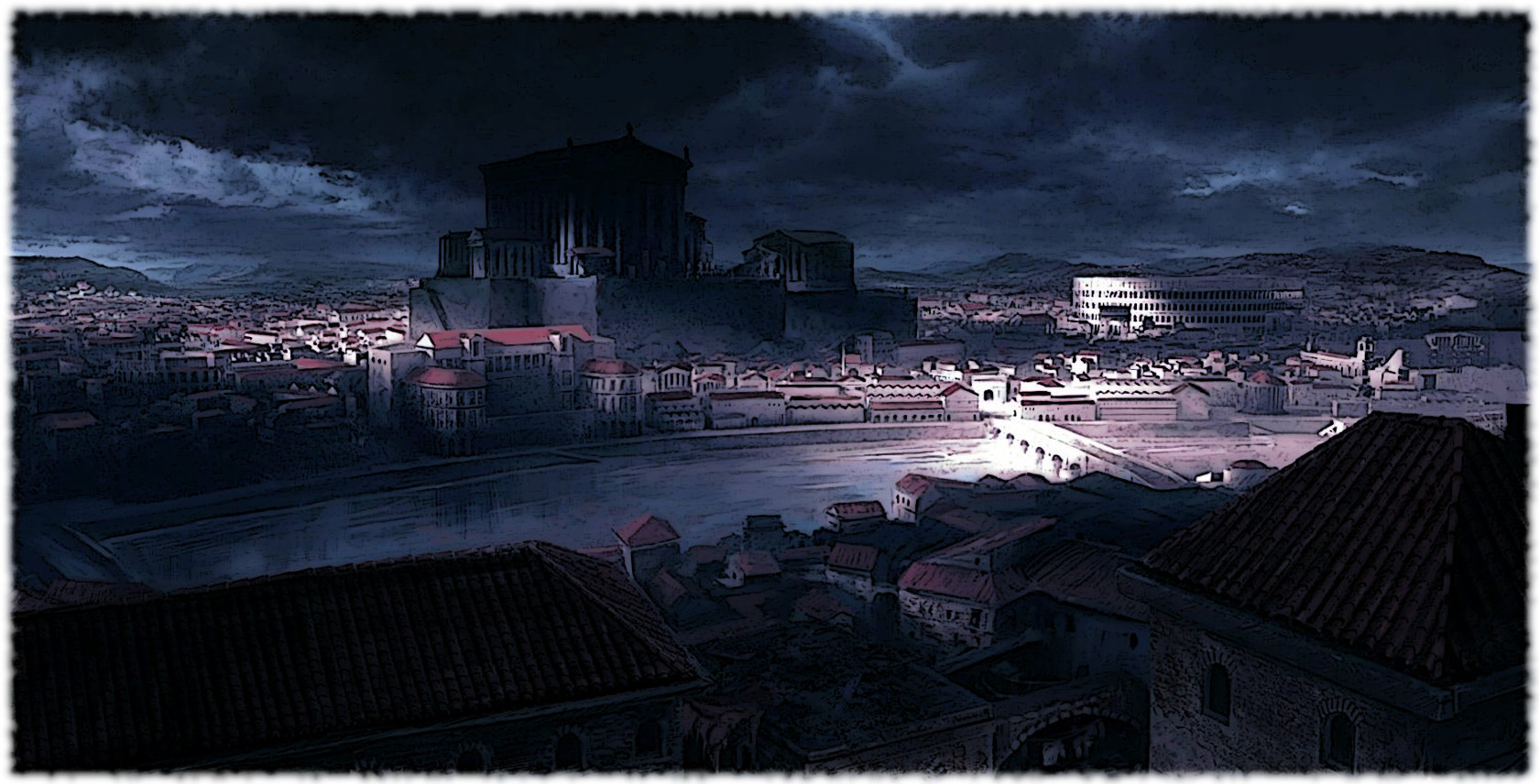
Climate
Rome has a Mediterranean climate, with cool, humid winters and warm, dry summers.
Its average annual temperature is above (68 °F) during the day and (50 °F) at night. In the coldest month – January, the average temperature is (54 °F) during the day and (37 °F) at night. In the warmest months – July and August, the average temperature is (86 °F) during the day and (64 °F) at night.
December, January and February are the coldest months, with a daily mean temperature of (46 °F). Temperatures during these months generally vary between (50 and 59 °F) during the day and between (37 and 41 °F) at night, with colder or warmer spells occurring frequently. Snowfall is rare but not unheard of, with light snow or flurries occurring almost every winter, generally without accumulation, and major snowfalls approximately once every 5 years.
The average relative humidity is 75%, varying from 72% in July to 77% in November. Sea temperatures vary from a low of (55 °F) in February and March to a high of (75 °F) in August
Economy
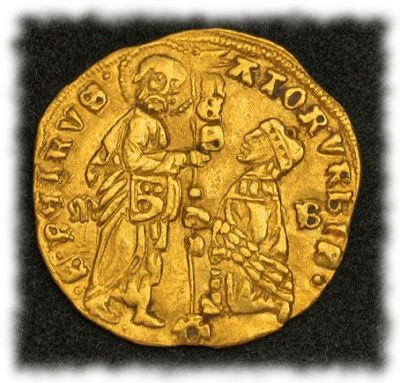
Pilgrimage
Rome has been a major Christian pilgrimage site since the Middle Ages. People from all over the Christian world visit Vatican City, within the city of Rome, the seat of the papacy. The Pope was the most influential figure during the Middle Ages. The city became a major pilgrimage site during the Middle Ages and the focus of struggles between the Papacy and the Holy Roman Empire starting with Charlemagne, who was crowned its first emperor in Rome in 800 by Pope Leo III. Apart from brief periods as an independent city during the Middle Ages, Rome kept its status as Papal capital and "holy city" for centuries, even when the Papacy briefly relocated to Avignon (1309–1377). Catholics believe that the Vatican is the last resting place of St. Peter.
Pilgrimages to Rome can involve visits to a large number of sites, both within Vatican City and in Italian territory. A popular stopping point is the Pilate's stairs: these are, according to the Christian tradition, the steps that led up to the praetorium of Pontius Pilate in Jerusalem, which Jesus Christ stood on during his Passion on his way to trial.[91] The stairs were, reputedly, brought to Rome by St. Helena in the 4th Century. For centuries, the Scala Santa has attracted Christian pilgrims who wished to honour the Passion of Jesus. Object of pilgrimage are also several catacombs built in the Roman age, in which Christians prayed, buried their dead and performed worship during periods of persecution, and various national churches (among them San Luigi dei francesi and Santa Maria dell'Anima), or churches associated with individual religious orders, such as the Jesuit Churches of Jesus and Sant'Ignazio.
Traditionally, pilgrims in Rome and Roman citizens thanking God for a grace should visit by foot the seven pilgrim churches (Italian: Le sette chiese) in 24 hours. This custom, mandatory for each pilgrim in the Middle Ages, was codified in the 16th century by Saint Philip Neri. The seven churches are the four major Basilicas (St Peter in Vatican, St Paul outside the Walls, St John in Lateran and Santa Maria Maggiore), while the other three are San Lorenzo fuori le mura (a palaeochristian Basilica), Santa Croce in Gerusalemme (a church founded by Helena, the mother of Constantine, which hosts fragments of wood attributed to the holy cross) and San Sebastiano fuori le mura (which lies on the Appian Way and is built above Roman catacombs).
Geography
[[]]
Rome is in the Lazio region of central Italy on the Tiber (Italian: Tevere) river. The original settlement developed on hills that faced onto a ford beside the Tiber Island, the only natural ford of the river in this area. The Rome of the Kings was built on seven hills: the Aventine Hill, the Caelian Hill, the Capitoline Hill, the Esquiline Hill, the Palatine Hill, the Quirinal Hill, and the Viminal Hill. Modern Rome is also crossed by another river, the Aniene, which flows into the Tiber north of the historic centre.
Although the city centre is about 24 kilometres (15 mi) inland from the Tyrrhenian Sea, the city territory extends to the shore, where the south-western district of Ostia is located.
Throughout the history of Rome, the urban limits of the city were considered to be the area within the city’s walls. Originally, these consisted of the Servian Wall, which was built twelve years after the Gaulish sack of the city in 390 BC. This contained most of the Esquiline and Caelian hills, as well as the whole of the other five. Rome outgrew the Servian Wall, but no more walls were constructed until almost 700 years later, when, in 270 AD, Emperor Aurelian began building the Aurelian Walls. These were almost 19 kilometres (12 mi) long, and were still the walls the troops of the Kingdom of Italy had to breach to enter the city in 1870.
History
Timeline
- 1084 - The city of Rome is attacked by the Normans.
- The Sack of Rome of May 1084 was a Norman sack, the result of the pope's call for aid from the duke of Apulia, Robert Guiscard. Pope Gregory VII was besieged in the Castel Sant'Angelo by the Emperor Henry IV in June 1083. He held out and called for aid from Guiscard, who was then fighting the Byzantine Emperor Alexius I Comnenus in the Balkans. He returned, however, to the Italian Peninsula and marched north with 36,000 men. He entered Rome and forced Henry to retire, but a riot of the citizens led to a three days sack, after which Guiscard escorted the pope to the Lateran. The Normans had mainly pillaged the old city, which was then one of the richest cities in Italy. After days of unending violence, the Romans rose up causing the Normans to set fire to the city. Many of the buildings of Rome were gutted on the Capitol and Palatine hills along with the area between the Colosseum and the Lateran. In the end the ravaged Roman populace succumbed to the Normans.
- 1108 - The church of San Clemente is in this year rebuilt.
- 1140 - The church of Santa Maria in Trastevere is restored.
- 1200 - The city becomes an independent commune
- 1232 - The cloisters in the Basilica of St. John Lateran are finished.
- 1300 - Pope Boniface VIII proclaims the First Holy Year.
- 1309 - The Papacy is moved to Avignon under Pope Clement V
- 1347 - The patriot and rebel Cola di Rienzo tries to restore the Roman Republic.
- 1348 - As in most of Europe, the Black Death strikes Rome.
Imperial Rome: Foundations of the Dark Medieval
The Early Empire
By the end of the Republic, the city of Rome had achieved a grandeur befitting the capital of an empire dominating the whole of the Mediterranean. It was, at the time, the largest city in the world. Estimates of its peak population range from 450,000 to over 3.5 million people with estimates of 1 to 2 million being most popular with historians. This grandeur increased under Augustus, who completed Caesar's projects and added many of his own, such as the Forum of Augustus and the Ara Pacis. He is said to have remarked that he found Rome a city of brick and left it a city of marble (Urbem latericium invenit, marmoream reliquit). Augustus's successors sought to emulate his success in part by adding their own contributions to the city. In AD 64, during the reign of Nero, the Great Fire of Rome left much of the city destroyed, but in many ways it was used as an excuse for new development.
Rome was a subsidized city at the time, with roughly 15 to 25 percent of its grain supply being paid by the central government. Commerce and industry played a smaller role compared to that of other cities like Alexandria. This meant that Rome had to depend upon goods and production from other parts of the Empire to sustain such a large population. This was mostly paid by taxes that were levied by the Roman government. If it had not been subsidized, Rome would have been significantly smaller.
Rome's population declined after its peak in the 2nd century. At the end of that century, during the reign of Marcus Aurelius, the Antonine Plague killed 2,000 people a day. Marcus Aurelius died in 180, his reign being the last of the "Five Good Emperors" and the Pax Romana. His son Commodus, who had been co-emperor since AD 177, assumed full imperial power, which is most generally associated with the gradual decline of the Western Roman Empire. Rome's population was only a fraction of its peak when the Aurelian Wall was completed in the year 273 (in that year its population was only around 500,000).
The Crisis of the Third Century
Starting in the early 3rd century, matters changed. The "Crisis of the third century" defines the disasters and political troubles for the Empire, which nearly collapsed. The new feeling of danger and the menace of barbarian invasions was clearly shown by the decision of Emperor Aurelian, who at year 273 finished encircling the capital itself with a massive wall which had a perimeter that measured close to 20 km (12 mi). Rome formally remained capital of the empire, but emperors spent less and less time there. At the end of 3rd century Diocletian's political reforms, Rome was deprived of its traditional role of administrative capital of the Empire. Later, western emperors ruled from Milan or Ravenna, or cities in Gaul. In 330, Constantine I established a second capital at Constantinople. At this time, part of the Roman aristocratic class moved to this new center, followed by many of the artists and craftsmen who were living in the city.
The Rise of Christianity
Christianity reached Rome during the 1st century AD. For the first two centuries of the Christian era, Imperial authorities largely viewed Christianity simply as a Jewish sect rather than a distinct religion. No emperor issued general laws against the faith or its Church, and persecutions, such as they were, were carried out under the authority of local government officials. A surviving letter from Pliny the Younger, governor of Bythinia, to the emperor Trajan describes his persecution and executions of Christians; Trajan notably responded that Pliny should not seek out Christians nor heed anonymous denunciations, but only punish open Christians who refused to recant.
Suetonius mentions in passing that during the reign of Nero "punishment was inflicted on the Christians, a class of men given to a new and mischievous superstition" (superstitionis novae ac maleficae). He gives no reason for the punishment. Tacitus reports that after the Great Fire of Rome in AD 64, some among the population held Nero responsible and that the emperor attempted to deflect blame onto the Christians. The war against the Jews during Nero's reign, which so destabilized the empire that it led to civil war and Nero's suicide, provided an additional rationale for suppression of this 'Jewish' sect.
Diocletian undertook what was to be the most severe and last major persecution of Christians, lasting from 303 to 311. Christianity had become too widespread to suppress, and in 313, the Edict of Milan made tolerance the official policy. Constantine I (sole ruler 324–337) became the first Christian emperor, and in 380 Theodosius I established Christianity as the official religion.
Under Theodosius, visits to the pagan temples were forbidden, the eternal fire in the Temple of Vesta in the Roman Forum extinguished, the Vestal Virgins disbanded, auspices and witch-crafting punished. Theodosius refused to restore the Altar of Victory in the Senate House, as asked by remaining pagan Senators.
The Empire's conversion to Christianity made the Bishop of Rome (later called the Pope) the senior religious figure in the Western Empire, as officially stated in 380 by the Edict of Thessalonica. In spite of its increasingly marginal role in the Empire, Rome retained its historic prestige, and this period saw the last wave of construction activity: Constantine's predecessor Maxentius built buildings such as its basilica in the Forum, Constantine himself erected the Arch of Constantine to celebrate his victory over the former, and Diocletian built the greatest baths of all. Constantine was also the first patron of official Christian buildings in the city. He donated the Lateran Palace to the Pope, and built the first great basilica, the old St. Peter's Basilica.
The Germanic invasions and collapse of the Western Empire
Still Rome remained one of the strongholds of Paganism, led by the aristocrats and senators. However, the new walls did not stop the city being sacked first by Alaric on 24 August, 410, by Geiseric in 455 and even by general Ricimer's unpaid Roman troops (largely composed of barbarians) on 11 July, 472. This was the first time in almost 800 years that Rome had fallen to an enemy. The previous sack of Rome had been accomplished by the Gauls under their leader Brennus in 387 BC. The sacking of 410 is seen as a major landmark in the decline and fall of the Western Roman Empire. St. Jerome, living in Bethlehem at the time, wrote that "The City which had taken the whole world was itself taken." These sackings of the city astonished all the Roman world. In any case, the damage caused by the sackings may have been overestimated. The population already started to decline from the late 4th century onward, although around the middle of the fifth century it seems that Rome continued to be the most populous city of the two parts of the Empire, with a population of not less than 650,000 inhabitants. The decline greatly accelerated following the capture of Africa Proconsularis by the Vandals. Many inhabitants now fled as the city no longer could be supplied with grain from Africa from the mid-5th century onward.
At the beginning of the 6th century Rome's population may have been less than 100,000. Many monuments were being destroyed by the citizens themselves, who stripped stones from closed temples and other precious buildings, and even burned statues to make lime for their personal use. In addition, most of the increasing number of churches were built in this way. For example, the first Saint Peter's Basilica was erected using spoils from the abandoned Circus of Nero. This "self-eating" attitude was a constant feature of Rome until the Renaissance. From the 4th century, imperial edicts against stripping of stones and especially marble were common, but the need for their repetition shows that they were ineffective. Sometimes new churches were created by simply taking advantage of early Pagan temples, while sometimes changing the Pagan god or hero to a corresponding Christian saint or martyr. In this way, the Temple of Romulus and Remus became the basilica of the twin saints Cosmas and Damian. Later, the Pantheon, Temple of All Gods, became the church of All Martyrs.
The Rule of the Barbarians and Byzantines
In 480, the last Western Roman emperor, Julius Nepos, was murdered and a Roman general of barbarian origin, Odoacer, declared allegiance to Eastern Roman emperor Zeno. Despite owing nominal allegiance to Constantinople, Odoacer and later the Ostrogoths continued, like the last emperors, to rule Italy as a virtually independent realm from Ravenna. Meanwhile, the Senate, even though long since stripped of wider powers, continued to administer Rome itself, with the Pope usually coming from a senatorial family. This situation continued until Theodahad murdered Amalasuntha, a pro-imperial Gothic queen, and usurped the power in 535. The Eastern Roman emperor, Justinian I (reigned 527–565), used this as a pretext to send forces to Italy under his famed general Belisarius, recapturing the city next year. The Byzantines successfully defended the city in a year-long siege, and eventually took Ravenna.
Gothic resistance revived however, and on 17 December, 546, the Ostrogoths under Totila recaptured and sacked Rome. Belisarius soon recovered the city, but the Ostrogoths retook it in 549. Belisarius was replaced by Narses, who captured Rome from the Ostrogoths for good in 552, ending the so-called Gothic Wars which had devastated much of Italy. The continual war around Rome in the 530s and 540s left it in a state of total disrepair — near-abandoned and desolate with much of its lower-lying parts turned into unhealthy marshes as the drainage systems were neglected and the Tiber's embankments fell into disrepair in the course of the latter half of the 6th century. Here, malaria developed. The aqueducts were never repaired, leading to a shrinking population of less than 50,000 concentrated near the Tiber and around the Campus Martius, abandoning those districts without water supply. There is a legend, significant though untrue, that there was a moment where no one remained living in Rome.
Justinian I tried to grant Rome subsidies for the maintenance of public buildings, aqueducts and bridges — though, being mostly drawn from an Italy dramatically impoverished by the recent wars, these were not always sufficient. He also styled himself the patron of its remaining scholars, orators, physicians and lawyers in the stated hope that eventually more youths would seek a better education. After the wars, the Senate was theoretically restored, but under the supervision of the urban prefect and other officials appointed by, and responsible to, the Byzantine authorities in Ravenna.
However, the Pope was now one of the leading religious figures in the entire Byzantine Empire and effectively more powerful locally than either the remaining senators or local Byzantine officials. In practice, local power in Rome devolved to the Pope and, over the next few decades, both much of the remaining possessions of the senatorial aristocracy and the local Byzantine administration in Rome were absorbed by the Church.
The reign of Justinian's nephew and successor Justin II (reigned 565–578) was marked from the Italian point of view by the invasion of the Lombards under Alboin (568). In capturing the regions of Benevento, Lombardy, Piedmont, Spoleto and Tuscany, the invaders effectively restricted Imperial authority to small islands of land surrounding a number of coastal cities, including Ravenna, Naples, Rome and the area of the future Venice. The one inland city continuing under Byzantine control was Perugia, which provided a repeatedly threatened overland link between Rome and Ravenna. In 578 and again in 580, the Senate, in some of its last recorded acts, had to ask for the support of Tiberius II Constantine (reigned 578–582) against the approaching Dukes, Faroald I of Spoleto and Zotto of Benevento.
Maurice (reigned 582–602) added a new factor in the continuing conflict by creating an alliance with Childebert II of Austrasia (reigned 575–595). The armies of the Frankish King invaded the Lombard territories in 584, 585, 588 and 590. Rome had suffered badly from a disastrous flood of the Tiber in 589, followed by a plague in 590. The latter is notable for the legend of the angel seen, while the newly elected Pope Gregory I (term 590–604) was passing in procession by Hadrian's Tomb, to hover over the building and to sheathe his flaming sword as a sign that the pestilence was about to cease. The city was safe from capture at least.
Agilulf, however, the new Lombard King (reigned 591 to c. 616), managed to secure peace with Childebert, reorganized his territories and resumed activities against both Naples and Rome by 592. With the Emperor preoccupied with wars in the eastern borders and the various succeeding Exarchs unable to secure Rome from invasion, Gregory took personal initiative in starting negotiations for a peace treaty. This was completed in the autumn of 598—later recognized by Maurice—lasting until the end of his reign.
The position of the Bishop of Rome was further strengthened under the usurper Phocas (reigned 602–610). Phocas recognized his primacy over that of the Patriarch of Constantinople and even decreed Pope Boniface III (607) to be "the head of all the Churches". Phocas's reign saw the erection of the last imperial monument in the Roman Forum, the column bearing his name. He also gave the Pope the Pantheon, at the time closed for centuries, and thus probably saved it from destruction.
During the 7th century, an influx of both Byzantine officials and churchmen from elsewhere in the empire made both the local lay aristocracy and Church leadership largely Greek speaking. However, the strong Byzantine cultural influence did not always lead to political harmony between Rome and Constantinople. In the controversy over Monothelitism, popes found themselves under severe pressure (sometimes amounting to physical force) when they failed to keep in step with Constantinople's shifting theological positions. In 653, Pope Martin I was deported to Constantinople and, after a show trial, exiled to the Crimea, where he died.
Then, in 663, Rome had its first imperial visit for two centuries, by Constans II — its worst disaster since the Gothic Wars when the Emperor proceeded to strip Rome of metal, including that from buildings and statues, to provide armament materials for use against the Saracens. However, for the next half century, despite further tensions, Rome and the Papacy continued to prefer continued Byzantine rule—in part because the alternative was Lombard rule, and in part because Rome's food was largely coming from Papal estates elsewhere in the Empire, particularly Sicily.
Medieval Rome
The Break with Byzantium and formation of the Papal States
Though seat of the papacy, condition that assured to the city a certain number of inhabitants, the population of Rome, that in the 4th century was estimated at about 500,000, soon underwent a precipitous decline. During the Middle Age, the built-up area shrank until Romans settlement was confined to the shore of the Tiber, where water was available. Only one of the ancient aqueducts was still operating. The decline was momentarily arrested under Pope Gregory I (590-604), whose pontificate signed the first step towards the temporal power of the Church. His work of conversation did not follow a despotic design, and eventually contributed to improve the contacts between Rome and the barbaric peoples. His papacy marked the foundation of medieval Rome, although not much is known about the city in this period since little archeological evidence has survived. For a while Italy underwent a period of peace but soon became a battleground again. In the 6th century, the possession of the city was still disputed by Goths and Byzantines. But in the 7th century Rome passed under the temporary protection of the popes, who ruled the city up until the 19th century, period in which the history of the papacy is intricately connected with the history of Rome.
When Pope Stephen III was threatened by the Lombards, he appealed for help to Pepin, king of the Franks. He defeated the barbars and granted the Pope a portion of Lombard territory (754), marking the beginning of the temporal power of the popes over the States of the Church. The 25th of December 800, Pepin's son, Charlemagne, was crowned by Leo III in Saint Peter's as Augustus and Emperor. The Holy Roman Empire survived until the abdication of Francis II of Austria in 1806. The walls of the Leonine City, built to defend the Borgo and St Peter's, date from the 9th century.
The strength of the papacy increased under Pope Nicholas I (858-67) but with his death the prestige of the popes declined and the German emperors took an active part in the papal elections throughout the 10th and early 11th centuries. Gregory VII (1073-85), helped by some Roman noble families, reasserted papal authority, but turned out to be unable to prevent the Norman Robert Guiscard from conquering Sicily and devasting Rome in 1084.
Current Events
Politics: Guelphs and Ghibelline?
The Guelphs and Ghibellines were factions supporting the Pope and the Holy Roman Emperor, respectively, in the Italian city-states of central and northern Italy. During the 12th and 13th centuries, rivalry between these two parties formed a particularly important aspect of the internal politics of medieval Italy. The struggle for power between the Papacy and the Holy Roman Empire had arisen with the Investiture Controversy, which began in 1075 and ended with the Concordat of Worms in 1122. The division between the Guelphs and Ghibellines in Italy, however, fuelled by the imperial Great Interregnum, persisted until the 15th century.
History
Origins
Guelph (often spelled Guelf; in Italian Guelfo, plural Guelfi) is an Italian form of the name of the House of Welf, the family of the dukes of Bavaria (including the namesake Welf II, Duke of Bavaria, as well as Henry the Lion). The Welfs were said to have used the name as a rallying cry during the Siege of Weinsberg in 1140, in which the rival Hohenstaufens of Swabia (led by Conrad III of Germany) used "Wibellingen", the name of a castle today known as Waiblingen, as their cry; "Wibellingen" subsequently became Ghibellino in Italian.
The names were likely introduced to Italy during the reign of Frederick Barbarossa. When Frederick conducted military campaigns in Italy to expand imperial power there, his supporters became known as Ghibellines (Ghibellini). The Lombard League and its allies were defending the liberties of the urban communes against the Emperor's encroachments and became known as Guelphs (Guelfi).
The Ghibellines were thus the imperial party, while the Guelphs supported the Pope. Broadly speaking, Guelphs tended to come from wealthy mercantile families, whereas Ghibellines were predominantly those whose wealth was based on agricultural estates. Guelph cities tended to be in areas where the Emperor was more of a threat to local interests than the Pope, and Ghibelline cities tended to be in areas where the enlargement of the Papal States was the more immediate threat. The Lombard League defeated Frederick at the Battle of Legnano in 1176. Frederick recognized the full autonomy of the cities of the Lombard league under his nominal suzerainty.
The division developed its own dynamic in the politics of medieval Italy, and it persisted long after the direct confrontation between Emperor and Pope had ceased. Smaller cities tended to be Ghibelline if the larger city nearby was Guelph, as the Guelph Republic of Florence and Ghibelline Republic of Siena faced off at the Battle of Montaperti, 1260. Pisa maintained a staunch Ghibelline stance against her fiercest rivals, the Guelph Republic of Genoa and Florence. Adherence to one of the parties could therefore be motivated by local or regional political reasons. Within cities, party allegiances differed from guild to guild, rione to rione, and a city could easily change party after internal upheaval. Moreover, sometimes traditionally Ghibelline cities allied with the Papacy, while Guelph cities were even punished with interdict.
Contemporaries did not use the terms Guelph and Ghibellines much until about 1250, and then only in Tuscany (where they originated), with the names "church party" and "imperial party" preferred in some areas.
Population
- Annual Census, 1100 A.D.: 35,350
Citizens of Rome
- Aristeas -- Poet and follower of Apollo
- Domina Ludi -- Lady of the Game
- Fulgenzio -- priest in training
- Quinto -- member of the city guard
Clergy
Craftsmen
Criminals
- Triga Consortium -- A ruthless gang of thieves from the Campus Martius.
- Carmelo Acconci -- Spokesman for the gangs of the Trans-Tiberum
Merchants
- Tarquinius -- Scholar of Secrets
Nightwalkers
- Berenice Barzetti
- Daria Notoriano {young and attractive given to Tarqinius in payment}
- Nives Bellandini {skinny glutton}
Patriciate
- Annibaldi family -- The Annibaldi were a powerful baronal family of Rome and the Lazio in the Middle Ages.
- Caetani -- The Caetani, or Gaetani, is the name of an Italian noble family which played a great part in the history of Pisa and of Rome, principally via their close links to the papacy.
- Colonna family -- Also known as Sciarrillo or Sciarra, were an Italian noble family who held considerable influence during the Dark Ages to the Renaissance. {Ghibelline}
- Conti di Segni -- The Conti di Segni were an important noble family of medieval and early modern Italy originating in Segni, Lazio. Many members of the family acted as military commanders or ecclesiastical dignitaries. {*}
- Cremaschi family -- A family of cloth merchants whose mercantile success have propelled them into the dangerous arena of Roman politics.
- Crescentii family -- A powerful extended family of wealthy merchants who formerly controlled the popes of the 10th century.
- Frangipani family -- The Frangipani family is a powerful Roman patrician clan with strong Guelph sympathies.
- Mancini family -- The Mancini family of Rome traces its origins back to Lucius Hostilius Mancinus who was consul in 145 BC and a commander of the Roman fleet during the Third Punic War.
- Orsini family -- The Orsini family were one of the most influential princely families in medieval Italy and renaissance Rome. {Guelph faction}
- Pierleoni family -- The family of the Pierleoni, meaning "sons of Peter Leo", was a great Roman patrician clan of the Middle Ages, headquartered in a tower house in the Jewish quarter, Trastevere.
- Prefetti di Vico -- An Italian noble family, of German origin, who established in Rome from the 10th century.
- Theophylacti family -- The counts of Tusculum were the most powerful secular noblemen in Latium, near Rome, in the present-day Italy between the 10th and 12th centuries.
Senatus Populusque Romanus (city council)
Festivities
The Life of people during the Middle ages was dictated by the changes in the season. The different seasons and months of the year were celebrated with Religious Feasts and Festivals - the Middle Ages holidays. The religion of Christianity had been established in England during the Dark Ages. In the Middle Ages, following the Norman conquest, new stone churches and cathedrals were built. Middle Ages Holidays marked an event of religious importance for every month of the year. The rural population of the Middle Ages had their days of rest and amusement, Middle Ages holidays were then much more numerous than at present. At that period the festivals of the Church were frequent and rigidly kept, as each of them was the pretext for a forced holiday from manual labor.
- Twelfth Night (January) -- Religious festival and feasts celebrating the visit of the Wise Men, or Magi, following the birth of Jesus.
- St Valentine's Day (February) -- The Medieval festival celebrating love - singing, dancing and pairing games.
- Carnival (Late February - Early March) --
- Easter (March) -- Easter celebrated by the Mystery plays depicting the crucifixion.
- Lent (40 days)
- Ash Wednesday (start of Lent)
- Holy Week (last week of Lent before Easter)
- Good Friday (end of Lent)
- Easter Sunday
- All Fool's Day (April) -- The Jesters, or Lords of Misrule, took charge for the day and caused mayhem with jokes and jests!
- May Day (May) -- May Day was a spring festival celebrating May Day when a Queen of the May was chosen and villagers danced around the maypole.
- Midsummer Eve (June) -- Midsummer Eve, the Mummers entertained at the 'Festival of Fire' reliving legends such as St George and the Dragon. Bones were often burned leading to the term 'bonfire'. The summer Solstice was June 23rd.
- St. Swithin's Day (July) -- St. Swithin's Day falls on 15th July. Legend says that during the bones of St Swithin were moved and after the ceremony it began to rain and continued to do so for forty days.
- Lammas Day (August) -- Lammas Day was celebrated on August 2nd. The ' loaf-mass ' day, the festival of the first wheat harvest of the year. Houses were sometimes decorated with garlands and there were candle lit processions.
- Michaelmas (September) -- The 29th September was when Michaelmas celebrated the life of St Michael and the traditional food on Michaelmas was goose or chicken.
- St Crispin's Day (October) -- October 25th celebrating St Crispin's Day. Revels and bonfires and people acted as 'King Crispin' .
- All Souls Day (November) -- The Day of the Dead - All Souls Day or All Hallow's Day ( Halloween ) when revels were held and bonfires were lit.
- Christmas (December) -- December 25 is celebrated as the birthday of Christ.
Fortifications
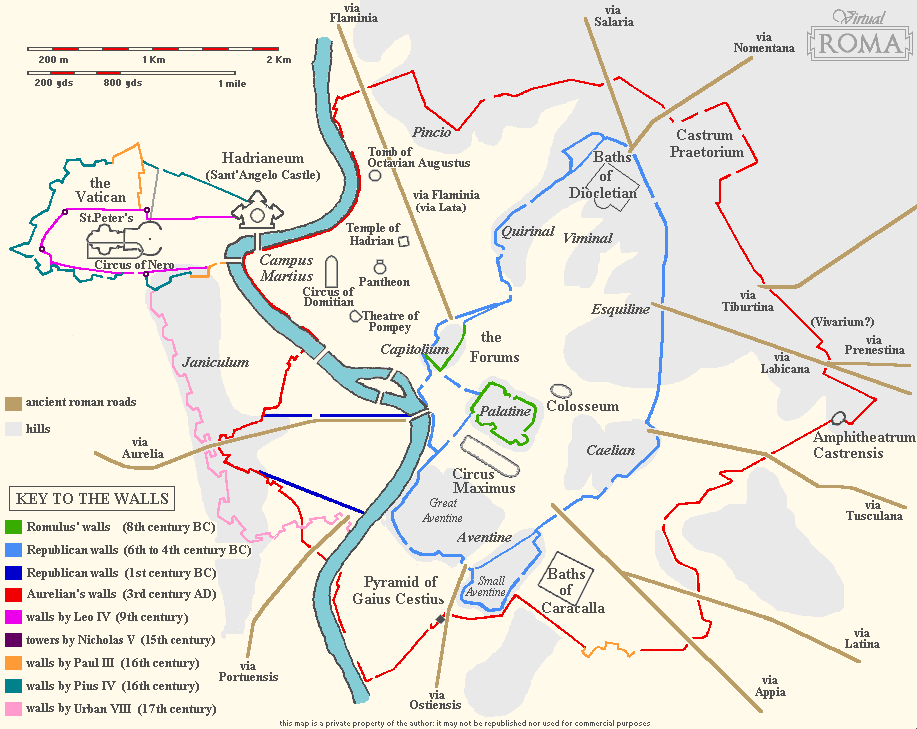
Defensive walls are a feature of ancient Roman architecture. The Romans generally fortified cities, rather than fortresses, but there are some fortified camps, such as the Saxon Shore forts like Porchester Castle in England. City walls were already significant in Etruscan architecture, and in the struggle for control of Italy under the early Republic many more were built, using different techniques. These included tightly-fitting massive irregular polygonal blocks, shaped to fit exactly in a way reminiscent of later Inca work. The Romans called a simple rampart wall an agger; at this date great height was not necessary.
Servian Wall
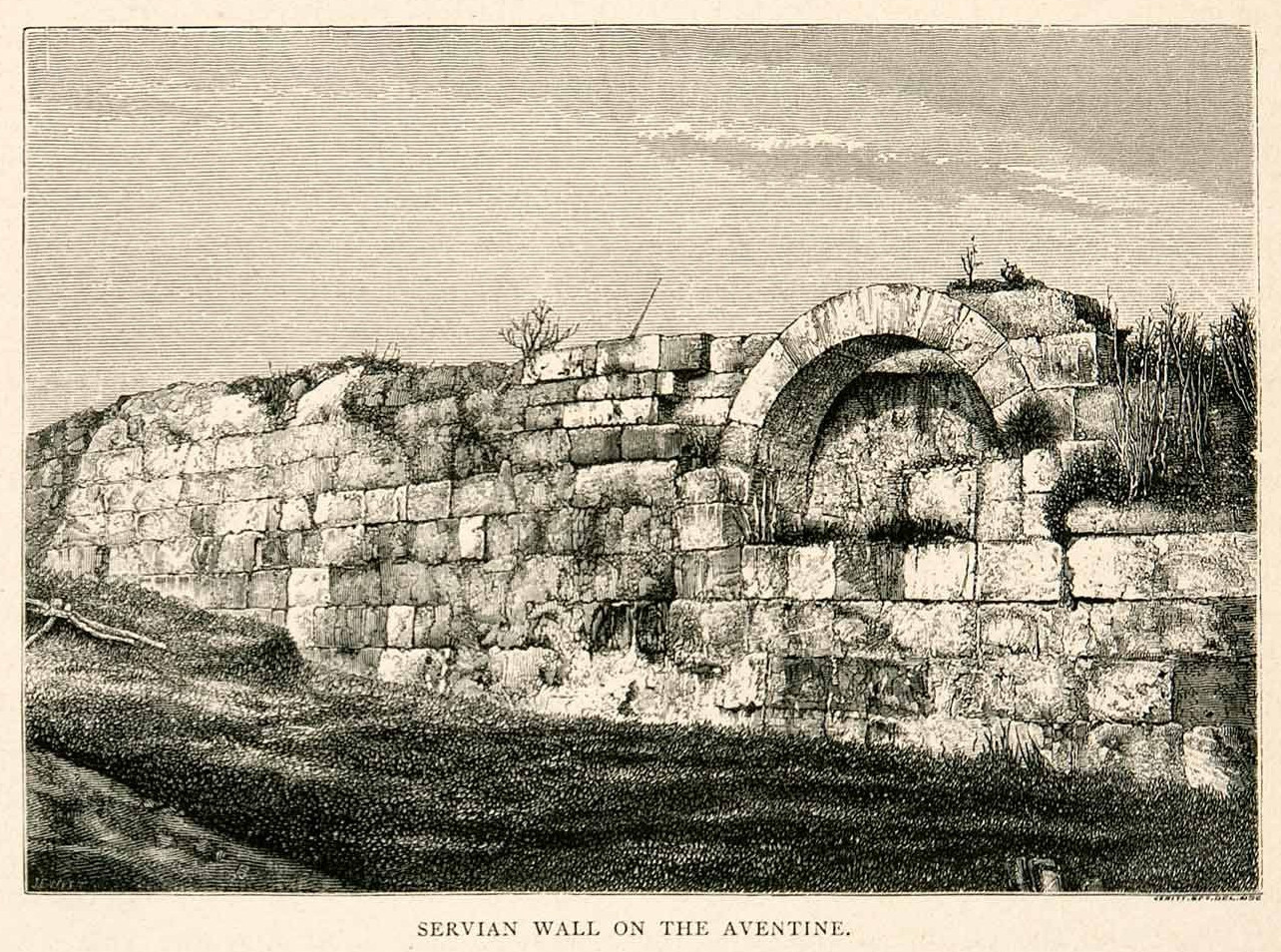
The Servian Wall (outlined in blue) was an ancient Roman defensive barrier constructed around the city of Rome in the early 4th century BC. The wall was up to 10 metres (32.8 ft) in height in places, 3.6 metres (12 ft) wide at its base, 11 km (7 mi) long,[1] and is believed to have had 16 main gates, though many of these are mentioned only from writings, with no other known remains. By the 3rd century AD it was superseded by the construction of the larger Aurelian Walls.
History
It is presumed that the wall is named after the sixth Roman King, Servius Tullius. Although its outline may go back to the 6th century BC, the currently extant wall was, it is estimated, built during the early Roman Republic, possibly as a way to prevent a repeat of the sack of Rome after the Battle of the Allia by the Gauls of Brennus. Due to the ease with which the Gauls entered the city, it is conjectured[by whom?] that at some time previous to this, Rome had been forced by its Etruscan rulers to dismantle any significant prior defenses.
Construction
The wall was built from large blocks of tuff (a volcanic rock made from ash and rock fragments ejected during an eruption) quarried from the Grotta Oscura quarry near Rome's early rival Veii. In addition to the blocks, some sections of the structure incorporated a deep fossa, or ditch in front of it, as a means to effectively heighten the wall during attack from invaders.
Along part of its topographically weaker northern perimeter was an agger, a defensive ramp of earth heaped up to the wall along the inside. This thickened the wall, and also gave defenders a base to stand while repelling any attack. The wall was also outfitted with defensive war engines, including catapults.
Usage
The Servian Wall was formidable enough to repel Hannibal during the Second Punic War. Hannibal famously invaded Italy across the Alps with elephants, and had crushed several Roman armies in the early stages of the war. However, the wall was never put to the test as Hannibal only once, in 211 BC, brought his Carthaginian army to Rome as part of a feint to draw the Roman army from Capua. When it was clear that this had failed, he turned away, without approaching closer than 3 miles (5 km) to Rome, as a Roman army sallied out of the Servian walls and pitched a camp next to Hannibal's. During the Roman civil wars, the Servian walls were repeatedly overrun.
The wall was still maintained through the end of the Republic and in the early Empire. By this time, Rome had already begun to grow outside the original Servian Wall. The organization of Rome into regions under Augustus placed regions II, III, IV, VI, VIII, X, and XI within the Servian Wall, with the other sections outside of it.[citation needed]
The wall became unnecessary as Rome became well protected by the ever-expanding military strength of the Republic and of the later Empire. As the city continued to grow and prosper, it was essentially unwalled for the first three centuries of the Empire. When German tribes made further incursions along the Roman frontier in the 3rd century AD, Emperor Aurelian had the larger Aurelian Walls built to protect Rome.
Aurelian Walls
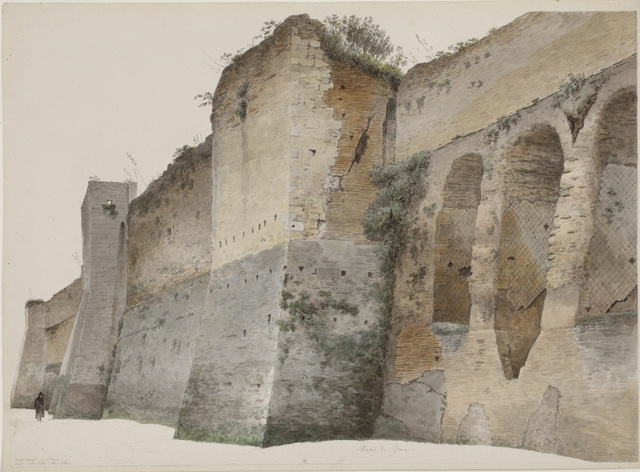
Introduction
The Aurelian Walls (Italian: Mura aureliane) are a line of city walls built between 271 AD and 275 AD in Rome, Italy, during the reign of the Roman Emperors Aurelian and Probus. They superseded the earlier Servian Wall built during the 4th century BC.
The walls enclosed all the seven hills of Rome plus the Campus Martius and, on the left bank of the Tiber, the Trastevere district. The river banks within the city limits appear to have been left unfortified, although they were fortified along the Campus Martius. The size of the entire enclosed area is 1,400 hectares (3,500 acres).
Construction
The full circuit ran for 19 kilometres (12 mi) surrounding an area of 13.7 square kilometres (5.3 sq mi). The walls were constructed in brick-faced concrete, 3.5 metres (11 ft) thick and 8 metres (26 ft) high, with a square tower every 100 Roman feet (29.6 metres (97 ft)).
In the 4th century, remodelling doubled the height of the walls to 16 metres (52 ft). By 500 AD, the circuit possessed 383 towers, 7,020 crenellations, 18 main gates, 5 postern gates, 116 latrines, and 2,066 large external windows.
History
By the third century AD, the boundaries of Rome had grown far beyond the area enclosed by the old Servian Wall, built during the Republican period in the late 4th century BC. Rome had remained unfortified during the subsequent centuries of expansion and consolidation due to lack of hostile threats against the city. The citizens of Rome took great pride in knowing that Rome required no fortifications because of the stability brought by the Pax Romana and the protection of the Roman Army. However, the need for updated defences became acute during the crisis of the Third Century, when barbarian tribes flooded through the Germanic frontier and the Roman Army struggled to stop them. In 270, the barbarian Juthungi and Vandals invaded northern Italy, inflicting a severe defeat on the Romans at Placentia (modern Piacenza) before eventually being driven back. Further trouble broke out in Rome itself in the summer of 271, when the mint workers rose in rebellion. Several thousand people died in the fierce fighting that resulted.
Aurelian's construction of the walls as an emergency measure was a reaction to the barbarian invasion of 270; the historian Aurelius Victor states explicitly that the project aimed to alleviate the city's vulnerability. It may also have been intended to send a political signal as a statement that Aurelian trusted that the people of Rome would remain loyal, as well as serving as a public declaration of the emperor's firm hold on power. The construction of the walls was by far the largest building project that had taken place in Rome for many decades, and their construction was a concrete statement of the continued strength of Rome.[3] The construction project was unusually left to the citizens themselves to complete as Aurelian could not afford to spare a single legionary for the project. The root of this unorthodox practice was due to the imminent barbarian threat coupled with the wavering strength of the military as a whole due to being subject to years of bloody civil war, famine and the Plague of Cyprian.
The walls were built in the short time of only five years, though Aurelian himself died before the completion of the project. Progress was accelerated, and money saved, by incorporating existing buildings into the structure. These included the Amphitheatrum Castrense, the Castra Praetoria, the Pyramid of Cestius, and even a section of the Aqua Claudia aqueduct near the Porta Maggiore. As much as a sixth of the walls is estimated to have been composed of pre-existing structures. An area behind the walls was cleared and sentry passages were built to enable it to be reinforced quickly in an emergency.
The actual effectiveness of the wall is disputable, given the relatively small size of the city's garrison. The entire combined strength of the Praetorian Guard, cohortes urbanae, and vigiles of Rome was only about 25,000 men – far too few to defend the circuit adequately. However, the military intention of the wall was not to withstand prolonged siege warfare; it was not common for the barbarian armies to besiege cities, as they were insufficiently equipped and provisioned for such a task. Instead, they carried out hit-and-run raids against ill-defended targets. The wall was a deterrent against such tactics.
Parts of the wall were doubled in height by Maxentius, who also improved the watch-towers. In 401, under Honorius, the walls and the gates were improved. At this time, the Tomb of Hadrian across the Tiber was incorporated as a fortress in the city defenses.
Gates
List of gates (porte), from the northernmost and clockwise:
• Porta del Popolo (Porta Flaminia) – here begins via Flaminia
• Porta Pinciana
• Porta Salaria – here begins via Salaria
• Porta Pia – here begins the new via Nomentana
• Porta Nomentana – here began the old via Nomentana
• Porta Praetoriana – old entrance to Castra Praetoria, the camp of the Praetorian Guard
• Porta Tiburtina – here begins via Tiburtina
• Porta Maggiore (Porta Praenestina) – here three aqueducts meet, and via Praenestina begins
• Porta San Giovanni – near Basilica di San Giovanni in Laterano
• Porta Asinaria – here begins the old via Tuscolana
• Porta Metronia
• Porta Latina – here begins via Latina
• Porta San Sebastiano (Porta Appia) – here begins the Appian Way
• Porta Ardeatina
• Porta San Paolo (Porta Ostiense) – next to the Pyramid of Cestius, leading to Basilica di San Paolo fuori le Mura, here via Ostiense begins
Gates in Trastevere (from the southernmost and clockwise):
• Porta Portuensis
• Porta Aurelia Pancraziana
• Porta Settimiana
• Porta Aurelia-Sancti Petri
Inns
Law & Lawlessness
Monuments
See: List of ancient monuments in Rome -- Wikipedia
Amphitheaters
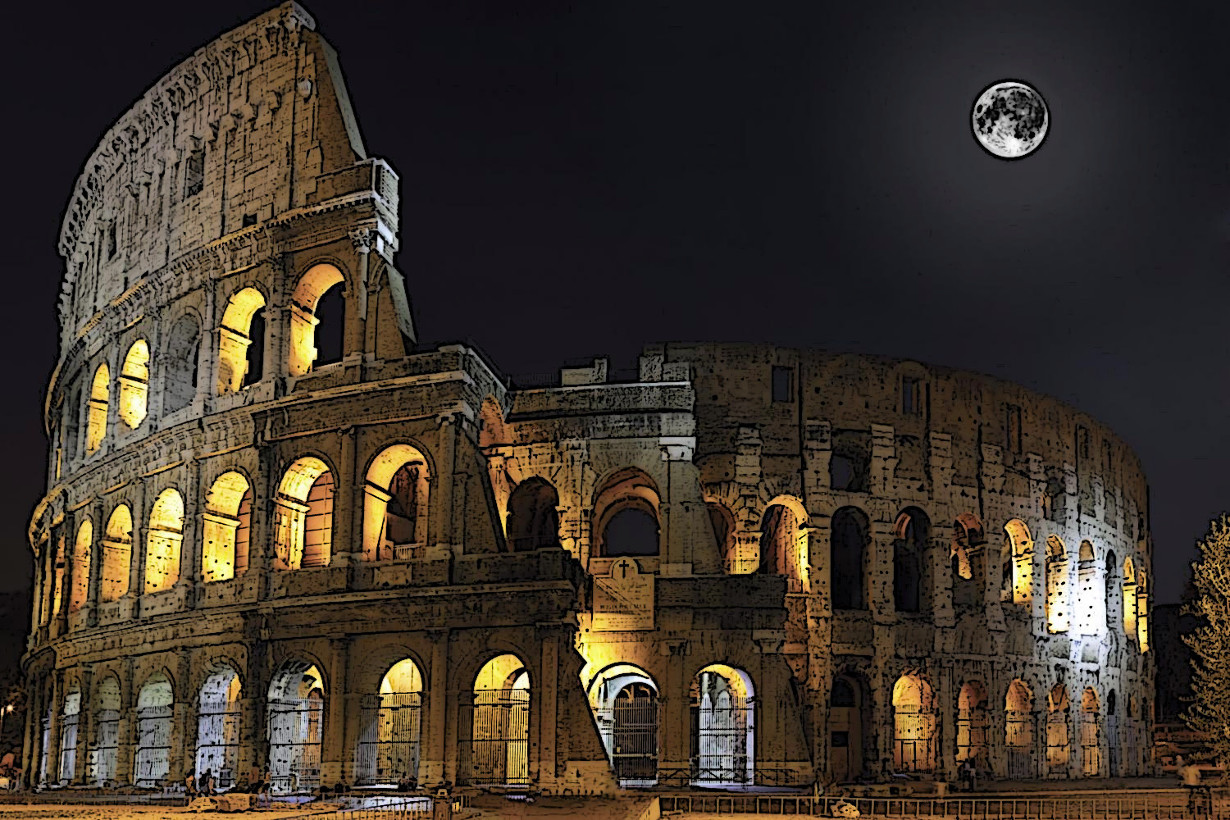
- Amphitheater of Caligula -- Built during the reign of the emperor Caligula. It was situated on the Campus Martius, probably near the Saepta Julia. (Location: Campus Martius) - {Demolished}
- Amphitheatrum Castrense -- This ancient Roman amphitheater of Rome is situated next to the church of Santa Croce in Gerusalemme. (Location: Esquiline Hill)
- Colosseum of Rome -- Also known as the Flavian Amphitheatre it is the largest oval amphitheater built during the Roman Empire, it is located in the center of the city. (Location: Center of Rome)
- Amphitheater of Nero -- The Amphitheater of Nero was a wooden amphitheater built by the Roman emperor Nero around 64 CE. {Destroyed during the Great Fire of Rome in 64 AD}
- Amphitheater of Statilius Taurus -- was an amphitheatre in ancient Rome. {Destroyed during the Great Fire of Rome in 64 AD}
Ludus of Rome
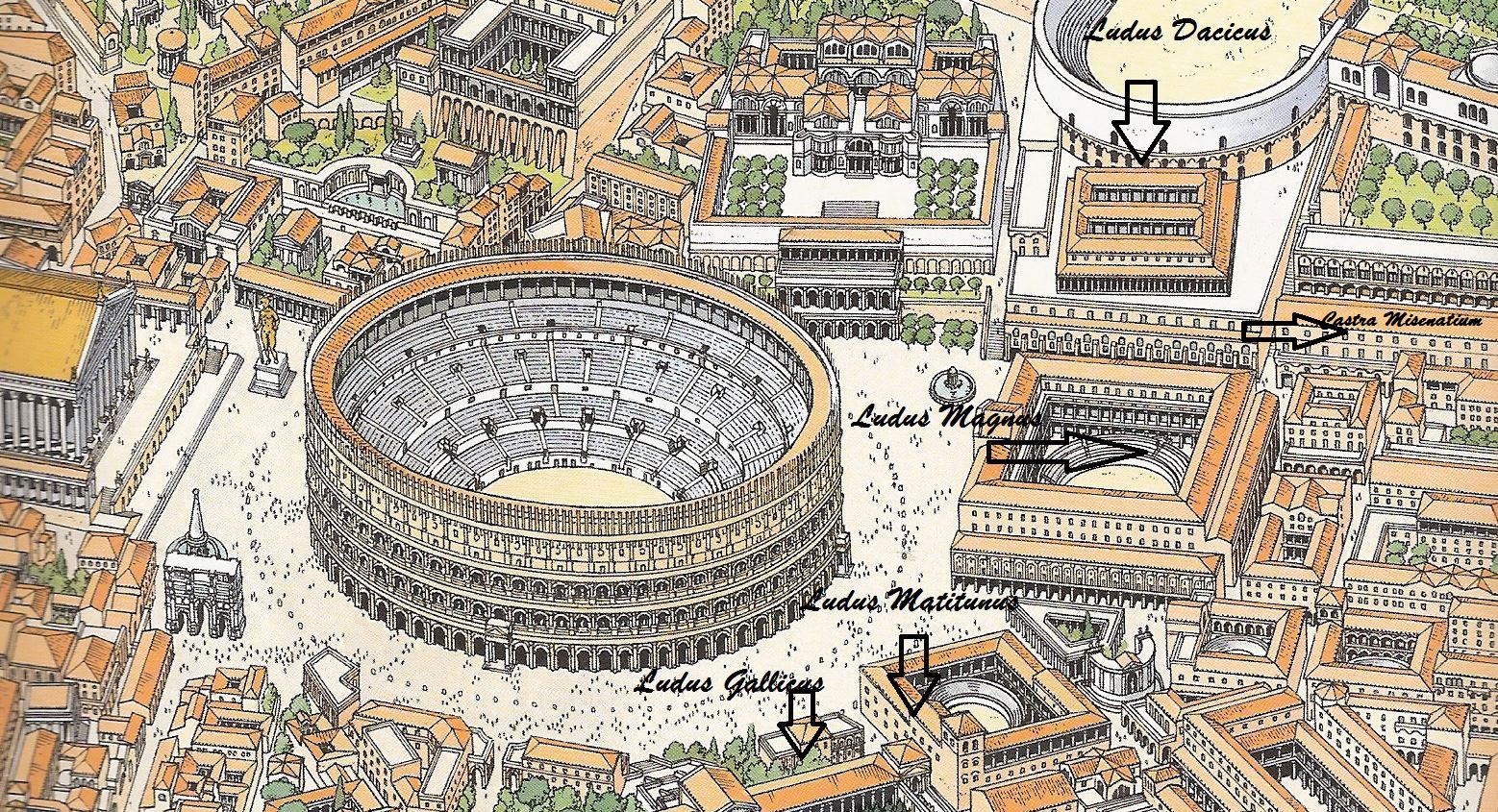
Aqueducts
- Anio Novus
- Anio Vetus
- Aqua Alexandriana
- Aqua Alsietina
- Aqua Appia
- Aqua Augusta (Rome)|Aqua Augusta
- Aqua Claudia
- Aqua Julia
- Aqua Marcia
- Aqua Martia
- Aqua Tepula
- Aqua Traiana
- Aqua Virgo
Arches (Triumphal)
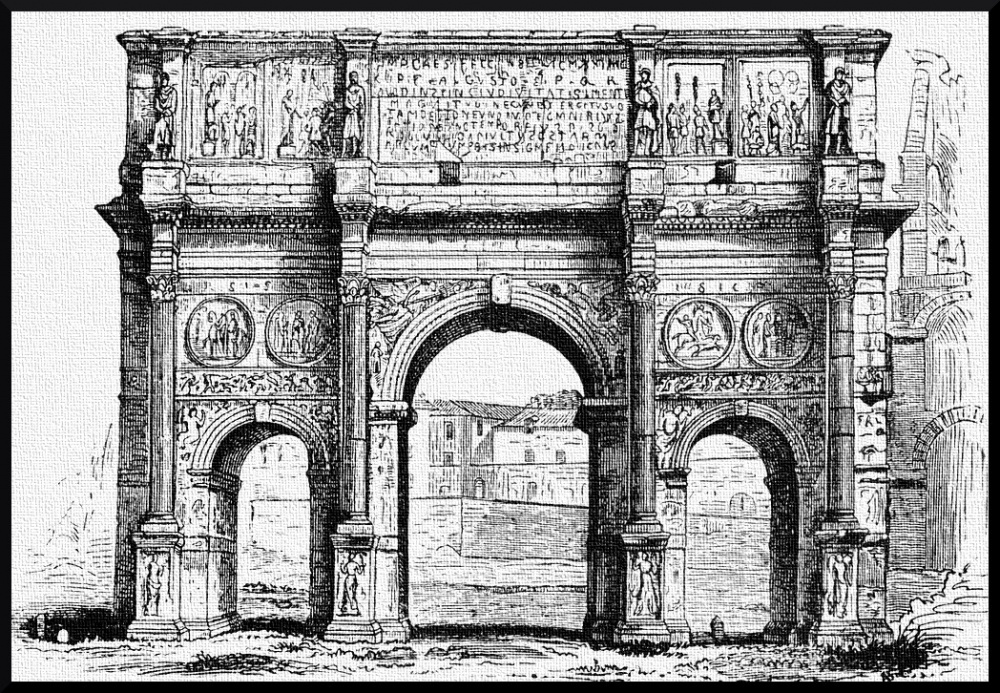
- Arch of Constantine
- Arch of Septimius Severus
- Arcus Argentariorum
- Arcus Novus
- Arch of Arcadius, Honorius and Theodosius
- Arch of Augustus
- Arch of Claudius (British victory)
- Arches of Claudius
- Arch of Constantine
- Arch of Dolabella and Silanus
- Arch of Drusus
- Arches of Drusus and Germanicus
- Arch of Gallienus
- Arch of Gratian, Valentinian and Theodosius
- Arch of Janus
- Arch of Lentulus and Crispinus
- Arch of Nero
- Arch of Octavius
- Arch of Pietas
- Arch of Septimius Severus
- Arch of Tiberius
- Arch of Titus (Circus Maximus)
- Arch of Titus (Roman Forum)
Baths
Bridges
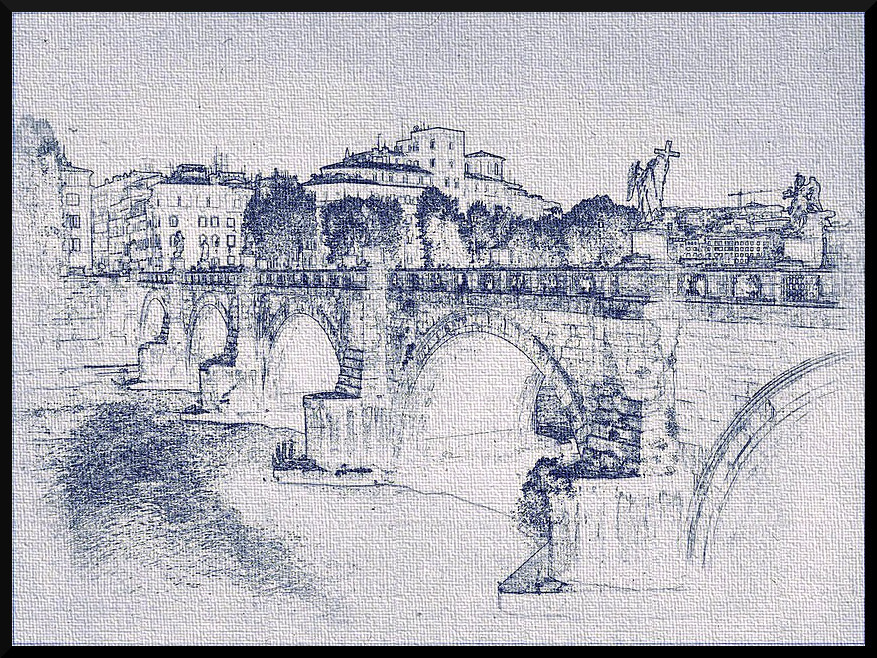
- Ponte Sant'Angelo -- Ponte Sant'Angelo, once the Aelian Bridge or Pons Aelius, meaning the Bridge of Hadrian, is a Roman bridge completed in 134 AD by Roman Emperor Hadrian, to span the Tiber, from the city center to his newly constructed mausoleum, now the towering Castel Sant'Angelo. The bridge is faced with travertine marble and spans the Tiber with five arches, three of which are Roman; it was approached by means of ramp from the river.
- Pons Aemilius
- Pons Agrippae
- Pons Aurelius
- Pons Cestius
- Pons Fabricius
- Pons Milvius
- Pons Neronianus -- The Pons Neronianus or Bridge of Nero was an ancient bridge in Rome built during the reign of the emperors Caligula or Nero to connect the western part of the Campus Martius with the Campus Vaticanus ("Vatican Fields"), where the Imperial Family owned land along the Via Cornelia. The bridge is now referred to as the Pons ruptus ("broken bridge"), because it will remain broken throughout the Middle Ages.
- Pons Probi
- Pons Sublicius
Catacombs
Rome has a extensive number of ancient catacombs, or underground burial places beneath or near the city, of which there are at least forty. Though most famous for Christian burials, they include pagan and Jewish burials, either in separate catacombs or mixed together. The first large-scale catacombs were excavated from the 2nd century onwards, mainly as a response to overcrowding and shortage of land. Originally they were carved through tuff, a soft volcanic rock, outside the boundaries of the city, because Roman law forbade burial places within city limits.
Those Who Came Before
The Etruscans, like many other European people, used to bury their dead in underground chambers. The original Roman custom was cremation, after which the burnt remains were kept in a pot, ash-chest or urn, often in a columbarium. From about the 2nd century AD, inhumation (burial of unburnt remains) became more fashionable, in graves or sarcophagi, often elaborately carved, for those who could afford them. Christians also preferred burial to cremation because of their belief in bodily resurrection at the Second Coming.
Jews and Christians
Since most Christians and Jews at that time belonged to the lower classes or were slaves, they usually lacked the resources to buy land for burial purposes. Instead, networks of tunnels were dug in the deep layers of tuff which occurred naturally on the outskirts of Rome. At first, these tunnels were probably not used for regular worship, but simply for burial and, extending pre-existing Roman customs, for memorial services and celebrations of the anniversaries of Christian martyrs. There are sixty known subterranean burial chambers in Rome. They were built outside the walls along main Roman roads, like the Via Appia, the Via Ostiense, the Via Labicana, the Via Tiburtina, and the Via Nomentana. Names of the catacombs – like St Calixtus and St Sebastian, which is alongside Via Appia – refer to martyrs that may have been buried there. About 80% of the excavations used for Christian burials date to after the time of the persecutions.
Construction
Roman catacombs are made up of underground passages (ambulacra), out of whose walls graves (loculi) were dug. These loculi, generally laid out vertically (pilae), could contain one or more bodies. A loculus large enough to contain two bodies was referred to as a bisomus. Another type of burial, typical of Roman catacombs, was the arcosolium, consisting of a curved niche, enclosed under a carved horizontal marble slab. Cubicula (burial rooms containing loculi all for one family) and cryptae (chapels decorated with frescoes) are also commonly found in catacomb passages. When space began to run out, other graves were also dug in the floor of the corridors - these graves are called formae.
Excavators (fossors), built vast systems of galleries and passages on top of each other. They lie 7–19 metres (23–62 ft) below the surface in an area of more than 2.4 square kilometres (590 acres). Narrow steps that descend as many as four stories join the levels. Passages are about 2.5 by 1 metre (8.2 ft × 3.3 ft). Burial niches (loculi) were carved into walls. They are 40–60 centimetres (16–24 in) high and 120–150 centimetres (47–59 in) long. Bodies were placed in chambers in stone sarcophagi in their clothes and bound in linen. Then the chamber was sealed with a slab bearing the name, age and the day of death. The fresco decorations provide the main surviving evidence for Early Christian art, and initially show typically Roman styles used for decorating homes - with secular iconography adapted to a religious function. The catacomb of Saint Agnes is a small church. Some families were able to construct cubicula which would house various loculi and the architectural elements of the space would offer a support for decoration. Another excellent place for artistic programs were the arcosolia.
The Catacombs of Rome
The Roman catacombs, of which there are forty in the suburbs, were built along the consular roads out of Rome, such as the Appian way, the via Ostiense, the via Labicana, the via Tiburtina, and the via Nomentana.
- Catacombs of Marcellinus and Peter -- These catacombs are situated on the ancient Via Labicana, today Via Casilina, near the church of Santi Marcellino e Pietro ad Duas Lauros. Their name refers to the Christian martyrs Marcellinus and Peter who, according to tradition, were buried here, near the body of St. Tiburtius.
- Catacombs of Domitilla -- Close to the Catacombs of San Callisto are the large and impressive Catacombs of Domitilla (named after Saint Domitilla), spread over 17 kilometres (11 miles) of underground caves.
- Catacombs of Commodilla -- These catacombs, on the Via Ostiensis, contain one of the earliest images of a bearded Christ. They originally held the relics of Saints Felix and Adauctus.
- Catacombs of Generosa -- Located on the Campana Road, these catacombs are said to have been the resting place, perhaps temporarily, of Simplicius, Faustinus and Beatrix, Christian Martyrs who died in Rome during the Diocletian persecution (302 or 303).
- Catacombs of Praetextatus -- These are found along the via Appia, and were built at the end of 2nd century. They consist of a vast underground burial area, at first in pagan then in Christian use, housing various tombs of Christian martyrs. In the oldest parts of the complex may be found the "cubiculum of the coronation", with a rare depiction for that period of Christ being crowned with thorns, and a 4th-century painting of Susanna and the old men in the allegorical guise of a lamb and wolves.
- Catacombs of Priscilla -- The Catacomb of Priscilla, situated at the Via Salaria across from the Villa Ada, probably derives its name from the name of the landowner on whose land they were built. They are looked after by the Benedictine nuns of Priscilla.
- Catacombs of San Callisto -- Sited along the Appian way, these catacombs were built after AD 150, with some private Christian hypogea and a funeral area directly dependent on the Catholic Church. It takes its name from the deacon Saint Callixtus, proposed by Pope Zephyrinus in the administration of the same cemetery - on his accession as pope, he enlarged the complex, that quite soon became the official one for the Roman Church. The arcades, where more than fifty martyrs and sixteen pontiffs were buried, form part of a complex graveyard that occupies fifteen hectares and is almost 20 km (12 mi) long.
- Catacombs of San Lorenzo -- Built into the hill beside San Lorenzo fuori le Mura, these catacombs are said to have been the final resting place of St. Lawrence. The church was built by Pope Sixtus III and later remodeled into the present nave. Sixtus also redecorated the shrine in the catacomb and was buried there.
- Catacombs of San Pancrazio -- Established underneath the San Pacrazio basilica which was built by Pope Symmachus on the place where the body of the young martyr Saint Pancras, or Pancratius, had been buried. In the 17th century, it was given to the Discalced Carmelites, who completely remodeled it. The catacombs house fragments of sculpture and pagan and early Christian inscriptions.
- Catacombs of San Sebastiano -- One of the smallest Christian cemeteries, this has always been one of the most accessible catacombs and is thus one of the least preserved (of the four original floors, the first is almost completely gone).
- Catacombs of San Valentino -- These catacombs were dedicated to Saint Valentine. In the 13th century, the martyr's relics were transferred to Basilica of Saint Praxedes.
- Catacombs of Sant'Agnese -- Built for the conservation and veneration of the remains of Saint Agnes of Rome. Agnes' bones are now conserved in the church of Sant'Agnese fuori le mura in Rome, built over the catacomb. Her skull is preserved in a side chapel in the church of Sant'Agnese in Agone in Rome's Piazza Navona.
- Catacombs of via Anapo -- On the via Salaria, the Catacombs of via Anapo are datable to the end of the 3rd or the beginning of the 4th century, and contain diverse frescoes of biblical subjects.
- Jewish Catacombs -- There are six known Jewish catacombs in Rome, two of which are open to the public: Vigna Randanini and Villa Torlonia.
Cemeteries
- Columbarium of Pomponius Hylas -- is a 1st-century AD Roman columbarium, situated near the Porta Latina on the Via Appia. Columbarium
- Esquiline Necropolis -- The Esquiline Necropolis was a prehistoric necropolis on the Esquiline in Rome, in use until the end of the 1st century AD.
- Vatican Necropolis -- The Vatican Necropolis lies under the Vatican City, at depths varying between 5–12 meters below Saint Peter's Basilica.
Churches
The Vatican
- Old St.Peter's Basilica -- Old St. Peter's Basilica was the building that stood, from the 4th to 16th centuries, where the new St. Peter's Basilica stands today in Vatican City.
Titular Churches
In the Catholic Church, a prelate raised to the rank of Cardinal Priest or Cardinal Deacon is assigned title to a church in Rome, that is, his titular church, which establishes his relationship to the Diocese of Rome, which has the pope for its bishop.
- Basilica Sanctae Mariae de Ara coeli in Capitolium -- The Basilica of St. Mary of the Altar of Heaven is a titular basilica in Rome, located on the highest summit of the Campidoglio.
- Santa Croce in Gerusalemme -- The Basilica of the Holy Cross in Jerusalem or Basilica di Santa Croce in Gerusalemme, is a minor basilica and titular church in Esquilino. It is one of the Seven Pilgrim Churches of Rome.
See: List of titular churches in Rome -- Wikipedia
Other Churches
Circuses
Columns
- Trajan's Column
- Column of Antoninus Pius
- Column of Marcus Aurelius
- Column of Phocas
Convents
Fountains
Gardens
Mausolea
- Hadrian's Mausoleum
- Mausoleum of Augustus
- Mausoleum of Helena
- Mausoleum of Maxentius
Porticoes
Statues
- Colossus of Constantine
- Colossus of Nero
- Equestrian Statue of Marcus Aurelius
Tombs
- Casal Rotondo
- Pyramid of Cestius
- Tomb of Caecilia Metella
- Tomb of Eurysaces the Baker
- Tomb of Geta
- Tomb of the Scipios
Regiones de Roma
During the Middle Ages, Rome was divided into a number of administrative regions (Latin, regiones), usually numbering between twelve and fourteen, which changed over time.
Evolution of the Regions
Originally the city of Rome had been divided by Augustus into 14 regions in 7 BC. Then sometime during the 4th century, Christian authorities instituted seven ecclesiastical regions, which ran parallel to the civil regions. With the collapse of Imperial authority in the Western Roman Empire, after the death of Julius Nepos in 480, much of the old imperial administrative structures began to fall into abeyance.
After the destructive Gothic Wars of the 6th century, the city of Rome had become virtually depopulated. When the city began to recover it was inhabited in new parts and whole districts were in ruins. Consequently, the Augustan regions now had no relationship to the administration of the city, but they continued to be used as a means for identifying property. But as Rome slowly recovered from the disasters of the Gothic wars it became necessary to organize the city for the purpose of defense, and one theory contends that this was the origin of the twelve medieval regions. In particular, it is suggested that it was connected with the Byzantine military system (the scholae militiae) and was introduced into Rome in the 7th century, along with its implementation at Ravenna. This saw the creation of a new series of regions based upon a different principle from either of the older ones. However, this revision did not last much longer than two centuries after the fall of the Exarchate of Ravenna in 751.
Certainly, the division of the city according to the revised civil and ecclesiastical regions appears to have fallen out of use in the confusion of the 10th century. Local variations seem to have sprung up that were adopted, used and then discarded as the years progressed. It has been conjectured that the sack of Rome by Robert Guiscard in 1084 caused a displacement of the population which probably made a revision of the regions necessary. The district from the Lateran Palace to the Colosseum was engulfed and ruined by fire, and the Caelian and Aventine hills were gradually abandoned. The number of regions needed for the south and south-east of the city became smaller, while there emerged a greater need for the organization of the rapidly growing districts to the north-west and along the Tiber.
The next major reform was after the revolution of 1143 and the establishment of the Commune of Rome, as the city was redivided into 14 regions. There was a minor adjustment made in the 13th century, bringing the total number down to thirteen, and it wasn’t until 1586 that another region was created, once again bringing the total number up to fourteen, and Rome kept these administrative divisions intact until the 19th century.
The Regiones of Rome
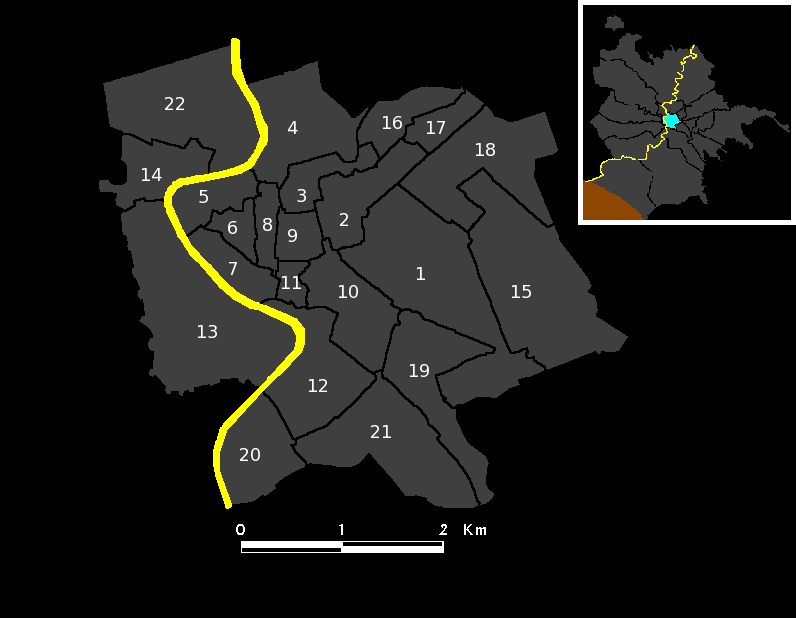
Unlike the Augustan regions of Rome, the medieval regions were not numbered, and few had any relationship to the ancient Roman divisions. They are numbered here merely for convenience.
- Medieval Rioni
-
http://roma.andreapollett.com/S5/rioni.htm
Private Residences
- -- Lateran Palace -- The Lateran Palace (Latin: Palatium Lateranense), formally the Apostolic Palace of the Lateran (Latin: Palatium Apostolicum Lateranense), is an ancient palace of the Roman Empire and later the main papal residence in southeast Rome.
- -- Quadrilaterae Palace -- Ancient residence of Rome's undead Augustus, Constantius.
Taverns
Religion
Roman Catholic Church of Rome
Churches
Cults
Pagan Temples
Aventine Hill
- Temple of Bona Dea
- Temple of Ceres
- Temple of Diana Aventina
- Temple of Juno Regina
- Temple of Luna
- Temple of Minerva
Caelian Hill
Capitoline Hill
- Temple of Fides
- Temple of Jupiter Custos
- Temple of Jupiter Feretrius
- Temple of Jupiter Optimus Maximus
- Temple of Jupiter Tonans
- Temple of Juno Moneta
- Temple of Ops
- Temple of Veiovis
- Temple of Fortuna Redux
Campus Martius
- Pantheon
- Temple of Apollo Sosianus
- Temple of Bellona
- Temple of Castor and Pollux
- Temple of Diana (Rome)
- Temple of the Dii Inferi
- Temple of Feronia
- Temple of Fortuna Equestris
- Temple of Hadrian
- Temple of Hercules Custos
- Temple of Hercules Musarum
- Temple of Isis and Serapis
- Temple of Juno Regina
- Temple of Jupiter Stator
- Temple of Juturna
- Temple of the Lares
- Temple of Matidia
- Temple of the Sun
- Temple of Mars
- Temple of Minerva Chalcidica
- Temple of Neptunus
- Temple of Fortuna Huiusce Diei
- Temple of the Nymphs
- Temple of Vulcanus
Esquiline Hill
- Temple of Juno Lucina
- Temple of Minerva Medica (no longer extant)
- Nymphaeum called the 'Temple of Minerva Medica'
Forum Boarium
- Temple of Hercules Pompeianus
- Temple of Hercules Victor
- Temple of Fortuna
- Temple of Mater Matuta
- Temple of Portunus
- Temple of Pudicitia Patricia
Forum Holitorium
- Temple of Janus
- Temple of Juno Sospita
- Temple of Piety
- Temple of Spes
- Temple of Victoria
Forum Romanum
Imperial fora
- Temple of Mars Ultor
- Temple of Minerva
- Temple of Trajan
- Temple of Peace
- Temple of Venus Genetrix
Palatine Hill
- Elagabalium
- Temple of Apollo Palatinus
- Temple of Cybele
- Temple of Juno Sospita
- Temple of Victory
- Temple of Fortuna Respiciens
Quirinal Hill
- Temple of the Flavia gens
- Temple of Quirinus
- Temple of Serapis
Tiber Island
- Temple of Asclepius
- Temple of Faunus
Werewolf Septs
While there are many ancient and abandoned temples in Rome, not all are abandoned. Of the Septs of the Garou, until recently there were none. Now there are two, the Sept of the Scroll Bearers awakened by the Warders of Man and the Sept of the Capitoline Wolf awakened by the tribe of Shadow Lords.
Nearby Septs
Visitors
Whore Houses
Nocturna Animalia
Rome at the close of the 11th century is dangerously crowded by Cainite standards. There are over thirty immortals who are considered "citizens". Unfortunately, if one includes all the vampiric visitors and dignitaries, not to mention the scum and riffraff that lurk on the edges of the respectable nocturnal society of Rome, there may be twice that number. This situation is new to the Eternal City and represents an ever present and growing threat to the Children of Caine, for every night the Silence of the Blood is imperiled.
Et Atrium Romanus (Court of Rome)
Romanus Senatus (Roman Senators)
Nobilibus familiis Romanorum (High Clans)
Inferiore gens ab Roma (Low Clans)
Memoria pro Mortuis (Remembrances for the Dead)
- Collat -- First Prince of Rome, who officially abdicated in favor of his youngest childe Titus Venturus Camillus otherwise known as Camilla. Supposedly, he departed Rome in the last decades before the First Punic War.
- Camilla -- The Second Prince of Rome during the transition from the Roman Republic to the Roman Empire — a period of time that includes the Punic Wars that destroyed Carthage. He vanished during the Great Fire that devastated Rome in 64 CE, and was presumed to have met his Final Death in the blaze.
- Marius Maior -- Fallen Patriarch -- Slain by his childe Hrothulf, he was the last of true Roman member of the line of Camilla.
- Massimiliano Nicotera -- The second of two childer Embraced by Petronius the Arbiter before his immigration to Constantinople. He and all his childer died in the fire set by the Normans in the Riots of 1084.
Incognitos (Strangers and Aliens)
Wraiths of Rome
Storytelling Medieval Rome
Mood of Medieval Rome: Darkness / Hunger / Secrecy
Theme:
The Roman Cainite Carnival: At Caesar Constantius' pleasure or in times of civil war, the prince can call for the Roman Carnival. Essentially, a period of Elysium, it serves as a time during which vendettas and feuds can lapse after a flair up. It is also called if some distinguished visitor arrives in the Eternal city. It bears more than a passing semblance to the Elysium of the Roman era, save that it lasts for a period of nights or weeks and only covers certain specified sites. Constantius can revoke the Roman carnival at will, but has rarely done so. It is one of the city's most stable and venerated traditions and has contributed to the survival of the nocturnal society of Roman Cainites.
Stories of the Eternal City
Websites


.jpg)


